
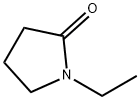
1-Ethyl-2-pyrrolidone(CAS#2687-91-4)
| Risk Codes | R22 – Harmful if swallowed R36 – Irritating to the eyes R62 – Possible risk of impaired fertility R41 – Risk of serious damage to eyes R61 – May cause harm to the unborn child |
| Safety Description | S26 – In case of contact with eyes, rinse immediately with plenty of water and seek medical advice. S36 – Wear suitable protective clothing. S45 – In case of accident or if you feel unwell, seek medical advice immediately (show the label whenever possible.) S36/37/39 – Wear suitable protective clothing, gloves and eye/face protection. S53 – Avoid exposure – obtain special instructions before use. |
| WGK Germany | 1 |
| RTECS | UY5769250 |
| TSCA | Yes |
| HS Code | 29337900 |
Introduction
Properties:N-(2-hydroxyethyl)morpholine is a colorless to pale yellow liquid with characteristic amine and alcohol properties. It is somewhat soluble in water and soluble in most organic solvents.Uses:N-(2-hydroxyethyl)morpholine is commonly used in organic synthesis as a catalyst, reagent, or solvent. It is mainly used in esterification, acylation, and amidation reactions, helping to increase reaction rates and yields.Preparation:There are two main methods for preparing N-(2-hydroxyethyl)morpholine:1. Reacting morpholine with 2-chloroethanol to obtain N-(2-hydroxyethyl)morpholine.2. Reacting sodium hydroxide with 2-chloroethanol in the presence of hydrochloric acid to obtain N-(2-hydroxyethyl)morpholine.Safety Information:N-(2-hydroxyethyl)morpholine is not highly toxic under normal usage conditions. However, as an organic compound, it has certain corrosive and irritating properties. Protective gloves, goggles, and clothing should be worn during handling to avoid skin and eye contact. Also, it is important to avoid contact with strong oxidizers and flammable materials to prevent hazards. …