
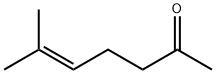
2-Octanone(CAS#111-13-7)
| Hazard Symbols | Xn – Harmful |
| Risk Codes | R21 – Harmful in contact with skin R10 – Flammable |
| Safety Description | S36/37 – Wear suitable protective clothing and gloves. S16 – Keep away from sources of ignition. |
| UN IDs | UN 1224 3/PG 3 |
| WGK Germany | 1 |
| RTECS | RH1484000 |
| TSCA | Yes |
| HS Code | 29141990 |
| Hazard Class | 3 |
| Packing Group | III |
| Toxicity | Both the acute oral LD50 in rats and the acute dermal LD50 in rabbits exceeded 5 g/kg (Moreno, 1973). |
Introduction
2-Octanone, also known as octan-2-one, is an organic compound. The following provides information on the properties, uses, preparation, and safety of 2-octanone:1. Properties:- Appearance: Colorless liquid.- Odor: Has a distinctive fragrance.- Density: About 0.82 g/cm³.- Solubility: Soluble in organic solvents such as ethanol, ethers, and chloroform.2. Uses:- Industrial applications: 2-Octanone is commonly used as a solvent and can be used in the production and processing of paints, adhesives, resins, and dyes.- Laboratory applications: It can also be used as a reaction solvent in organic synthesis and may serve as a catalyst or raw material in the synthesis of certain compounds.3. Preparation:- 2-Octanone can be obtained through the radical addition reaction of 1-octene under acidic conditions. This reaction is usually carried out at low temperatures to avoid side reactions.4. Safety information:- 2-Octanone has low toxicity, but proper use and storage are still necessary.- Avoid contact with strong oxidizers, strong acids, and strong bases to prevent hazardous reactions.- Ensure good ventilation during use to prevent vapor poisoning.- Appropriate personal protective equipment, such as gloves, safety goggles, and protective clothing, should be worn when handling 2-octanone.