
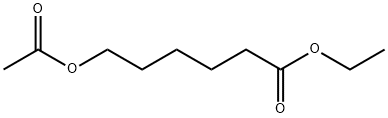
Propyl butyrate(CAS#105-66-8)
| Hazard Symbols | Xi – Irritant |
| Risk Codes | R10 – Flammable R36/37/38 – Irritating to eyes, respiratory system and skin. |
| Safety Description | S16 – Keep away from sources of ignition. S26 – In case of contact with eyes, rinse immediately with plenty of water and seek medical advice. S36 – Wear suitable protective clothing. |
| UN IDs | UN 3272 3/PG 3 |
| WGK Germany | 2 |
| RTECS | ET6200000 |
| HS Code | 29156000 |
| Hazard Class | 3.2 |
| Packing Group | III |
| Toxicity | LD50 orally in rats: 15,000 mg/kg, P. M. Jenner et al., Food Cosmet. Toxicol. 2, 327 (1964) |
Introduction
Propyl butyrate, also known as butyric acid propyl ester, is an organic compound. The following is an introduction to the properties, uses, preparation, and safety information of propyl butyrate:Properties:- Appearance: Propyl butyrate is a colorless liquid with a distinctive odor.- Solubility: Propyl butyrate can dissolve in organic solvents such as alcohols and ethers.- Stability: Propyl butyrate is relatively stable at room temperature but can react with oxygen to form peroxides.Uses:- Industrial uses: Propyl butyrate is commonly used as a solvent and has broad applications in paints, coatings, and cleaners.Preparation:Propyl butyrate is generally prepared through an esterification reaction. Common reaction methods include acid-catalyzed reactions and transesterification reactions. In acid-catalyzed reactions, butyric acid and propanol can be used as raw materials. Under suitable temperature and catalyst conditions, esterification occurs to produce propyl butyrate.Safety Information:- Propyl butyrate is generally considered a relatively safe compound, but safe handling should still be observed to avoid direct contact with skin and eyes.- Avoid inhaling vapors and fumes, and ensure good ventilation.