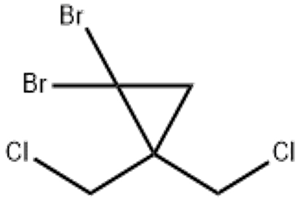
1-1-Dibromo-2-2-bis chloromethyl cyclopropane CAS 98577-44-7
Introduction
Toxin peptides are a class of toxic peptide molecules, usually produced by bacteria, plants, or animals. The properties of toxin peptides depend on their structure and source, and some are neurotoxic, cytotoxic, or otherwise biological. CALCISEPTINE IS A TOXIN PEPTIDE WITH CAS NUMBER 178805-91-9, AND ITS SPECIFIC PROPERTIES REQUIRE FURTHER INVESTIGATION.
The preparation of toxin peptides usually needs to be extracted from living organisms or obtained by synthetic methods, and the preparation process can be complex and requires professional technical support.
Toxin peptides are potentially toxic, and the dosage and concentration need to be strictly controlled when used to avoid harm to the human body or the environment. When operating in the laboratory, you need to wear personal protective equipment and follow the relevant safety operating procedures. For the research and application of toxin peptides, relevant regulations and safety standards should be followed to ensure the safety of people and the environment.
Application
1,1-Dibromo-2,2-bis(chloromethyl)cyclopropane (CAS 98577-44-7) is a specialized gem‑dihalocyclopropane building block with a unique combination of two bromine atoms and two chloromethyl groups on a strained cyclopropane ring. As a powerful synthetic intermediate, it serves as the key precursor for the generation of [1.1.1]propellane via lithium‑halogen exchange with methyllithium, a highly strained carbocycle used to access bicyclo[1.1.1]pentane (BCP) scaffolds that serve as bioisosteres of para‑substituted benzene rings in modern drug discovery. This compound is also employed in the continuous preparation of spiroalkane compounds, which are valuable three‑dimensional scaffolds for medicinal chemistry to improve pharmacokinetic properties and target selectivity. In heterocyclic synthesis, it reacts with amines and aldehydes or ketones in the presence of magnesium chloride to form lactams, a core structure in numerous pharmaceutical APIs and natural product analogs. As a functionalized gem‑dihalocyclopropane, it participates in ring‑opening and substitution reactions to construct complex organic molecules including alkaloids, heterocycles, cyclopropanes, and aromatic ring systems for pharmaceutical, agrochemical, and fine chemical research. Its four halogen handles enable orthogonal functionalization and cross‑coupling strategies for rapid generation of drug‑like libraries. Xinchem offers custom synthesis, custom chemical synthesis, and contract manufacturing of this high‑purity building block with flexible scaling from R&D to commercial tons. Contact us today for a competitive quote and reliable global supply.