
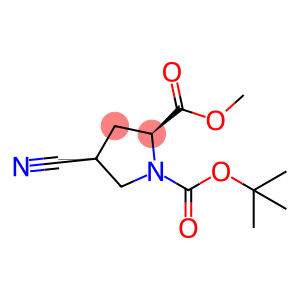
1,2-Pyrrolidinedicarboxylicacid, 4-cyano-, 1-(1,1-dimethylethyl) 2-methyl ester, (2S,4S)-(CAS#487048-28-2)
| Hazard Class | IRRITANT |
Introduction
1, 4-cyano-, 1-(1,1-dimethylethyl) 2-methyl ester, (2S,4S)-is an organic compound. The following is a description of its nature, use, formulation and safety information:
Nature:
-Chemical formula: C14H20N2O4
-Molecular weight: 284.32g/mol
-Appearance: Colorless solid
-Melting point: 75-80°C
-Storage conditions: Store in a cold dark place
Use:
- 1, 4-cyano-, 1-(1,1-dimethylethyl) 2-methylester, (2S,4S)-is a protecting group reagent, commonly used in organic synthesis as a protecting ester of proline.
-It can be used as a protection reagent for amino acid residues in synthetic polypeptides and proteins, and control specific reactions by adding or removing protecting groups.
Preparation Method:
- 1, 4-cyano-, 1-(1,1-dimethyllethyl) 2-methyll ester, (2S,4S)-The synthesis method usually involves reacting cis-L-proline with formic anhydride and BOC-ON, and then further chemical reactions with cyano and alcohol to obtain the product.
Safety Information:
- 1, 4-cyano-, 1-(1,1-dimethylethyl) 2-methylester, (2S,4S)-is usually relatively safe under reasonable use conditions, but laboratory safety guidelines still need to be followed.
-It may be irritating to the skin and eyes, so you should wear appropriate protective equipment when in contact.
-When synthesizing or using, care should be taken to avoid inhaling its dust or generating its vapor.
-When handling this compound, follow appropriate waste handling and storage regulations.
Application
(2S,4S)-1-tert-Butyl 2-methyl 4-cyanopyrrolidine-1,2-dicarboxylate (CAS 487048-28-2) is a chiral, Boc-protected cyano proline ester widely used as a key pharmaceutical intermediate in drug discovery. Its rigid pyrrolidine ring with defined (2S,4S) stereochemistry and a strategically placed cyano group makes it a privileged scaffold for the synthesis of potent dipeptidyl peptidase-4 (DPP-4) inhibitors, including sitagliptin and its analogs, for the treatment of type 2 diabetes mellitus. The orthogonal protecting groups (Boc and methyl ester) enable selective deprotection and functionalization, facilitating the construction of complex drug-like molecules. This building block also supports the development of antiviral agents, antifibrotic compounds, and other enzyme modulators. Its high stereochemical purity ensures reproducible results in structure-activity relationship (SAR) studies, asymmetric synthesis, and scalable GMP manufacturing. Xinchem offers custom synthesis, custom chemical synthesis, and contract manufacturing of this versatile intermediate with flexible scaling from R&D to commercial tons. Contact us today for a competitive quote and reliable global supply.