
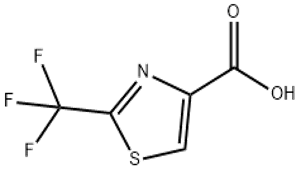
2-(trifluoromethyl)thiazole-4-carboxylic acid(CAS# 915030-08-9)
| Hazard Symbols | Xn - Harmful |
| Risk Codes | 22 - Harmful if swallowed |
| WGK Germany | 3 |
| Hazard Class | IRRITANT |
Introduction
2-(trifluoromethyl)thiazole-4-carboxylic acid is an organic compound with the chemical formula C5H2F3NO2S. Its nature, use, formulation and safety information are described below.
Nature:
2-(trifluoromethyl)thiazole-4-carboxylic acid is a white crystalline solid. It can be dissolved in some organic solvents such as dimethylsulfamide (DMSO) and carbon disulfide (CS2), but is insoluble in water. Its melting point is about 220-223°C.
Use:
2-(trifluoromethyl)thiazole-4-carboxylic acid is a commonly used organic synthesis intermediate. It can be used to synthesize some bioactive compounds in the field of medicine, such as drugs and pesticides. In addition, it can also be used as a synthetic raw material for dyes and photosensitive substances.
Method:
The preparation of 2-(trifluoromethyl)thiazole-4-carboxylic acid is generally obtained by the reaction of methyl sulfide and cyanomethane. The specific steps are as follows: firstly, 2-amino -1, 3-thiazole is reacted with trifluoroacetaldehyde to generate 2-(trifluoromethyl)-1, 3-thiazole; then, the obtained 2-(trifluoromethyl)-1, 3-thiazole is reacted with cyanomethane to generate the target product 2-(trifluoromethyl)thiazole-4-carboxylic acid.
Safety Information:
The toxicity and danger of 2-(trifluoromethyl)thiazole-4-carboxylic acid has not been exhaustively studied. However, as a chemical, general safety practices should be followed, such as wearing appropriate protective equipment (such as glasses, gloves and laboratory coats) and handling in a well-ventilated area. After exposure to this compound, the affected area should be cleaned promptly with soap and water. If necessary, seek medical advice for further management.
Application
2-(Trifluoromethyl)thiazole-4-carboxylic acid (CAS 915030-08-9) is a versatile and high-value heterocyclic building block widely employed in pharmaceutical, agrochemical, and materials science R&D. Its unique structure integrates a thiazole ring, a trifluoromethyl group, and a carboxylic acid functionality, providing an excellent foundation for constructing complex molecular architectures.
The electron-withdrawing trifluoromethyl (CF₃) group significantly enhances the compound's lipophilicity and metabolic stability, making it a valuable scaffold in drug design and development. As a pharmaceutical intermediate, it is a key precursor for synthesizing various bioactive compounds, including anti-inflammatory, analgesic, antiviral, and anticancer agents. It has been utilized in the development of IRAK4 inhibitors, CFTR modulators, and T cell activators, demonstrating its critical role in targeting complex diseases.
In agrochemical research, this compound serves as a crucial building block for the synthesis of novel pesticides and herbicides. The thiazole core is a well-established pharmacophore, with derivatives showing a wide range of therapeutic applications, such as antibacterial, antiretroviral, antifungal, and antihypertensive activities. The carboxylic acid group enables versatile derivatization into amides, esters, and other functionalized products, supporting rapid structure-activity relationship (SAR) studies. Furthermore, it is used as a synthetic raw material for dyes and photosensitive substances.
As a white crystalline solid (mp 220-223°C), it is soluble in organic solvents like DMSO and is available in high purity (≥95%) for research and development purposes. Xinchem offers custom synthesis, custom chemical synthesis, and contract manufacturing of high-purity 2-(Trifluoromethyl)thiazole-4-carboxylic acid with flexible scaling from R&D to commercial tons. Contact us for a competitive quote and reliable global supply.