
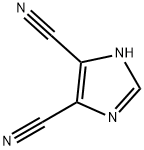
4,5-Dicyanoimidazole(CAS#1122-28-7)
| Risk Codes | R37/38 – Irritating to respiratory system and skin. R41 – Risk of serious damage to eyes R36/37/38 – Irritating to eyes, respiratory system and skin. R20/22 – Harmful by inhalation and if swallowed. R36 – Irritating to the eyes R20/21/22 – Harmful by inhalation, in contact with skin and if swallowed. R11 – Highly Flammable |
| Safety Description | S26 – In case of contact with eyes, rinse immediately with plenty of water and seek medical advice. S39 – Wear eye / face protection. S36/37/39 – Wear suitable protective clothing, gloves and eye/face protection. S36/37 – Wear suitable protective clothing and gloves. S16 – Keep away from sources of ignition. |
| UN IDs | UN 1648 3/PG 2 |
| WGK Germany | 3 |
| HS Code | 29332900 |
| Hazard Note | Irritant |
| Hazard Class | 6.1 |
| Packing Group | III |
Introduction
4,5-Dicyanoimidazole (4,5-Dicyanoimidazole) is an organic compound. The following provides information about its properties, uses, preparation, and safety:Properties:- Appearance: 4,5-Dicyanoimidazole is a colorless crystalline or white powder solid.- Solubility: It is nearly insoluble in water but soluble in organic solvents such as ethanol and ether.- Stability: It is relatively stable under normal conditions.Uses:- Catalyst: 4,5-Dicyanoimidazole can be used as an important catalyst in organic synthesis reactions such as oxidation, disproportionation, and carbonylation.- Chemical reagent: In organic synthesis, 4,5-Dicyanoimidazole is often used as an intermediate or reagent in various organic reactions.Preparation:- 4,5-Dicyanoimidazole can be prepared by reacting urea with hydrogen cyanide under alkaline conditions.- Specific preparation methods can be found in organic chemistry synthesis manuals or scientific literature.Safety Information:- 4,5-Dicyanoimidazole is relatively safe under normal conditions. As a chemical substance, proper handling and storage are very important.- When using or handling 4,5-Dicyanoimidazole, normal laboratory safety protocols should be followed.- Avoid contact with skin and eyes, and ensure adequate ventilation.- In case of accidental contact or inhalation, wash immediately with water or seek medical attention.