

Dimethyl disulfide(CAS#624-92-0)
| Risk Codes | R11 - Highly Flammable R20/22 - Harmful by inhalation and if swallowed. R36 - Irritating to the eyes R51/53 - Toxic to aquatic organisms, may cause long-term adverse effects in the aquatic environment. R36/37/38 - Irritating to eyes, respiratory system and skin. R26 - Very Toxic by inhalation R22 - Harmful if swallowed R36/37 - Irritating to eyes and respiratory system. |
| Safety Description | S26 - In case of contact with eyes, rinse immediately with plenty of water and seek medical advice. S61 - Avoid release to the environment. Refer to special instructions / safety data sheets. S45 - In case of accident or if you feel unwell, seek medical advice immediately (show the label whenever possible.) S38 - In case of insufficient ventilation, wear suitable respiratory equipment. S36/37/39 - Wear suitable protective clothing, gloves and eye/face protection. S28A - S16 - Keep away from sources of ignition. S60 - This material and its container must be disposed of as hazardous waste. S57 - Use appropriate container to avoid environmental contamination. S39 - Wear eye / face protection. S29 - Do not empty into drains. |
| UN IDs | UN 2381 3/PG 2 |
| WGK Germany | 2 |
| RTECS | JO1927500 |
| TSCA | Yes |
| HS Code | 29309070 |
| Hazard Class | 3 |
| Packing Group | II |
| Toxicity | LD50 orally in Rabbit: 290 - 500 mg/kg |
Dimethyl disulfide Methyl disulfide | CAS 624 92 0
One Line Sourcing Position
High purity Dimethyl disulfide for petrochemical sulfiding, flavor formulation, and agricultural fumigation applications.
Quick RFQ Form
Fill below to get instant quote:
Name Email Company Required quantity Delivery destination Submit
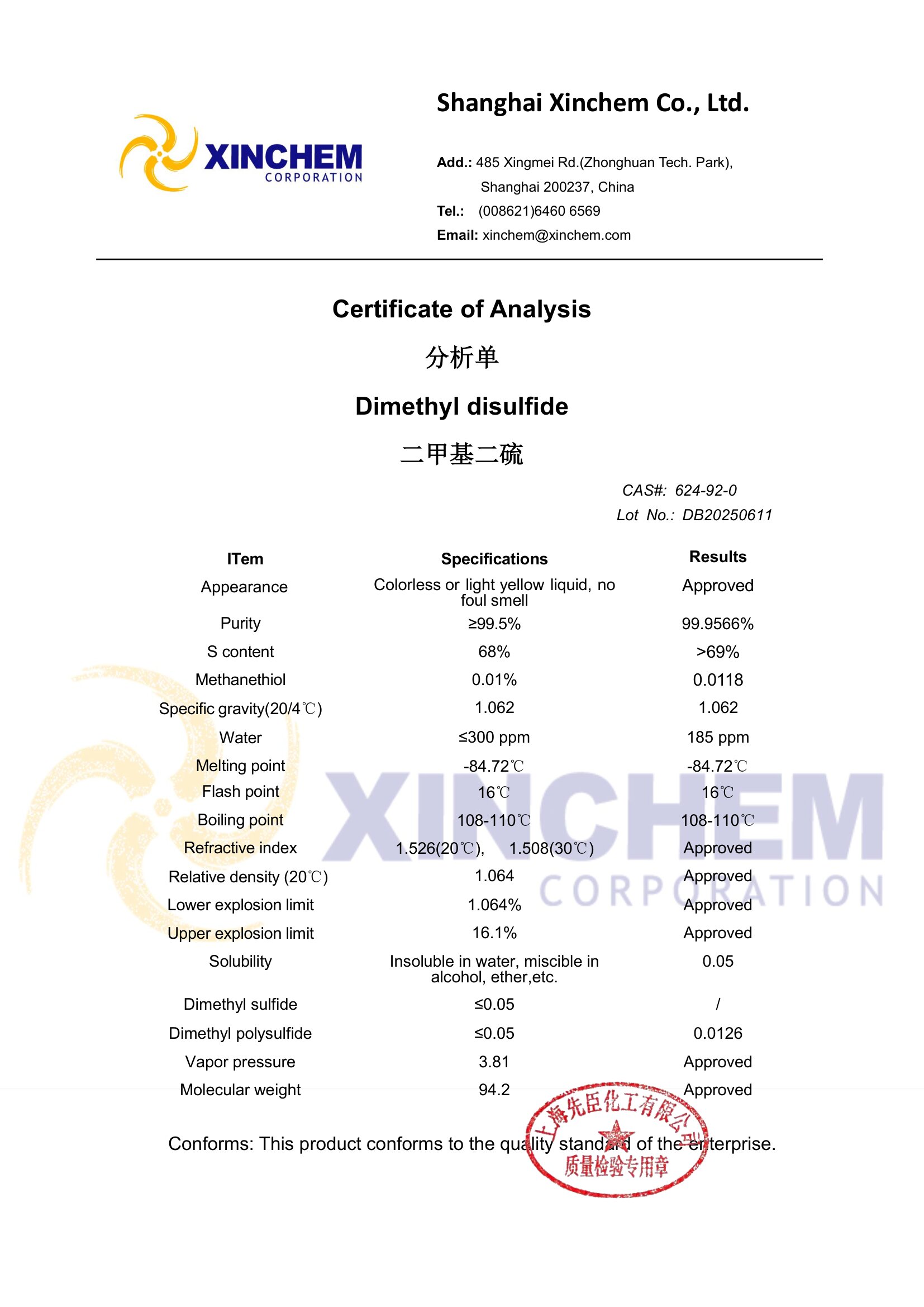
Specification
Purity by GC: 98.0 percent minimum, typical batch 98.5 to 99.0 percent
Appearance: Colorless to light yellow to light orange clear liquid
Molecular formula: C2H6S2
Molecular weight: 94.19 g per mol
Melting point: minus 85 degrees Celsius
Boiling point: 109 to 110 degrees Celsius
Density: 1.046 to 1.060 g per mL at 25 degrees Celsius
Refractive index n20/D: 1.5235 to 1.5265
Vapor pressure: 22 mmHg at 20 degrees Celsius
Flash point: 15 degrees Celsius (closed cup)
Autoignition temperature: greater than 572 degrees Fahrenheit
Water solubility: Slightly miscible with water (4.2 g per L at 20 degrees Celsius)
Explosive limit: 1.1 to 16.1 percent (v per v)
Vapor density: 3.24 (vs air)
Stock Status: In Stock in US warehouse and China hub
Available Quantity and Lead Time
Regular supply: 1 kg to 50 metric tons per shipment
Lead time: 3 to 5 days for standard packaging; bulk orders require 7 to 10 days
Document Support
COA SDS HPLC chromatogram NMR spectrum Mass spectrum MS available upon request
Application
Dimethyl disulfide (DMDS) is a versatile organosulfur compound with a broad range of industrial and specialty applications.
In the petrochemical and refining industry, DMDS is the leading sulfiding agent for activating hydrotreating catalysts in hydrodesulfurization processes, accounting for over 50 percent of global market demand. It transforms metal oxide species into active metallic sulfide crystalline phases in situ, enabling efficient sulfur removal from fuels to meet stringent environmental regulations. DMDS also serves as an effective anti-coking agent for steamcrackers, propane and butane dehydrogenation units, and renewable diesel plants. With the highest sulfur content on the market at 68 percent, it provides superior dosage efficiency and controlled sulfur release. It is also used to replace methyl mercaptan as a jet fuel additive, as a solvent for sulfur, and as a corrosion inhibitor.
In the flavor and fragrance industry, DMDS is a high-impact odorant widely used as a food additive and flavoring agent. It is approved as FEMA GRAS (No. 3536), meets JECFA specifications (No. 564), and complies with FDA 21 CFR 172.515. It contributes characteristic onion, garlic, cheese, meat, soup, and savory notes, as well as cabbage, vegetable, and sulfurous nuances. It is also used to enhance the aroma of fresh seafood and optimize food flavor profiles.
In agriculture, DMDS serves as an effective soil fumigant for controlling pathogens and pests. Studies have demonstrated its efficacy in reducing Salmonella enterica in soil and alleviating banded leaf and sheath blight in maize.
In organic synthesis, DMDS is used as a reagent for the preparation of 4-(methylthio)phenol, aryl methyl sulfides, and other sulfur-containing compounds. It is also employed as an analytical reference standard for quantifying volatile sulfur compounds in food products.
Custom Synthesis Support
We offer custom synthesis for dimethyl disulfide derivatives including isotopically labeled analogs, higher purity grades (99.5 percent and above), and custom formulations. Share your technical datasheet for feasibility review.
Packaging and Shipping
Available in 250 g, 1 kg, 5 kg, 25 kg steel drums, or IBC totes. Custom packaging such as amber glass bottles under inert atmosphere is supported. Fastest dispatch within 7 days after order confirmation.
Dimethyl disulfide is a highly flammable liquid with subsidiary toxic hazard. UN 2381, Class 3 (6.1), Packing Group II. Proper shipping name: DIMETHYL DISULFIDE. Labels: 3 plus 6.1 (Flammable liquid and Poison). Store in a cool, well ventilated area below 15 degrees Celsius, away from ignition sources, strong oxidizing agents, strong bases, and strong reducing agents. Keep container tightly closed and grounded during transfer.
Why XinChem
XinChem provides dimethyl disulfide with strict control of purity and impurity profile for US customers. Our ISO 9001 certified facility monitors every batch by GC and density analysis, ensuring consistent quality for petrochemical, flavor, and agricultural applications. We maintain a buffer stock in US warehouses for emergency deliveries within 48 hours. Each order includes a full documentation package: COA, SDS, and chromatograms accessible through our online portal. Our technical support team assists with handling precautions, stability under storage, and regulatory compliance including TSCA (Yes), EINECS 210-871-0, FEMA GRAS No. 3536, JECFA No. 564, and FDA 21 CFR 172.515. For contract customers, we offer quarterly price locks and consignment inventory to reduce supply chain risk. Trusted by numerous refineries, flavor houses, and agricultural chemical companies in North America. We also provide free sample evaluation for qualified R&D projects and a price match guarantee against any valid competitor quote for equivalent quality.
FAQ
Q1 How should dimethyl disulfide be stored safely?
A Store in a cool, well ventilated area below 15 degrees Celsius, away from heat, sparks, open flames, strong oxidizing agents, strong bases, and strong reducing agents. Keep container tightly closed and grounded during transfer. Shelf life is 24 months under recommended conditions.
Q2 What purity grades do you supply?
A Standard grade is 98.0 percent minimum by GC. We also supply 98.5 percent, 99.0 percent, and 99.5 percent grades for analytical reference, high-end flavor applications, and sensitive petrochemical processes.
Q3 Is dimethyl disulfide soluble in water?
A It is slightly miscible with water (4.2 g per L at 20 degrees Celsius). It is miscible with ethanol, ethyl ether, alcohol, most organic solvents, and oils.
Q4 Do you provide sample quantities for flavor development or catalyst testing?
A Yes, free samples are available for qualified US companies. Shipping fee applies for small quantities due to hazardous material classification.
Q5 Is dimethyl disulfide approved for use as a food flavoring?
A Yes, it is FEMA GRAS (No. 3536), meets JECFA specifications (No. 564), and complies with FDA 21 CFR 172.515 and EU regulations 1334/2008 and 178/2002. No safety concern at current levels of intake when used as a flavoring agent.
Q6 What safety precautions are required when handling dimethyl disulfide?
A DMDS is highly flammable and toxic by inhalation and ingestion. It causes skin and serious eye irritation, may cause an allergic skin reaction, and is very toxic to aquatic life with long-lasting effects. Use in a fume hood with full PPE including chemical resistant gloves, safety goggles, and protective clothing. Do not breathe vapors. Keep away from heat, sparks, and open flames. In case of contact, rinse immediately with plenty of water and seek medical attention.
Q7 What are the primary industrial applications of dimethyl disulfide?
A Primary applications include: (1) sulfiding agent for hydrotreating catalyst activation in petroleum refining; (2) anti-coking agent for steamcrackers and dehydrogenation units; (3) food flavoring agent for onion, garlic, cheese, meat, and savory flavors; (4) soil fumigant in agriculture; (5) chemical intermediate for organic synthesis; and (6) analytical reference standard for volatile sulfur compound analysis.

![2,2′-[1,2-ethanediylbis(oxy)]bis(ethanethiol)(CAS#14970-87-7)](https://www.xinchem.com/uploads/2-2-1-2-ethanediylbis-oxy-bis-ethanethiol.png)