
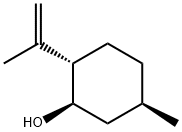
ISO PULEGOL(CAS#89-79-2)
| Hazard Symbols | Xn – Harmful |
| Risk Codes | R22 – Harmful if swallowed R36/37/38 – Irritating to eyes, respiratory system and skin. |
| Safety Description | S26 – In case of contact with eyes, rinse immediately with plenty of water and seek medical advice. S36/37/39 – Wear suitable protective clothing, gloves and eye/face protection. |
| UN IDs | NA 1993 / PGIII |
| WGK Germany | 2 |
| FLUKA BRAND F CODES | 10-23 |
| Toxicity | The acute oral LD50 in rats was reported as 1.03 ± 0.10 ml/kg and the acute dermal LD50 in rabbits as approximately 3 ml/kg |
ISO PULEGOL(CAS#89-79-2) Introduction
Properties
Isobutanol, also known as isobutyl alcohol, is an organic compound. It is a colorless liquid with a pungent odor at normal temperature and pressure. The following are some properties of isobutanol:
1. Solubility: Isobutanol is soluble in water, forming hydrogen bonds with water, but its solubility in water is relatively low. It is also miscible with many organic solvents such as ether, acetone, etc.
3. Density: The density of isobutanol is approximately 0.81 g/cm³.
4. Chemical properties: Isobutanol has nucleophilic properties and can participate in acid-base neutralization reactions. It can be oxidized by oxidizing agents to methanol, acetaldehyde, etc., and can also undergo dehydration to form isobutene or butene. In the presence of a catalyst, it can undergo dehydrogenation to produce butadiene.
5. Flammability: Isobutanol is a flammable liquid and can burn in the presence of oxygen, producing carbon dioxide and water. Appropriate safety procedures and protective measures should be followed when handling it.
![4-methyl-1-oxaspiro[5.5]undecene(CAS#68228-06-8)](https://www.xinchem.com/uploads/4-methyl-1-oxaspiro5.5undecene.jpg)