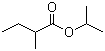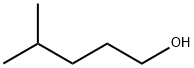

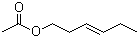
Leaf acetate(CAS#3681-71-8)
| Risk Codes | R36/38 – Irritating to eyes and skin. R10 – Flammable |
| Safety Description | S26 – In case of contact with eyes, rinse immediately with plenty of water and seek medical advice. S36 – Wear suitable protective clothing. S24/25 – Avoid contact with skin and eyes. |
| UN IDs | UN 3272 3/PG 3 |
| WGK Germany | 2 |
| RTECS | MP8425050 |
| TSCA | Yes |
| HS Code | 29153900 |
| Hazard Class | 3 |
| Packing Group | III |
| Toxicity | Both the acute oral LD50 value in rats and the acute dermal LD50 value in rabbits exceeded 5 g/kg (Wohl, 1974). |
Introduction
Isobutyl acetate is an organic compound. Below is an introduction to the properties, uses, preparation, and safety information of isobutyl acetate:Properties:Isobutyl acetate is a colorless liquid with a fruity odor at room temperature. It is a volatile solvent that can dissolve many organic compounds.Uses:Isobutyl acetate has a wide range of applications. It is an important organic compound commonly used as a solvent, flavoring agent, and additive. Isobutyl acetate can also be used in coatings, inks, and cleaning products.Preparation:Isobutyl acetate can be prepared by the reaction of an alcohol with an acid anhydride. A common method is to react isobutanol with acetic anhydride under acidic conditions, yielding isobutyl acetate and acetic acid as a byproduct.Safety Information:Isobutyl acetate poses minimal harm to the human body under normal usage conditions. It is a volatile liquid, and excessive exposure may cause irritation to the eyes and respiratory system. When using isobutyl acetate, avoid excessive contact and inhalation, and ensure a well-ventilated working environment. It should also be kept away from open flames and oxidizing agents, and stored in a dry, cool place.