
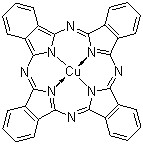
Phthalocyanine Blue (CAS#147-14-8)
Chemical Property:
| Molecular Formula | C32H16CuN8 |
| Molar Mass | 576.07 |
| Melting Point | 600℃ (dec.) |
| Water Solubility | <0.1 g/100 mL at 20℃ |
| Appearance | Form Fine Crystalline Powder, color Dark blue |
| Storage Condition | Inert atmosphere,Room Temperature |
| MDL | MFCD00010719 |
| Physical and Chemical Properties | Melting Point: 600 (dec)water-soluble:<0.1g/100 mL at 20 CAppearance: bright blue crystals have purple luster solubility: insoluble in water, ethanol and hydrocarbon solvents, Olive solution in concentrated sulfuric acid, after dilution, there was a blue precipitate. hue or color: bright red and blue relative density: 1.50-1.79 Bulk density/(lb/gal):12.5-14.9 melting point/℃:600 (decomposition) average particle size/μm:0.08 particle shape: Rod (square) specific surface area/(m2/g):30-90 pH value/(10% slurry):6.5-8.0 oil absorption/(g/100g):32-70 hiding power: transparent diffraction curve: 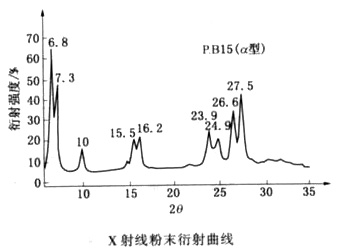 reflection curve:  solubility: insoluble in water, ethanol and hydrocarbon solvents, olive-colored solution in concentrated sulfuric acid, dilute After release, it showed blue precipitate. hue or color: bright green light blue density/(g/cm3):1.59 Bulk density/(lb/gal):12.4-14.1 melting point/℃:480 average particle size/μm:123 particle shape: Rod (monoclinic) specific surface area/(m2/g):33-63 pH value/(10% slurry):5.5-8.5 oil absorption/(g/100g):34-85 hiding power: transparent diffraction curve: 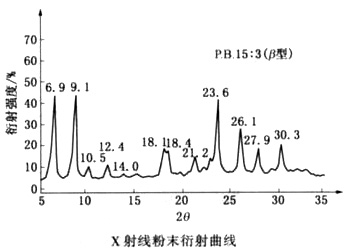 reflection curve: 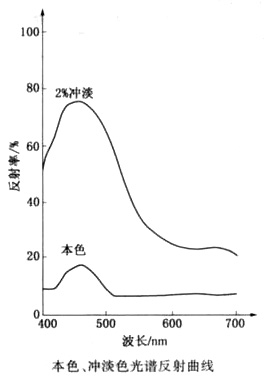 solubility: insoluble in water, ethanol and hydrocarbon solvents, Olive solution in concentrated sulfuric acid, diluted blue Color precipitation. hue or color: bright green light blue density/(g/cm3):1.60 Bulk density/(lb/gal):13.1-14.7 melting point/℃:480 average particle size/μm:78 particle shape: Rod (monoclinic) specific surface area/(m2/g):38-95 pH value/(10% slurry):5.5-8.0 oil absorption/(g/100g):54-58 hiding power: transparent diffraction curve: 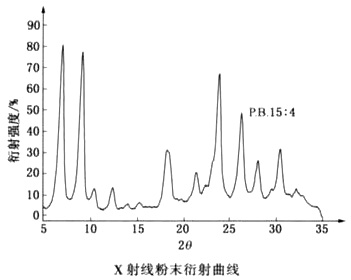 reflection curve: 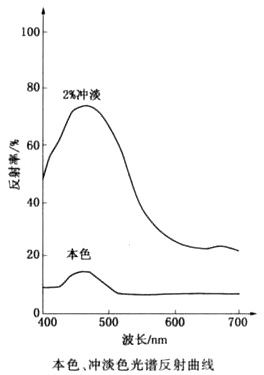 solubility: insoluble in water, ethanol and hydrocarbon solvents, Olive solution in concentrated sulfuric acid, blue after dilution Precipitation. hue or color: Red diffraction curve: 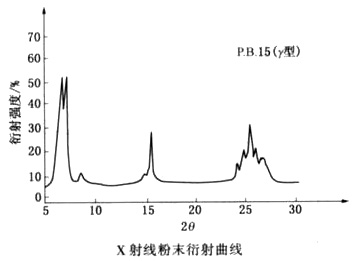 solubility: insoluble in water, ethanol and hydrocarbon solvent, in concentrated sulfuric acid in olive color solution, diluted blue precipitation. hue or color: red and blue diffraction curve: 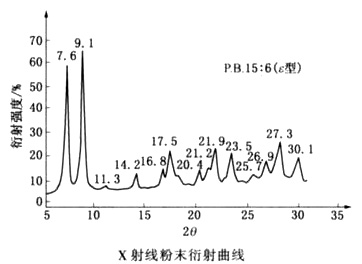 This product is red and blue powder, the color light is less bright than the β-type phthalocyanine pigment. Excellent performance. In particular, in line with the performance requirements of paint, in the organic solvent does not produce increased crystallization, no flocculation, good storage stability. This product is brilliant blue powder. Bright color, strong coloring. Insoluble in water and organic solvents. Excellent performance, in the non-polar solvent does not produce increased crystallization, can be used in coatings. Green blue powder. Density 1.54~1.75g/cm3. It is an unstable α-type phthalocyanine dye, which has strong coloring power and excellent fastness performance, but it is easy to produce crystal increase and lose pigment performance in case of non-polar solvent, so it is not suitable for coating. This product is red light dark blue powder. It is an unstable α-phthalocyanine pigment with bright color and strong coloring power. Insoluble in water, ethanol and hydrocarbons. Dissolved in concentrated sulfuric acid for olive color, diluted blue precipitation. It has excellent fastness properties and is an irreplaceable blue variety in pigments. |
| Use | Used for coloring of paint, ink, plastic and rubber, etc. There are 160 kinds of commercial formulations of the pigment. Compared with other crystal forms of CuPc, the unstable α-crystal form of CuPc, A stronger red light is given, with higher coloration intensity and low cost characteristics. It is mainly used for offset printing ink packaging and metal decorative printing ink. Under normal conditions, it is stable to organic solvents, and the crystal form and color light change when stored in aromatic hydrocarbons, excellent light fastness, can withstand 200 ℃, further increase the temperature can be transformed into beta-type; Also applies to polyurethane foam and rubber; pure and bright color light makes it used for water-based coating and paper coloring and pigment printing paste. There are 252 kinds of commercial dosage forms of the pigment, which are of β-CuPc type, pure green, light blue or green |
| Safety Description | S24/25 - Avoid contact with skin and eyes. |
| WGK Germany | - |
| RTECS | GL8510000 |
| TSCA | Yes |
| HS Code | 32041300 |
| Toxicity | LD50 intraperitoneal in rat: > 3gm/kg |
Phthalocyanine Blue (CAS#147-14-8)
quality
Pigment Blue 15:3 is a widely used organic pigment, also known as thicker Danyu blue. It is a blue-blue powdery solid with good tinting and covering power. Here are some of its main properties:
1. Color: Blue 15:3 presents a vivid cyan blue with high chromaticity and transparency. It is often used in pigments to prepare blue and green color palettes.
2. Chemical stability: Blue 15:3 has good chemical stability and is able to maintain its color and properties under different environmental conditions. It is light-resistant, heat-resistant, and less susceptible to chemicals.
3. Solubility: Blue 15:3 has certain solubility in conventional organic solvents, such as alcohols, ketones, esters and aromatic hydrocarbons. But it hardly dissolves in water.
4. Durability: Blue 15:3 has good durability and is not susceptible to problems such as oxidation, pigment decay and fading. It is often used to make products with high requirements for weather resistance, such as coatings, inks and plastics.
It is worth noting that blue 15:3 is a chemically synthesized organic pigment, which may have certain residues or environmental pollution problems compared with natural pigments. Relevant safety operation guidelines should be followed during use, and waste should be disposed of properly. Uses and synthesis methods
Pigment Blue 15:3, also known as Phthalocyanine Blue, is a commonly used organic pigment. Its main use is as a pigment for coloring products such as paints, plastics, inks, rubber, and textiles. It has good hiding properties, lightfastness and weather resistance, and is widely used in various pigment products.
Synthesis method, blue 15:3 is generally obtained by the synthesis of phthalocyanine dyes. The specific steps include:
1. Synthesis of pentaminophthalocyanine metal salt: First, 1,4-dicarbamoylbenzene is reacted with phthalide to obtain diamine compounds. It is then reacted with metal salts under acidic conditions to obtain pentaminophthalocyanine metal salts.
2. Synthesis of phthalocyanine metal salts: pentaminophthalocyanine metal salts are reacted with metal salts such as lithium oxide or titanium tetrachloride to obtain phthalocyanine metal salts.
3. Formation of blue 15:3: The phthalocyanine metal salt is reacted with reagents such as aluminum chloride or sulfur chloride, and under appropriate conditions, a cyclization reaction occurs to form blue 15:3.
This method of synthesis of pigments has been widely used in the chemical industry, and there have been many improved and optimized methods.
Application
Phthalocyanine Blue (C.I. Pigment Blue 15, Copper Phthalocyanine, CuPc, CAS 147-14-8) is a synthetic organic pigment renowned for its exceptionally brilliant blue hue, unrivaled tinctorial strength, and outstanding durability. Introduced commercially in the 1930s, this macrocyclic complex has become the dominant blue pigment across global industries, largely supplanting all other blue colorants in coatings due to its superior performance profile.
In the coatings and paints sector, Phthalocyanine Blue is indispensable for formulating high-performance automotive OEM finishes, industrial paints, powder coatings, and marine coatings. It exhibits excellent lightfastness (rated 7–8), remarkable weather and chemical resistance, and high heat stability, ensuring long‑term color retention even under severe outdoor exposure. Within the printing ink industry, the pigment is a staple for offset inks, water‑based flexo inks, solvent‑based gravure inks, and UV‑curable systems, where it delivers high transparency, excellent rheology, and low viscosity for high‑speed printing. For plastics and polymers, PB15 is widely used to color polyolefins (PP, PE), PVC, PS, ABS, and EVA for applications ranging from toys and household containers to automotive parts and engineering masterbatches, where its non‑migratory nature and high heat stability are critical.
Beyond traditional coloration, Phthalocyanine Blue serves as a high‑purity organic semiconductor in advanced electronics. Copper(II) phthalocyanine functions as a p‑type semiconductor and is incorporated as an electron‑donor layer in organic photovoltaic (OPV) cells, as a charge‑transport layer in organic field‑effect transistors (OFETs), and as a hole‑ or electron‑blocking layer in organic light‑emitting diodes (OLEDs) to enhance device efficiency and lifetime. In textile applications, the pigment is used for dyeing synthetic fibers (polyester, polyamide) and pigment printing on cotton and blends, offering excellent wash fastness and light resistance. In cosmetics, its safety profile permits use in eyeshadows, nail polishes, and other decorative products. The pigment is available in several crystal modifications—α‑phase (red‑shade, PB15:0, PB15:1, PB15:2) and β‑phase (green‑shade, PB15:3, PB15:4)—to meet specific shade, dispersion, and stability requirements.
Xinchem is a premier manufacturer and reliable supplier of high‑purity Phthalocyanine Blue (Pigment Blue 15). We offer flexible custom synthesis, tailored custom chemical synthesis, and robust contract manufacturing to meet your specific industrial or research needs. Our global supply chain supports seamless scaling from R&D samples to commercial tons, backed by comprehensive quality documentation and regulatory compliance. Contact us today for a competitive quote and dependable global supply.