

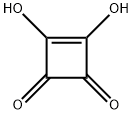
Squaric acid(CAS#2892-51-5)
| Hazard Symbols | Xi – Irritant |
| Risk Codes | R36/37/38 – Irritating to eyes, respiratory system and skin. R43 – May cause sensitization by skin contact |
| Safety Description | S26 – In case of contact with eyes, rinse immediately with plenty of water and seek medical advice. S36 – Wear suitable protective clothing. S37/39 – Wear suitable gloves and eye/face protection |
| UN IDs | 3261 |
| WGK Germany | 3 |
| RTECS | GU1800000 |
| TSCA | Yes |
| HS Code | 29144090 |
| Hazard Note | Irritant |
| Hazard Class | 8 |
| Packing Group | II |
Introduction
3,4-Dihydroxy-3-cyclobutene-1,2-dione, also known as diketone, is an organic compound containing two keto groups and two hydroxyl groups. The following is an introduction to the properties, uses, preparation, and safety information of this compound:Properties:- Appearance: White crystalline solid.- Solubility: Low solubility in water; soluble in organic solvents such as ethanol, acetone, and dichloromethane.- Chemical properties: This compound is relatively stable and is not easily decomposed or prone to auto-oxidation.Uses:- Diketone can be used as a ligand in coordination chemistry and as an important intermediate in organic synthesis.- It can be used in organic synthesis reactions, such as Michael addition and Knoevenagel condensation.Preparation:- Diketone is usually prepared through the Knoevenagel condensation reaction between a ketone and an aldehyde.- This reaction is typically carried out under basic catalysis, commonly using bases such as acetylacetone and pyridine.- After the reaction, high-purity diketone product can be obtained through crystallization or extraction.Safety information:- Diketone has low toxicity but still needs to be handled and stored properly in the laboratory.- During use, inhalation of diketone dust and contact with skin and eyes should be avoided.- Appropriate protective equipment should be worn, such as laboratory gloves, safety goggles, and protective clothing.
![2-(2 2-difluorobenzo[d][1 3]dioxol-5-yl)acetonitrile(CAS# 68119-31-3)](https://www.xinchem.com/uploads/222difluorobenzod13dioxol5ylacetonitrile.png)