
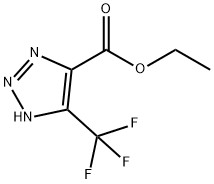
1H-1,2,3-Triazole-4-carboxylic acid, 5-(trifluoromethyl)-, ethyl ester(CAS#862112-26-3)
1H-1,2,3-Triazole-4-carboxylic acid, 5-(trifluoromethyl)-, ethyl ester(CAS#862112-26-3)
Chemical properties
Hydrolysis reaction: The ester group in the molecule can undergo a hydrolysis reaction under acidic or alkaline conditions to form the corresponding carboxylic acid. For example, under alkaline conditions, the reaction with a sodium hydroxide solution breaks the ester group to form 5-(trifluoromethyl)-1H-1,2,3-triazole-4-carboxylic acid and ethanol.
Substitution reaction: The hydrogen atom on the triazole ring can be replaced by other groups under certain conditions. Due to the strong electron-withdrawing effect of trifluoromethyl, the hydrogen atom in the paraposition with trifluoromethyl group on the triazole ring has a certain activity, and can undergo substitution reaction with some electrophiles or nucleophiles.
Cycloaddition reaction: 1,2,3-triazole ring can participate in some cycloaddition reactions as a diene or diene body, such as Diels-Alder reaction with alkenes, alkynes, etc., or cycloaddition reaction in click chemistry, etc., for the construction of more complex organic molecular structures.
use
Medicinal chemistry: As an important intermediate, it can be used to synthesize potentially biologically active drug molecules. The presence of triazole rings and trifluoromethyl often confers better bioavailability, metabolic stability, and specific binding to the target. For example, in the research and development of some antibacterial, antiviral, and antitumor drugs, the compound is used as a starting material or key intermediate to construct a drug molecule with specific pharmacological activity through further structural modification and reaction.
Materials science: It can be used to prepare functional materials. The properties of the material can be improved by reacting or copolymerizing with other molecules or polymers with specific functions to introduce their unique structures and properties into the material, such as for the preparation of polymer materials with special optical, electrical, or thermal properties.
In the field of organic synthetic chemistry: it is an important raw material for the synthesis of other triazole or trifluoromethyl compounds. With its special structure and reactivity, different types of organic compounds can be constructed through various chemical reactions, which provides an important building block for organic synthetic chemistry.
Application
Ethyl 5-(trifluoromethyl)-1H-1,2,3-triazole-4-carboxylate is a functionalized heterocyclic building block that combines a 1,2,3-triazole core with a strongly electron-withdrawing trifluoromethyl group and an ethyl ester. The triazole ring serves as a stable amide bioisostere, while the CF3 group enhances metabolic stability, lipophilicity, and target binding affinity. This compound is widely used in medicinal chemistry as a key intermediate for the synthesis of antifungal, antiviral, and anticancer agents, as well as inhibitors of kinases and proteases. The ethyl ester enables facile hydrolysis to the carboxylic acid for amide coupling, or reduction to the alcohol. It is also employed in click chemistry for the preparation of functionalized triazole libraries, and in agrochemical research for the development of herbicides and fungicides. Its unique substitution pattern allows rapid structure-activity relationship (SAR) studies and scalable GMP manufacturing. Xinchem offers custom synthesis, custom chemical synthesis, and contract manufacturing of this high-purity building block with flexible scaling from R&D to commercial tons. Contact us for a competitive quote and reliable global supply.

![2,4-Dichloro-7H-pyrrolo[2,3-d]pyrimidine(CAS#90213-66-4)](https://www.xinchem.com/uploads/24-Dichloro-7H-pyrrolo23-dpyrimidine.png)