
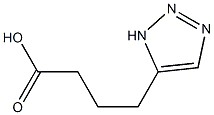
1H-1,2,3-Triazole-4-butanoic acid(CAS#872701-04-7)
1H-1,2,3-Triazole-4-butanoic acid(CAS#872701-04-7) Introduction
1H-1,2,3-Triazole-4-butanoic acid is a white crystalline solid, soluble in water and organic solvents. It is a weak acid that can react with a base to form the corresponding salt.Use:
1H-1,2,3-Triazole-4-butanoic acid is commonly used in synthesis and research, and is mainly used as an intermediate compound and a lead compound for functional materials. It can be used as an intermediate for drugs, a coordination ligand for optical materials, and a ligand for metal catalysts.
Preparation Method:
The preparation method of 1H-1,2,3-Triazole-4-butanoic acid is relatively simple. A common synthetic route is to obtain 1,3-dibutyl -1,3-diazopropane by reaction with sodium hypochlorite, which is then converted to 1H-1,2,3-Triazole-4-butanoic acid by acid-catalyzed hydrogenolysis.
Safety Information:
1H-1,2,3-Triazole-4-butanoic acid is generally safe under normal conditions of use. However, during operation, you still need to pay attention to avoid contact with skin, eyes, etc., and ensure that the operation is carried out in a well-ventilated environment. If ingested or inhaled, seek medical attention as soon as possible. Detailed information on safe handling and storage can be found in the safety data sheets provided by chemical laboratories and chemical manufacturers.
Application
1H-1,2,3-Triazole-4-butanoic acid (CAS 872701-04-7) is a high-purity heterocyclic building block specifically designed as a versatile intermediate for medicinal chemistry and drug discovery. The 1,2,3-triazole ring provides superior metabolic stability and acts as a reliable bioisostere for labile amide bonds in peptide mimetics. The four-carbon butanoic acid linker offers an optimal LogP of -0.3, balancing solubility and permeability. The terminal carboxylic acid enables rapid amide and ester conjugation, while the triazole core is efficiently installed via copper-catalyzed azide-alkyne cycloaddition (CuAAC) for accelerated library synthesis. This scaffold has been validated as a key autotaxin inhibitor in fibrosis and oncology programs. Its dual N/O donor sites support the development of metal-organic framework (MOF) ligands for material science. The compound's water solubility suggests good bioavailability, and it demonstrates antimicrobial properties. Xinchem offers flexible custom synthesis, custom chemical synthesis, and contract manufacturing of this high-purity building block, supported by comprehensive quality documentation and reliable global supply, scaled from R&D to commercial tons. Contact us for a competitive quote.