

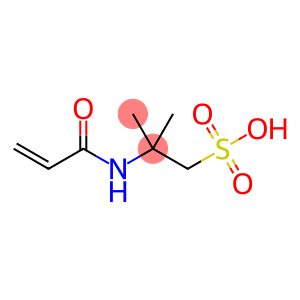
2-Acrylamido-2-methylpropanesulfonic Acid(CAS#15214-89-8)–AMPS Monomer for Oilfield Polymers
1. Properties:
- Appearance and Physical Form: 2-Acrylamido-2-methylpropanesulfonic acid (AMPS) is a white crystalline powder supplied as free‑flowing granules or fine powder. The product exhibits a slight characteristic odor and is hygroscopic.
- Solubility: AMPS is highly soluble in water (1500 g/L at 20°C), forming an acidic solution. It is also soluble in polar organic solvents such as dimethylformamide (DMF), partially soluble in methanol and ethanol, and practically insoluble in acetone, hydrocarbons, and non‑polar solvents. The sulfonic acid group imparts excellent water solubility and ion‑exchange properties to the monomer and its polymers.
- Chemical Properties: AMPS is a reactive, hydrophilic acrylic monomer containing a polymerizable vinyl group and a strongly acidic sulfonic acid group (−SO₃H) on a branched tert‑butyl spacer. The geminal dimethyl groups adjacent to the sulfonic acid provide steric hindrance, imparting exceptional hydrolytic and thermal stability (decomposition temperature of the monomer: 210°C; sodium salt homopolymer decomposition: 329°C). This structural design enables AMPS‑based polymers to retain rheological properties under high‑temperature (up to 200°C), high‑salinity, and high‑pressure conditions encountered in oilfield applications. The monomer readily undergoes free‑radical homopolymerization and copolymerization with a wide range of comonomers including acrylamide, acrylic acid, itaconic acid, styrene, and vinyl acetate. The resulting copolymers can be tailored to specific molecular weight distributions and functional properties for diverse industrial applications.
2. Applications:
Oilfield & Gas Well Cementing (Primary Fluid Loss Control):
- Fluid Loss Reducer for Oil Well Cement: AMPS copolymers are used as high‑performance non‑retarding fluid loss control agents in oil well cementing operations, particularly in deep, high‑temperature wells. When formulated into cement slurries, AMPS‑based polymers effectively control fluid loss by forming a thin, low‑permeability filter cake at the wellbore wall, reducing water loss into porous formations, and improving cement slurry integrity and zonal isolation.
- Drilling Fluids and Mud Additives: AMPS homopolymers and copolymers function as viscosifiers, rheology modifiers, and high‑temperature stabilizers in water‑based drilling fluids. They improve hole‑cleaning capacity, enhance cuttings transport, and maintain fluid properties under extreme downhole conditions. Their excellent salt‑ and temperature‑resistance makes them suitable for high‑salinity and high‑temperature (HTHP) drilling environments.
- Fracturing Fluids: AMPS copolymers are used as viscosifiers and friction reducers in hydraulic fracturing fluids for enhanced oil and gas recovery from unconventional reservoirs. They maintain high viscosity under high shear, high temperature, and high salinity, ensuring effective proppant transport and fracture propagation.
- Enhanced Oil Recovery (EOR): AMPS copolymers are employed in polymer flooding, water‑control polymers, and conformance control operations. They act as mobility control agents that reduce the water‑oil mobility ratio, improve sweep efficiency, and increase oil recovery from mature reservoirs. The copolymers offer high viscosity even at low polymer concentrations, excellent salt resistance, and long‑term thermal stability under reservoir conditions.
- Scale Inhibitors for Oilfield Production: AMPS copolymers (e.g., IA/AMPS copolymers) are widely used to control co‑production of calcium carbonate (CaCO₃) and calcium sulfate (CaSO₄) scales in oilfield production systems due to their high complexation, dispersion, and thermal stability.
Industrial Water Treatment:
- Scale Inhibitor and Dispersant: AMPS copolymers are used in cooling towers, boilers, and reverse osmosis (RO) systems to inhibit the formation of inorganic scales, including calcium carbonate, calcium sulfate, barium sulfate, magnesium silicate, and silica scales. They function through threshold inhibition, crystal distortion, and particle dispersion mechanisms.
- Corrosion Inhibitor: AMPS polymers provide metal surface protection in closed‑loop water circulation systems, reducing corrosion of iron, zinc, aluminum, copper, and alloys.
- Flocculant for Sludge Dewatering: AMPS homopolymers or copolymers with acrylamide/acrylic acid serve as flocculants for sludge dewatering in wastewater treatment plants.
Superabsorbent Polymers & Personal Care:
- Superabsorbent Polymers (SAPs) for Hygiene Products: AMPS is a key comonomer in the production of superabsorbent polymers used in diapers, adult incontinence products, and feminine hygiene products. The sulfonic acid group imparts high water absorption capacity (up to several hundred times its own weight), electrical conductivity, and improved gel strength under load.
- Cosmetics & Personal Care Formulations: AMPS homopolymers and copolymers are used as thickeners, rheology modifiers, emulsion stabilizers, and film‑forming agents in lotions, creams, gels, shampoos, hair styling products, and sunscreens. They improve product texture, provide a pleasant skin feel, and enhance formulation stability across a wide pH range.
Textile & Leather Industry:
- Warp Sizing Agent: AMPS copolymers are used as textile sizing agents, thickeners, dispersants, and non‑woven emulsion binders. They improve fiber lubricity, abrasion resistance, and dye receptivity.
- Acrylic Fiber Modifier: AMPS imparts cationic dye receptability to acrylic fibers, enabling deeper and more uniform dyeing with basic dyes.
Paper & Coatings:
- Paper Coating and Sizing: AMPS copolymers enhance pigment dispersant performance, improve scrub resistance, reduce grit formation, and serve as paper coating binders and surface sizing agents.
- Paints & Coatings: AMPS polymers improve coating durability, water resistance, and mechanical properties in latex paints and industrial coatings.
Construction Chemicals:
- Superplasticizer for Concrete: AMPS is used in the synthesis of polycarboxylate ether (PCE) superplasticizers for high‑performance concrete formulations, improving workability, water reduction, and compressive strength.
- Cement Retarder: AMPS‑based copolymers function as high‑temperature cement retarders in oil well cementing, extending thickening time and ensuring safe placement under ultra‑high temperature conditions (≥200°C).
Other Industrial Applications:
- Agriculture: AMPS polymers serve as plant protection agents, improving the effectiveness of agrochemical formulations and controlling release of active ingredients.
- Adhesives: AMPS copolymers improve adhesion strength, thermal stability, and mechanical properties in pressure‑sensitive adhesives, wood glues, and emulsion adhesives.
- Biomedical Materials: AMPS is used in hydrogels and nanogels for drug delivery, antibacterial coatings, and tissue engineering scaffolds due to its biocompatibility and water affinity.
3. Preparation Method:
- Laboratory Method: AMPS can be prepared in the laboratory by reacting acrylonitrile with isobutylene to form a nitrile intermediate, followed by hydrolysis and sulfonation. Alternative routes involve the reaction of 2‑methyl‑2‑amino‑1‑propanol with acrylic acid, followed by sulfonation with chlorosulfonic acid or sulfur trioxide. The product is purified by recrystallization from water or alcohol.
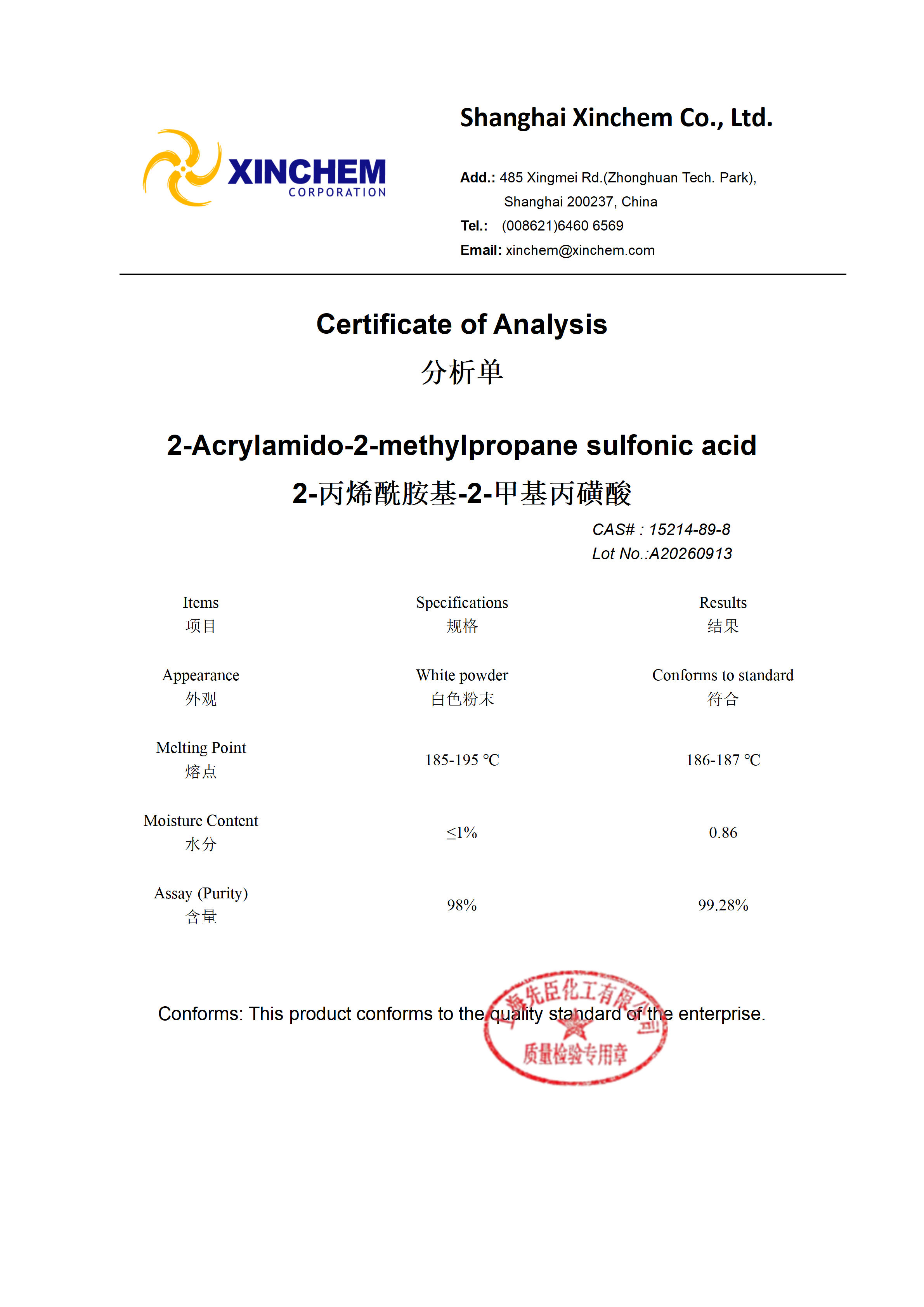
- Industrial Process: Industrial production of high‑purity AMPS is carried out through a well‑established two‑step process: (1) Amidation: Acrylonitrile is reacted with isobutylene in the presence of a strong acid catalyst to form 2‑acrylamido‑2-methylpropionitrile (nitrile intermediate). (2) Sulfonation and Hydrolysis: The nitrile intermediate is hydrolyzed and sulfonated using oleum (fuming sulfuric acid) or sulfur trioxide at controlled temperatures (60–100°C), yielding crude AMPS. (3) Crystallization and Purification: The crude product is cooled, crystallized, filtered, and washed to remove impurities (unreacted starting materials, inorganic salts). Recrystallization from water or organic solvents yields high‑purity AMPS (≥99%) as a white crystalline powder. (4) Drying and Packaging: The purified monomer is dried under reduced pressure at 40–50°C and packaged in moisture‑proof containers (25 kg polyethylene‑lined bags, drums, or FIBCs). Quality parameters include assay (≥98–99%), melting point (195°C dec.), water content (≤0.5%), and residual acrylonitrile content (≤5 ppm).
4. Safety Information:
- Hazard Classification: According to CLP Regulation (EC) No 1272/2008 and GHS, AMPS is classified as hazardous with the following hazard statements: H302 (Harmful if swallowed), H332 (Harmful if inhaled), H315 (Causes skin irritation), H318 (Causes serious eye damage), H335 (May cause respiratory irritation). Hazard pictograms: GHS07, GHS05. Signal word: Danger.
- Health Hazards:
- Inhalation: Harmful if inhaled (H332). Inhalation of dust may cause respiratory tract irritation, coughing, and throat discomfort.
- Skin Contact: Causes skin irritation (H315). Prolonged or repeated exposure may lead to dermatitis.
- Eye Contact: Causes serious eye damage (H318). Direct contact may result in corneal injury.
- Ingestion: Harmful if swallowed (H302). May cause gastrointestinal irritation, nausea, and vomiting.
- First Aid Measures:
- Eye Contact: Rinse cautiously with plenty of water for at least 15 minutes, removing contact lenses if present. Seek immediate medical attention.
- Skin Contact: Wash skin with plenty of soap and water. Remove contaminated clothing. Seek medical advice if irritation persists.
- Inhalation: Remove victim to fresh air. Keep at rest in a position comfortable for breathing. Call a poison center or doctor if feeling unwell.
- Ingestion: Rinse mouth immediately. Do NOT induce vomiting. Seek immediate medical attention. If conscious, drink water to dilute.
- Fire & Reactivity Hazards: Flash point: 160°C closed cup. AMPS is not combustible but may decompose on heating, releasing toxic and irritating fumes including sulfur oxides (SOₓ), carbon monoxide, and nitrogen oxides. Use water spray, foam, dry powder, or CO₂ as extinguishing media appropriate for the surrounding fire.
- Environmental Precautions: Avoid release into natural water bodies, drains, or soil. AMPS is not classified as a PBT (persistent, bioaccumulative, toxic) or vPvB substance under REACH criteria. However, large spills should be contained to prevent environmental contamination.
- Storage & Stability: Store at 2–8°C in tightly closed, moisture‑proof containers in a cool, dry, well‑ventilated area away from direct sunlight, heat sources, strong oxidizing agents, and strong bases. The product is light sensitive and hygroscopic; protect from light and atmospheric moisture to prevent decomposition and caking. Under recommended storage conditions (2–8°C, low humidity), AMPS has a shelf life of 12–24 months in tightly closed original containers. Avoid storage above 40°C, where thermal decomposition may occur.
- Regulatory Compliance: 2-Acrylamido-2-methylpropanesulfonic acid (CAS#15214-89-8, EC#239-268-0) is listed on EINECS, TSCA, DSL, AICS, NZIoC, ENCS, KECI, PICCS, and other regional chemical inventories. It is REACH registered (Registration No. 01-2119496238-26-XXXX). The monomer is not subject to specific use restrictions for industrial applications. For oilfield and water treatment applications, end‑users must ensure final formulated products comply with relevant local regulations. Always consult the Safety Data Sheet (SDS) and local regulations for complete safety, environmental, and regulatory information specific to each product grade and application jurisdiction.
Write your message here and send it to us



![(4R,12aS)-7-(benzyloxy)-9-broMo-4-Methyl-3,4-dihydro-2H-[1,3]oxazino[3,2-d]pyrido[1,2-a]pyrazine-6,8(12H,12aH)-dione(CAS#1206102-10-4)](https://www.xinchem.com/uploads/benzyloxy.png)