
2-Chloro-4-fluorobenzyl chloride(CAS# 93286-22-7)
| Hazard Symbols | C - Corrosive |
| Risk Codes | 34 - Causes burns |
| Safety Description | S45 - In case of accident or if you feel unwell, seek medical advice immediately (show the label whenever possible.) S36/37/39 - Wear suitable protective clothing, gloves and eye/face protection. S26 - In case of contact with eyes, rinse immediately with plenty of water and seek medical advice. |
| UN IDs | 3265 |
| HS Code | 29039990 |
| Hazard Note | Corrosive/Lachrymatory |
| Hazard Class | 8 |
| Packing Group | III |
Introduction
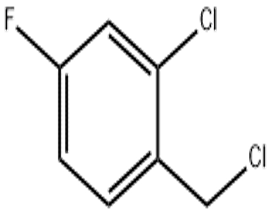
It is an organic compound with a chemical formula of C7H5Cl2F and a molecular weight of 177.02g/mol. It is a colorless to pale yellow liquid with a pungent odor.
It is often used as an intermediate in organic synthesis. It can be used to synthesize other organic compounds containing benzyl chloride structure, such as for the preparation of drugs, pesticides and dyes. It can also be used as an antiseptic and antiseptic.
The compound can be produced by reacting benzyl fluoride with hydrogen chloride. First, benzyl fluoride and hydrogen chloride react under specific conditions to form 4-chlorobenzyl hydrochloride, which reacts with cuprous chloride to form phosphonium.
When using the poison, attention should be paid to its toxicity and irritation. It can cause irritation and damage to the skin, eyes and respiratory system. Protective measures should be taken during operation, such as wearing protective gloves, goggles and protective masks. At the same time, it should be away from the fire and oxidant, avoid contact with open flame. During storage and transportation, it should avoid reaction with air, moisture and water. Properly dispose of waste and comply with relevant safety procedures.
Application
2-Chloro-4-fluorobenzyl chloride (CAS 93286-22-7) is a high-purity bifunctional benzyl chloride building block featuring a reactive chloromethyl group, an ortho-chlorine, and a para-fluorine on the benzene ring. This specific 2-chloro-4-fluoro substitution pattern is critical for structure-activity relationships (SAR), as analogs with different substituents can show over 100-fold differences in biological activity. In pharmaceutical R&D, it serves as a key intermediate for the synthesis of anticancer and anti-inflammatory drug candidates, and has been directly studied as a scaffold for ADAMTS-4 (aggrecanase) inhibitors in osteoarthritis drug discovery. In agrochemical synthesis, it is used to formulate herbicides and insecticides. In material science, this reagent enables the production of specialty polymers and resins with enhanced thermal stability and chemical resistance. Its reactive benzyl chloride group participates in nucleophilic substitution reactions, hydrolysis, and palladium-catalyzed couplings (e.g., Suzuki-Miyaura) to construct complex organic molecules. High purity grades (≥98% by GC) are available as a clear to pale yellow liquid. Xinchem offers custom synthesis, custom chemical synthesis, and contract manufacturing of this essential halogenated building block, with flexible scaling from R&D to commercial tons. Contact us for a competitive quote and reliable global supply.