
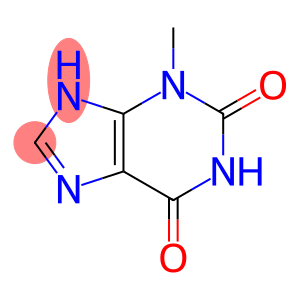
3-Methylxanthine(CAS#1076-22-8)
| Risk Codes | R22 - Harmful if swallowed R26/27/28 - Very toxic by inhalation, in contact with skin and if swallowed. |
| Safety Description | S22 - Do not breathe dust. S24/25 - Avoid contact with skin and eyes. |
| WGK Germany | 1 |
| RTECS | ZD8750000 |
| HS Code | 29335990 |
| Toxicity | LD50 intraperitoneal in mouse: 894mg/kg |
Introduction
3-Methylxanthine is an organic compound that is also known as caffeine. The following is an introduction to the properties, uses, preparation methods and safety information of 3-methylxanthine:Quality:- 3-Methylxanthine is a white crystalline solid that is tasteless or slightly bitter.- It is slightly soluble in water, and the solubility is temperature-dependent.- It is soluble in absolute ethanol and chloroform, but insoluble in non-polar solvents such as ether.- The chemical structure of 3-methylxanthine contains a methyl group and three nitrogen atoms, and it has a certain alkalinity.Use:- 3-Methylxanthine is a widely used stimulant and is often used as a major ingredient in coffee and tea.- It has a refreshing effect, relieves fatigue, increases stamina and concentration.Method:- 3-Methylxanthine is prepared in a variety of ways, the most common being extracted from coffee beans and tea leaves.- Extraction methods include water immersion, solvent extraction, and supercritical CO2 extraction.- In addition to extracting from natural sources, it can also be prepared by chemical synthesis.Safety Information:- 3-Methylxanthine is considered safe at general dosages, but excessive intake may cause some side effects such as insomnia, anxiety, heart palpitations, etc.- For certain populations, such as pregnant women, children, and people with cardiovascular disease, excessive caffeine intake may cause adverse effects.- Long-term high caffeine intake can also lead to addiction and dependence.
Application
3-Methylxanthine (CAS 1076-22-8) is a xanthine derivative and a well-established non‑selective phosphodiesterase (PDE) inhibitor, primarily used as a research tool to elevate intracellular levels of the second messengers cAMP and cGMP. As a key pharmaceutical intermediate, this compound is utilized in the synthesis of the antidiabetic drug linagliptin and serves as a valuable building block for developing other xanthine‑based therapeutic agents. As a major metabolite of both caffeine and theophylline, 3‑methylxanthine is also employed as a reference standard in analytical and pharmacokinetic studies to monitor drug metabolism pathways. Its ability to relax smooth muscle and modulate inflammatory responses makes it of interest in respiratory research for bronchodilation effects, as well as in oncology research for its anti‑proliferative and pro‑apoptotic properties in various cancer cell lines. Additionally, this compound is used in neurobiological and cardiovascular studies to explore cyclic nucleotide signaling pathways, including RNA aptamer research involving the xanthine/guanine base. Xinchem offers custom synthesis, custom chemical synthesis, and contract manufacturing of high‑purity 3‑methylxanthine with flexible scaling from R&D to commercial tons. Contact us for a competitive quote and reliable global supply.