
page_banner

product

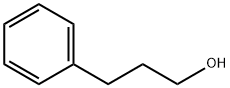
3-Phenyl-1-propanol(CAS#122-97-4)

Chemical Property:

Molecular Formula C9H12O
Molar Mass 136.19
Density 1.001g/mLat 20°C(lit.)
Melting Point −18°C(lit.)
Boling Point 119-121°C12mm Hg(lit.)
Flash Point 229°F
JECFA Number 636
Water Solubility 10.3 g/L (20 ºC)
Solubility 0.1g/l insoluble
Vapor Presure 1.13-25Pa at 20-25℃
Appearance Transparent liquid
Color Clear colorless
BRN 1857542
pKa 15.04±0.10(Predicted)
Storage Condition Sealed in dry,Room Temperature
Refractive Index n20/D 1.526(lit.)
MDL MFCD00002950
Physical and Chemical Properties Colorless viscous liquid. With a sweet floral aroma and sweet fruit flavor, diluted fresh and pleasant fruits. The boiling point is 236 ° C, and the flash point is 109 ° C. Soluble in ethanol, propylene glycol and most non-volatile oils, insoluble in glycerol and mineral oil, very slightly soluble in water (1:300). Natural products are found in strawberry, Suhe fragrant paste, repose fragrant paste, tea, Peru fragrant paste, cinnamon leaf oil, cinnamon oil, etc.
Use Suitable for cholecystitis, cholangitis, cholelithiasis, biliary postoperative syndrome and hypercholesterolemia

Product Detail

Product Tags

3-Phenyl-1-propanol(CAS#122-97-4) Introduction

Phenylpropanol (C6H5CH2OH), also known as 2-phenylethanol, is an organic compound. The following is an introduction to the properties, uses, preparation, and safety information of phenylpropanol:

Properties:
- Appearance: Phenylpropanol is a colorless to slightly yellow liquid.
- Solubility: It can dissolve in water and various organic solvents.

Uses:
- Chemical industry: Phenylpropanol is an important chemical raw material and can be used to prepare other organic compounds such as esters, amines, ethers, and ketones.
- Fragrance: Phenylpropanol has aromatic characteristics and is often used in the production of perfumes and fragrances.

Preparation:
- Through the hydrogenation of styrene: Styrene reacts with hydrogen in the presence of a catalyst to produce phenylpropanol.
- Another common method is the reduction of benzaldehyde to phenylpropanol.

Safety Information:
- Avoid contact with strong oxidizers to prevent fire or explosion.
- Avoid inhalation or skin contact.
- Do not discharge phenylpropanol into water sources or soil to prevent environmental pollution.
  • Previous:
  • Next:

  • Write your message here and send it to us