
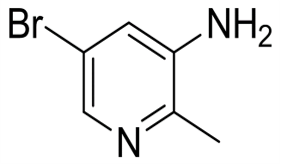
5-Bromo-2-methylpyridin-3-amine(CAS# 914358-73-9)
| Risk Codes | 41 - Risk of serious damage to eyes |
| Safety Description | S26 - In case of contact with eyes, rinse immediately with plenty of water and seek medical advice. S39 - Wear eye / face protection. |
| Hazard Class | IRRITANT |
Introduction
2-Methyl-3-amino-5-bromopyridine is an organic compound. It is a white crystalline solid with a strong odor.
2-Methyl-3-amino-5-bromopyridine has a wide range of applications in many fields. It is often used as an intermediate in pesticides and insecticides, and can be used to synthesize highly effective insecticides, herbicides and fungicides. It can also be used as a reagent or catalyst in organic synthesis reactions.
There are two main methods for preparing 2-methyl-3-amino-5-bromopyridine. One is to react 2-chloro-5-bromopyridine with methylamine to produce 2-methyl-3-amino-5-bromopyridine; The other is to react bromoacetate with carbamate to produce 2-methyl-3-amino-5-bromopyridine.
It is a harmful substance that can have irritating and toxic effects on the human body. Appropriate protective equipment such as gloves, goggles, and protective clothing should be worn when operating. It should be stored in a cool, dry, well-ventilated place, away from fire and combustibles. It should not be mixed with strong oxidants and strong acids to prevent dangerous reactions.
Application
5-Bromo-2-methylpyridin-3-amine (CAS 914358-73-9) is a high-purity, polysubstituted pyridine building block featuring a unique 2-methyl-3-amino-5-bromo substitution pattern. This strategic arrangement imparts distinct electronic and steric properties, making it an invaluable intermediate in pharmaceutical, agrochemical, and materials research.
As a key pharmaceutical intermediate, this compound serves as a versatile scaffold for constructing bioactive molecules, including kinase inhibitors, receptor modulators, and other therapeutic agents. The free 3-amino group allows for direct functionalization, while the 5-bromo handle is a prime site for palladium-catalyzed cross-coupling reactions, such as the Suzuki-Miyaura coupling. This eliminates the need for additional protection/deprotection steps, significantly streamlining the synthesis of novel pyridine derivatives for structure-activity relationship (SAR) studies.
Its physicochemical properties, including a pKa of 4.53 and a topological polar surface area (TPSA) of 38.9 Ų, align well with the chemical space of central nervous system (CNS) drugs. It has been utilized in the synthesis of metanicotine analogs for treating CNS disorders. Furthermore, derivatives synthesized from this compound have demonstrated significant biological activities, including anti-thrombolytic effects and potent antibacterial activity against Escherichia coli. Beyond pharmaceuticals, it is a valuable precursor for functionalized heterocycles, dyes, agrochemicals, and fine chemicals.
Xinchem offers custom synthesis, custom chemical synthesis, and contract manufacturing of this essential building block with flexible scaling from R&D to commercial tons. Contact us for a competitive quote and reliable global supply.