
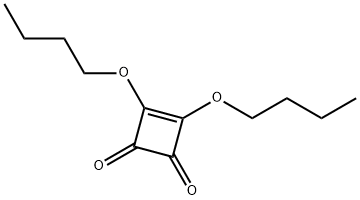
Dibutyl squarate(CAS#2892-62-8)
| Hazard Symbols | Xn – Harmful |
| Risk Codes | R36/37/38 – Irritating to eyes, respiratory system and skin. R42/43 – May cause sensitization by inhalation and skin contact. |
| Safety Description | S26 – In case of contact with eyes, rinse immediately with plenty of water and seek medical advice. S27 – Take off immediately all contaminated clothing. S36/37/39 – Wear suitable protective clothing, gloves and eye/face protection. S45 – In case of accident or if you feel unwell, seek medical advice immediately (show the label whenever possible.) |
| WGK Germany | 3 |
| RTECS | GU1772066 |
| HS Code | 29145090 |
Introduction
3,4-Di-n-butoxy-3-cyclobutene-1,2-dione is an organic compound, commonly abbreviated as DBOD.Properties: DBOD is a solid that appears as white crystals at room temperature. DBOD has low toxicity and is non-flammable. It is a stable compound and is not easily decomposed.Uses: DBOD is commonly used as an intermediate in organic synthesis. It can be used for the synthesis of carbonyl compounds and carbonyl reduction reactions in organic reactions. DBOD can also be used as a raw material for photosensitive dyes and can be applied in fluorescence labeling, dyes, and catalysts.Preparation: The synthesis of DBOD is usually achieved through the synthetic route of the target compound. The specific method depends on the reaction conditions and the required structure. A common synthesis method involves the carbonyl reduction reaction of a carbonyl compound, reacting a 1,2-dione with n-butanol and sodium hydroxide, under appropriate temperature and reaction time to produce DBOD.Safety Information: DBOD has low toxicity but should still be handled with care. During use, avoid contact with skin, eyes, and inhalation of its vapors. If it comes into contact with skin or eyes, rinse immediately with plenty of water. When storing and handling DBOD, avoid sources of ignition and direct sunlight. During use and storage, it should be kept separate from other chemicals to prevent reactions or accidents.