
Hexadecyl vinyl ether (CAS#822-28-6)
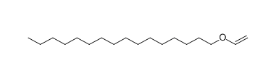
Hexadecyl vinyl ether, also known as cetyl vinyl ether or 1-vinyloxyhexadecane, is a long-chain alkyl vinyl ether featuring a reactive vinyl ether headgroup attached to a C16 saturated hydrocarbon tail. It is supplied as a clear, colorless to pale yellow liquid with a mild odor, essentially insoluble in water but soluble in many organic solvents. The compound has a molecular weight of 268.48 g/mol, a boiling point of 338.8 °C at atmospheric pressure, and a density of approximately 0.82 g/cm³. Its flash point of 45.8 °C places it among combustible liquids that require standard precautions against ignition sources during handling and storage.
The defining structural feature of Hexadecyl vinyl ether is the combination of a highly reactive enol ether functionality with a long, crystallizable hydrophobic tail. The vinyl ether group is electron-rich and participates readily in cationic polymerization, while the C16 chain introduces side-chain crystallization that is absent in short-chain vinyl ethers such as butyl vinyl ether. This structural duality—reactive head, crystallizable tail—is the origin of the compound's distinctive performance in polymer design. The compound is chemically stable under ordinary storage conditions but is moisture-sensitive in the presence of strong acids, which can hydrolyze the vinyl ether linkage.
Applications
The primary application of Hexadecyl vinyl ether is as a reactive monomer for living cationic polymerization and copolymerization. Its long-chain structure enables the synthesis of well-defined amphiphilic block copolymers with exceptionally narrow molecular weight distributions (Mw/Mn often below 1.3, and frequently below 1.1, when initiated by systems such as HI/I₂ or metal halides). Unlike long-chain acrylates, which do not readily undergo living cationic polymerization, Hexadecyl vinyl ether is uniquely suited to precision macromolecular engineering where exact hydrophilic–lipophilic balance and controlled nanostructure formation are required.
In specialty coatings and surface modification, the compound functions as a hydrophobicity-imparting comonomer. Polymers and copolymers incorporating Hexadecyl vinyl ether exhibit enhanced water repellency, flexibility, and low surface energy, making them valuable in outdoor and marine coating systems where moisture resistance is critical. The same hydrophobic character benefits adhesives and sealants, where the long alkyl chain contributes flexibility and durable adhesion on plastics, metals, and glass under humid conditions. In textile treatment, Hexadecyl vinyl ether is used to impart water repellency and stain resistance to outdoor apparel, upholstery, and protective fabrics.
A distinctive emerging application exploits the side-chain crystallization of poly(cetyl vinyl ether), which provides a sharp, defined melting transition (Tm) that is absent in amorphous poly(butyl vinyl ether). This property is the basis for thermo-responsive adhesives, phase-change materials, and temperature-switchable coatings, where a precise thermal switching behavior is the functional requirement. In cosmetic and personal care formulations, the compound's emollient character and film-forming ability contribute to smooth texture, spreadability, and moisture retention in creams, lotions, and hair care products. Hexadecyl vinyl ether also serves as an internal plasticizer and a chemical intermediate for specialty polymers and modified resins where a combination of flexibility, durability, and hydrophobicity is essential.
Preparation Method
The industrial and laboratory synthesis of Hexadecyl vinyl ether follows the general route for alkyl vinyl ethers: the base-catalyzed addition of cetyl alcohol (1-hexadecanol) to acetylene. In this process, cetyl alcohol is reacted with acetylene gas in the presence of a strong base, typically potassium hydroxide or sodium hydroxide, which deprotonates the alcohol to form the alkoxide. The alkoxide then undergoes nucleophilic addition to acetylene, generating the vinyl ether linkage under relatively mild conditions. The reaction is conducted under pressure to maintain an adequate acetylene concentration in the liquid phase, and the product is isolated by distillation. An alternative laboratory approach employs a mercuric acetate–catalyzed transvinylation between cetyl alcohol and a lower vinyl ether (such as iso-octyl vinyl ether); in related transvinylation studies, co-distillation of the liberated alcohol with the product was identified as a factor affecting yield and purity, and process design must account for this behavior. Commercial material is typically purified to ≥95% and supplied under an inert atmosphere to protect the moisture-sensitive vinyl ether group.
Safety Information
Available regulatory and supplier data indicate that Hexadecyl vinyl ether is not classified as a hazardous material for transportation under DOT/IATA criteria, and it is not subject to the hazardous goods documentation required for corrosive or acutely toxic substances. The compound is handled as a combustible liquid with a flash point of 45.8 °C; it should be kept away from heat, sparks, open flames, and hot surfaces, and containers should be grounded and bonded during transfer to prevent static accumulation.
Because the vinyl ether group is susceptible to acid-catalyzed hydrolysis, contact with strong acids and acidic contaminants should be avoided, and the material should be stored in a cool, dry, well-ventilated area in tightly closed containers. Standard industrial hygiene practices are recommended: use local exhaust ventilation where mists or vapors may be generated, wear protective gloves and eye/face protection appropriate to the handling scale, and avoid prolonged or repeated skin contact. In case of eye contact, rinse cautiously with water for several minutes and seek medical attention if irritation persists. Spills should be absorbed with inert material and disposed of in accordance with local regulations; release to drains and watercourses should be avoided. The compound is intended for industrial and research use, and its handling should be restricted to technically qualified personnel.