

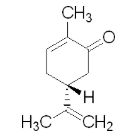
L-Carvone (CAS#6485-40-1)
L-Carvone, also designated (R)-(−)-carvone or *l*-carvone, is a monoterpene ketone and the principal chiral constituent of spearmint essential oil, where it accounts for approximately 65% of the oil. It is the enantiomer of *d*-carvone, the chief aroma compound of caraway and dill seed oils; the two enantiomers share identical physical constants except for the sign of optical rotation, yet they differ dramatically in odor—L-carvone delivers the characteristic sweet spearmint note, while *d*-carvone is perceived as caraway-like.
The compound is supplied as a colorless to pale yellow clear liquid with a boiling point of 227–230 °C, a density of 0.956–0.960 g/mL at 25 °C, and a flash point of 88–93 °C (closed cup). Its optical rotation falls in the range of −57° to −62° (neat), and the FCC specification requires an angular rotation of −57° to −62° with an assay of not less than 97.0%. L-Carvone is insoluble in water and glycerol but miscible with alcohol, ether, chloroform, propylene glycol, and fixed oils. The compound contains a conjugated enone system (an α,β-unsaturated ketone) and an isopropenyl side chain, features that make it a versatile electrophile and a valuable chiral building block.
Applications
The dominant commercial application of L-Carvone is as a flavor and fragrance ingredient that delivers an authentic spearmint character. It is regulated as FEMA 2249, affirmed as GRAS under FDA 21 CFR 182.60, and evaluated by JECFA as having “no safety concern at current levels of intake when used as a flavouring agent”. Reported FEMA use levels span soft drinks (850 mg/kg), frozen dairy (120 mg/kg), candy (180 mg/kg), baked goods (110 mg/kg), and alcoholic beverages (130 mg/kg).
In oral care and confectionery, L-Carvone is the benchmark spearmint flavor for toothpastes, mouthwashes, chewing gum, and breath-freshening products, where its cooling, clean minty profile is preferred over peppermint for a milder sensory experience. In fragrance, it functions as a top-to-heart note in fine fragrance at typical levels of 0.5–2% (up to 5%) and in oral care at 0.1–0.5% (up to 1%), contributing herbal freshness and minty lift to functional and personal care compositions. It is also used in air fresheners, aromatherapy, and alternative medicine products.
Beyond sensory applications, L-Carvone is a versatile chiral pool starting material in asymmetric organic synthesis. It is employed in the preparation of carvomenthol, carvomenthone, dihydrocarvone, carveol, and limonene, and serves as a key precursor for enantiopure natural product targets including sesquiterpenoids and octyne derivatives. The compound reacts with lithium dimethylcuprate to install a methyl group trans to the isopropenyl group with good stereoselectivity, and its enone and isopropenyl functionalities enable a broad range of stereocontrolled transformations. In agricultural and industrial applications, L-Carvone has been used as a mosquito repellent and to prevent premature sprouting of potatoes.
Preparation Method
L-Carvone is obtained commercially by two principal routes: isolation from natural essential oils and chemical synthesis from limonene.
Isolation from spearmint oil exploits the natural abundance of L-carvone in Mentha spicata. The essential oil is subjected to fractional distillation under reduced pressure, and the fraction enriched in L-carvone is further purified to meet FCC and food-grade specifications. This route is preferred for “natural” label claims but is limited by crop availability and cost.
The synthetic route from *d*-limonene is the dominant industrial process for high-volume supply. *d*-Limonene, a byproduct of the citrus industry, is converted to L-carvone through a three-stage sequence: (1) regioselective electrophilic addition of in situ generated nitrosyl chloride to the more electron-rich endocyclic double bond of limonene, forming limonene nitrosochloride; (2) conversion of the nitrosochloride to carvoxime, during which stereochemical inversion occurs; and (3) hydrolysis of carvoxime with oxalic acid to liberate L-carvone. The overall yield of the two final steps has been reported to exceed 80% under optimized orthogonal design conditions. A related laboratory procedure refluxes carvoxime with 10% oxalic acid for one hour to effect the hydrolysis. Alternative synthetic approaches include anodic oxidation of isopinocamphone enol acetate and multi-step sequences involving CuCN-mediated conjugate addition followed by DBU-assisted elimination.
Safety Information
L-Carvone carries a GHS Warning classification with a harmonized hazard profile that includes both physical and health endpoints. The core hazard statements are H227 (Combustible liquid), H302 (Harmful if swallowed), H317 (May cause an allergic skin reaction), and H401 (Toxic to aquatic life). The substance is assigned to Flammable Liquids Category 4, Acute Oral Toxicity Category 4, Skin Sensitization Category 1, and Short-term Aquatic Hazard Category 2. Some regulatory assessments classify skin sensitization as Category 1B. Vapors are heavier than air and may spread along floors; explosive mixtures with air may form upon intense heating.
Acute toxicity data indicate a favorable systemic profile at intended use levels. Oral LD₅₀ values exceed 2,000–5,000 mg/kg in rats, and dermal LD₅₀ values exceed 2,000 mg/kg, with no mortality, clinical signs, or necropsy abnormalities in acute dermal studies at 2,000 mg/kg. L-Carvone is not classified as a skin or eye irritant in animal and human studies, although it is recognized as a mild skin sensitizer in sensitized individuals. The JECFA evaluation concluded that L-Carvone and *d*-carvone present no safety concern at current levels of intake when used as flavouring agents.
The principal occupational hazard is skin sensitization and flammability. For safe handling, keep away from heat, sparks, open flames, and hot surfaces (P210). Avoid breathing mist or vapors (P261), and wear protective gloves, eye protection, and face protection (P280). Wash skin thoroughly after handling (P264), and do not eat, drink, or smoke when using the product (P270). Contaminated work clothing should not be allowed out of the workplace (P272). Avoid release to the environment (P273). In case of skin contact, wash with plenty of water; if skin irritation or a rash occurs, seek medical advice (P302+P352, P333+P313). If swallowed and feeling unwell, call a poison center or physician and rinse mouth (P301+P312+P330). In case of fire, use dry sand, dry chemical, or carbon dioxide; water spray may be ineffective or may spread the fire (P370+P378). Store in a cool, dry place in tightly sealed containers, protected from heat and light, with a recommended shelf life of 24 months under proper storage conditions.
