
L-Phenylalanine-4-(borono-10B)-(CAS#80994-59-8)
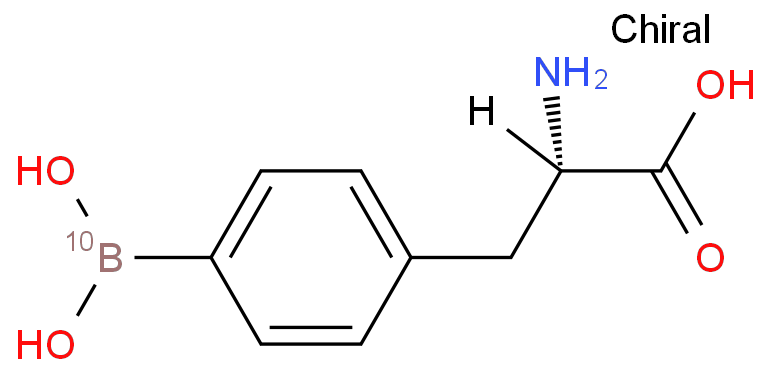
L-Phenylalanine-4-(borono-10B) is a boron-10-enriched non-natural amino acid, chemically designated as 4-borono-L-phenylalanine (L-BPA), in which a boronic acid group (-¹⁰B(OH)₂) is attached to the 4-position of the phenylalanine aromatic ring. It is supplied as a white to off-white solid with the molecular formula C₉H₁₂BNO₄ and a molecular weight of 208.21 g/mol; the ¹⁰B isotopic enrichment can reach 98% or higher. Its aqueous solubility is limited (approximately 0.5 mg/mL), and its solubility in DMSO is approximately 0.2 mg/mL, so sonication is usually required when preparing solutions. The molecule combines the zwitterionic character of an amino acid with the Lewis acidity of a boronic acid, enabling reversible formation of cyclic boronate esters with diols and hydroxy acids. This reactivity is the chemical basis for its use as an enzyme inhibitor and targeted delivery vector. Storage conditions are critical for maintaining isotopic enrichment and chemical purity: the powder should be kept sealed, protected from light, and stored at -20 °C, where it can remain stable for up to 3 years; solutions are recommended to be stored at -80 °C to minimize degradation.
Applications
The core application of L-Phenylalanine-4-(borono-10B) is as a boron delivery agent for Boron Neutron Capture Therapy (BNCT), and it has been approved in Japan as a boron-10 agent for the treatment of unresectable locally advanced or recurrent head and neck cancer. BNCT is a binary targeted radiotherapy: the amino acid structure of L-BPA is recognized by L-type amino acid transporter 1 (LAT1), which is highly expressed on tumor cells, enabling active uptake and selective accumulation of boron-10 within tumor cells. Subsequent irradiation with low-energy thermal neutrons causes the ¹⁰B nucleus to capture a neutron and undergo fission, releasing high-linear energy transfer alpha particles and lithium-7 ions. These particles have a path length of only 4–9 µm (approximately one cell diameter), allowing precise destruction of tumor cell DNA while maximally sparing surrounding normal tissue. L-BPA also shows clinically relevant tumor-to-normal tissue uptake ratios (T:N ≈ 3:1) for glioblastoma and melanoma, meeting the basic threshold for effective BNCT.
Beyond BNCT, this compound has extended value as a boronated amino acid building block in drug discovery. The boronic acid group can act as a reversible covalent "warhead" that forms stable tetrahedral boronate adducts with threonine or serine residues in protease active sites, a mechanism successfully exploited in proteasome inhibitors such as bortezomib and ixazomib. The amino acid scaffold of L-BPA can also be used in the design of PROTACs (proteolysis-targeting chimeras) or targeted covalent inhibitors, where its carboxyl and amino groups enable amide coupling to introduce boronic acid warheads or ¹⁰B reporter groups into chimeric molecules, achieving boron isotope labeling and functional modulation of specific E3 ligases or target proteins.
Preparation Method
The synthesis of L-Phenylalanine-4-(borono-10B) faces the central challenge of maintaining L-configuration optical purity and ¹⁰B isotopic abundance. One reported process starts from an amino-protected (S)-4-halophenylalanine and, in the presence of bis(2-dimethylaminoethyl) ether as a ligand, sequentially reacts with a boronating reagent and a Grignard reagent to form an amino-protected (S)-4-borono-L-phenylalanine intermediate. The amino protecting group (such as Boc or Trt) is then removed to afford L-BPA. The advantage of this strategy is that it avoids cumbersome purification steps and facilitates obtaining a product with high chemical purity, high optical purity, and high isotopic purity simultaneously.
Another widely used route is based on palladium-catalyzed cross-coupling: L-4-iodophenylalanine is directly coupled with pinacolborane under metal catalysis to introduce the boronate ester group onto the aromatic ring. This method is efficient, gives good product purity, and readily allows conversion of the pinacol ester to the free boronic acid by transesterification or hydrolysis. At the industrial level, to overcome the limitations of traditional methods, such as high cost, long cycle times, and toxic reagents, processes using high-energy ultrasound combined with auxiliary chemical stripping at ambient temperature and pressure have also been reported to improve process economics and scalability.
Safety Information
Hazard classification data for the free base form of L-Phenylalanine-4-(borono-10B) are limited, but safety data for its hydrochloride salt form indicate moderate health hazards, with GHS hazard statements including H302 (Harmful if swallowed), H315 (Causes skin irritation), H319 (Causes serious eye irritation), and H335 (May cause respiratory irritation). Some safety data sheets describe the substance as "Toxic," indicating that prudent protective measures are required in research and handling environments for active pharmaceutical ingredients. When used as a BNCT active pharmaceutical ingredient, its clinical use must be conducted within a strict medical regulatory framework; handling in non-clinical settings is primarily for research and development purposes.
For handling protection, it is recommended to wear protective gloves, protective clothing, and eye/face protection (corresponding to P280), avoid inhalation of dust or aerosols, and perform weighing and dissolution operations in a well-ventilated area. Because the substance is typically supplied in ¹⁰B-enriched form, contact with strong oxidizers should be avoided during handling, and waste should be disposed of in compliance with established practices for isotopically labeled compounds. During storage, containers should be kept tightly closed, and the powder should be stored at -20 °C and solutions at -80 °C, protected from light, to maintain isotopic abundance and chemical stability.