
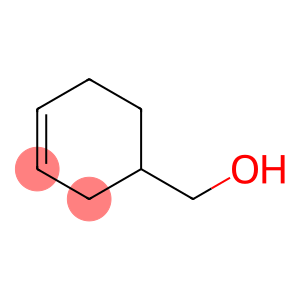
1,2,3,6-tetrahydrobenzylalcohol(CAS#1679-51-2)
| Safety Description | S23 - Do not breathe vapour. S24/25 - Avoid contact with skin and eyes. |
| WGK Germany | 3 |
| HS Code | 29061990 |
Introduction
3-Cyclohexen-1-carbinol is an organic compound. The following is an introduction to its properties, uses, manufacturing methods and safety information:Quality:- Appearance: 3-cyclohexen-1-carbinol is a colorless to pale yellow liquid.- Solubility: It is soluble in a variety of organic solvents such as ethanol, acetone, and dimethyl sulfoxide.- Odor: has a special aromatic odor.- Stability: It is relatively stable to air and light, but reacts when exposed to acidic or alkaline conditions.Use:- 3-Cyclohexen-1-carbinol is mainly used as a reactant in organic synthesis and can be used to synthesize chemicals and functional compounds.- Its aromatic properties, it can also be used as a solvent and degreasing agent.Method:- 3-Cyclohexen-1-carbinol can be obtained by the carbazolation of cyclohexene. The specific steps include the reaction of cyclohexene with iodine and nitrosohydrogen acid to form 4-cyclohexyl-1,2,3-pentantrione sulfoxide, which is then refluxed with pyridine salt dimethyliodate to obtain 3-cyclohexen-1-methanol.Safety Information:- 3-Cyclohexen-1-carbinol generally does not pose a direct health hazard when used and stored properly. It is still an organic solvent and care should be taken to prevent inhalation and contact with the skin to avoid causing irritation or allergic reactions.- Wear appropriate protective gloves, glasses, and respiratory protective gear during use.- During storage, it should be stored in an airtight container, away from ignition and oxidants.
Application
1,2,3,6-Tetrahydrobenzyl alcohol (3-Cyclohexene-1-methanol) is a versatile cycloaliphatic primary alcohol used across multiple industries. As a reactive intermediate, it is critical for producing specialty polymers, serving as a monomer in atom transfer radical polymerization (ATRP) to create epoxy end-functionalized polystyrene and as a building block for photo-cross-linkable polymers with redissolution properties for coatings and advanced adhesives. In materials science, it is a key precursor for synthesizing epoxy resins and unsaturated polyester resins (UPR). In organic synthesis, its alkene and primary alcohol groups enable oxidation, esterification, and polymerization for fine chemicals. The compound also functions as a specialty fragrance material, where its esters provide powerful floral, woody, and fruity notes for perfumery. Research also indicates potential pharmaceutical applications, including studies on its biological activity against certain cancer cell lines. Xinchem offers custom synthesis and contract manufacturing of this high-purity intermediate with flexible scaling from R&D to commercial tons. Contact us for a competitive quote.