
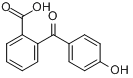
2-(4-Hydroxybenzoyl)benzoic acid (CAS#85-57-4)
2-(4-Hydroxybenzoyl)benzoic acid, also abbreviated as HBBA, is an aromatic organic compound featuring a benzophenone core with a carboxylic acid group on one benzene ring and a hydroxyl group at the para position of the other. It is supplied as a white to off-white crystalline solid or powder with a melting point of approximately 213 °C and a predicted boiling point of 512.6 °C at 760 mmHg. The compound is sparingly soluble in water but dissolves in common organic solvents including ethanol, methanol, acetone, and dimethyl sulfoxide.
The presence of both a carboxylic acid (pKa ≈ 3.35) and a phenolic hydroxyl group makes the molecule a versatile synthetic handle for a wide range of chemical transformations, including esterification, amidation, and etherification. Its benzophenone chromophore also confers the ability to absorb ultraviolet radiation, which underpins its use in UV-protective applications.
Applications
The primary application of 2-(4-Hydroxybenzoyl)benzoic acid is as a pharmaceutical intermediate and activated ester building block. It has been employed in the clinical development of anti-inflammatory agents, antibiotics, and anticancer compounds. The compound facilitates selective transformations in organic synthesis pathways, enabling the construction of complex drug-like architectures through its dual functional groups. Its role as an activated ester is particularly valued in medicinal chemistry, where it serves as a precursor for the synthesis of diverse bioactive molecules.
Beyond pharmaceuticals, the compound functions as a key intermediate in the production of UV-absorbing polymers and sunscreen agents. Its benzophenone structure efficiently absorbs harmful UV radiation, making it valuable in the formulation of photoprotective materials, coatings, and polymer stabilizers. The compound is also used as an intermediate for dyes, agrochemicals, and other fine chemicals, where its bifunctional reactivity allows for tailored derivatization.
Preparation Method
A classical route to 2-(4-Hydroxybenzoyl)benzoic acid involves the decomposition of phenolphthalein oxime with dilute sulfuric acid, a method first reported in the chemical literature. More generally, the compound is accessible through Friedel-Crafts acylation strategies. One approach employs 4-hydroxybenzophenone or related precursors under acidic catalytic conditions. Industrially, multi-step routes starting from benzene derivatives are used, with aluminum chloride as a Lewis acid catalyst under controlled temperature and inert atmosphere to ensure product purity and yield.
Another described preparation involves the esterification of a hydroxybenzoic acid derivative followed by reaction with benzoic anhydride under acidic conditions to construct the benzophenone framework. The choice of route depends on the availability of starting materials and the required purity for the intended application, with Friedel-Crafts based processes remaining the most widely practiced for producing material at commercial scale.
Safety Information
2-(4-Hydroxybenzoyl)benzoic acid carries a GHS07 classification with the signal word Warning. The harmonized hazard statements include H302 (Harmful if swallowed) and H319 (Causes serious eye irritation) . Some safety data sheets additionally list H315 (Causes skin irritation) and H335 (May cause respiratory irritation) . The compound is not classified as a carcinogen by IARC or the U.S. EPA, and it is not regulated as a hazardous material for transport.
For safe handling, avoid generating or inhaling dust, and use local exhaust ventilation where dust may be produced. Personal protective equipment including safety goggles or a face shield, protective gloves, and protective clothing should be worn. In case of eye contact, rinse cautiously with water for several minutes and remove contact lenses if present and easy to do so; continue rinsing. If swallowed, rinse mouth and seek medical attention if symptoms occur. Store in a cool, dry, well-ventilated area in tightly closed containers, protected from moisture and away from strong oxidizing agents. The compound should be kept under an inert atmosphere at room temperature to maintain stability.