
7-Diethylamino-4-methylcoumarin (CAS#91-44-1)
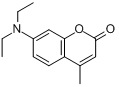
7-Diethylamino-4-methylcoumarin, commonly known as Coumarin 1 or Coumarin 460, is a 7-aminocoumarin derivative with a diethylamino donor group at the 7-position and a methyl substituent at the 4-position of the coumarin core. It is a bichromophoric fluorescent dye that exhibits bright blue-white fluorescence in very dilute solutions, with maximum absorption around 440 nm and emission maxima ranging from approximately 460 nm to 567 nm depending on the solvent environment. The compound is supplied as a light tan to pale yellow powder or grains and is soluble in organic solvents such as methanol, acetone, and ether, but insoluble in water. Its high fluorescence quantum yield and photostability make it a benchmark laser dye in the blue-green spectral region.
Applications
The primary and most distinctive application of 7-Diethylamino-4-methylcoumarin is as a laser dye. It serves as an ideal laser medium for green lasers due to its high quantum yield and stability, and is widely employed in tunable dye lasers for spectroscopy, isotope separation, and directed synthesis research. In photonics, it functions as a luminescent phosphor in LEDs and a fluorescent dopant in optical materials.
In the life sciences and analytical chemistry, the compound is used as a fluorescent marker and probe. It enables cell labeling and imaging in cell biology and molecular biology research, and is used in fluorescence microscopy, flow cytometry, and bioimaging applications to visualize cellular structures and processes with high sensitivity. It also serves as a molecular probe in ELISA, PCR, and immunofluorescence detection, and as an optical sensor for detecting ions, metal ions, and organic molecules in environmental monitoring.
Preparation Method
The industrial and laboratory synthesis of 7-Diethylamino-4-methylcoumarin is based on the Pechmann condensation. 3-Diethylaminophenol is reacted with ethyl acetoacetate in the presence of a Lewis acid catalyst, typically zinc chloride, often in combination with a co-catalyst such as stannous chloride or titanium tetrachloride, under heating to effect cyclizative condensation. Upon completion, the reaction mixture is washed with acid and the crude product is isolated, then purified by recrystallization to achieve the purity required for laser-grade material. Optimized catalytic systems have been developed to shorten reaction times, improve yield and purity, and reduce wastewater generation compared to earlier processes.
Safety Information
Safety classifications for 7-Diethylamino-4-methylcoumarin vary across suppliers. A common harmonized classification assigns H302 (Harmful if swallowed) and H411 (Toxic to aquatic life with long lasting effects) with the signal word Warning. Some suppliers also include H319 (Serious eye irritation), while certain safety data sheets note skin and eye irritation categories and inhalation toxicity under dust-generating conditions. Other assessments conclude that available data do not meet classification criteria for health hazards under the given concentration. The material may form combustible dust concentrations in air, and fine dust dispersed in air can form an explosive mixture.
For safe handling, avoid generating or inhaling dust, and use local exhaust ventilation where dust may be produced. Personal protective equipment including safety goggles, protective gloves, and suitable respiratory protection for dust should be worn. Store in a cool, dark, dry, well-ventilated area with containers kept tightly closed, away from ignition sources and incompatible oxidizing materials. In case of eye contact, rinse with plenty of water for at least 15 minutes; for skin contact, wash with soap and water. If inhaled, move to fresh air. Ingestion should be followed by rinsing the mouth and seeking medical attention if symptoms occur. Release to the aquatic environment should be avoided in accordance with H411 precautionary statements.