

Methyl Cellosolve (CAS#109-86-4)
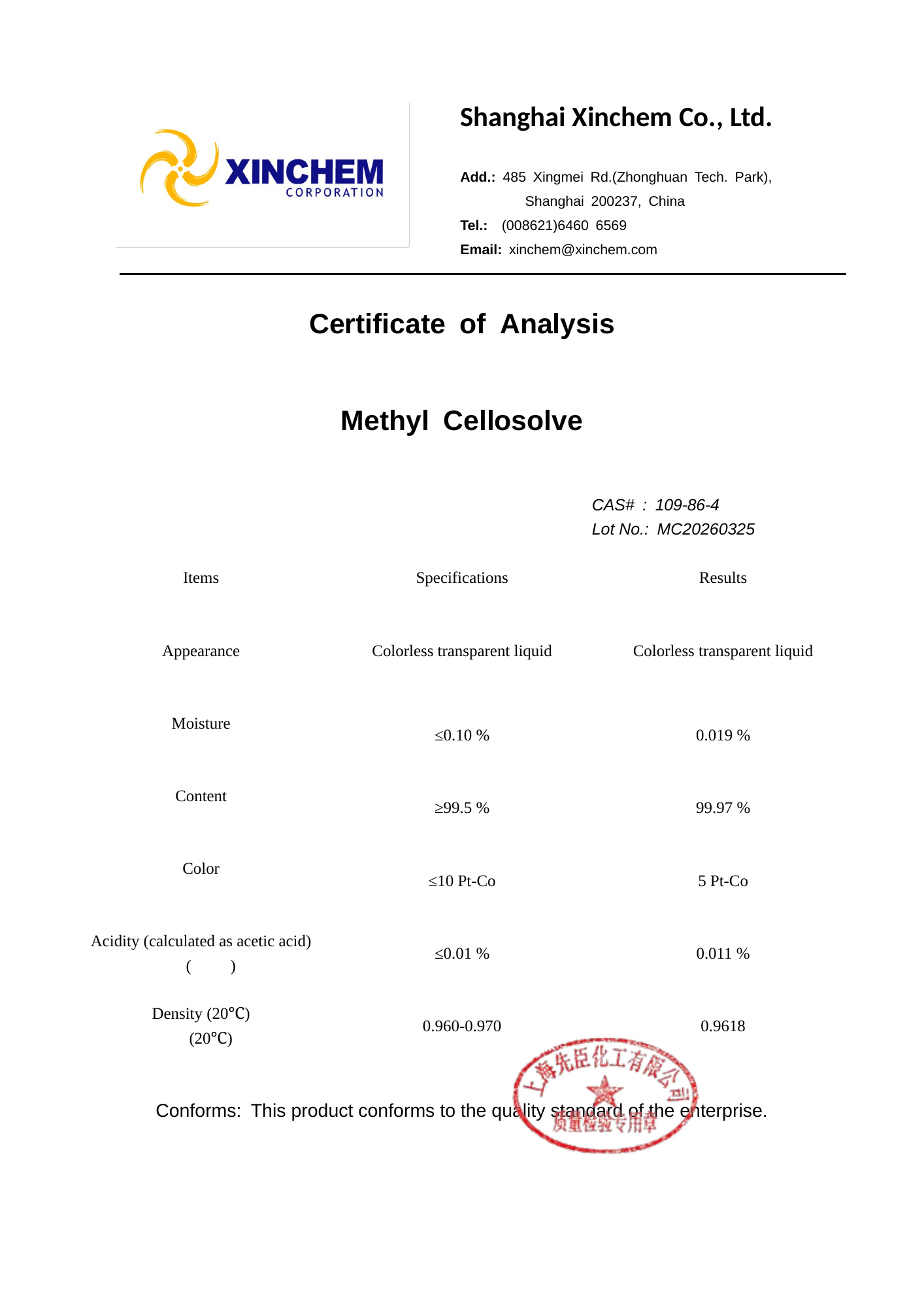
Methyl Cellosolve, chemically designated as 2-methoxyethanol or ethylene glycol monomethyl ether, is a clear, colorless liquid with a mild, ether-like odor. It is a flammable, volatile, and hygroscopic compound. With a boiling point of 124–125 °C and a flash point of 38–40 °C, it serves as a medium-volatility solvent that balances evaporation rate and solvency power. The compound exhibits a specific gravity of 0.966 at 20 °C and a vapor pressure of 6.17 mmHg at 20 °C. Its unique amphiphilic nature, possessing both a hydrophilic hydroxyl group and a lipophilic ether group, allows it to be fully miscible with water and a wide range of organic solvents.
Applications
Methyl Cellosolve is a versatile industrial solvent with broad applications across multiple sectors. In the coatings industry, it is primarily used as a solvent for nitrocellulose, synthetic resins, alcohol-soluble dyes, and ethyl cellulose, and serves as a quick-drying agent for varnishes and a coating diluent. The printing and dyeing sector utilizes it as a penetrating agent and leveling agent, as well as a solvent in printing inks. In the formulation of paints, varnishes, dyes, inks, and resins, its excellent solvency property makes it a valuable component, helping to create stable dispersions without splitting or fading. Additionally, it serves as a de-icing additive for jet fuel and is used in the production of specialized textiles and adhesives, where it aids in solubilizing tough resins to achieve the right cure speed and bond strength.
Preparation Method
Methyl Cellosolve is commercially manufactured through the reaction of methanol with ethylene oxide. The industrial production is dominated by the base-catalyzed addition of methanol to ethylene oxide. The synthesis proceeds via a nucleophilic ring-opening of the ethylene oxide molecule. A basic catalyst (e.g., sodium methoxide) deprotonates methanol to form the highly nucleophilic methoxide ion, which attacks one of the carbon atoms of the ethylene oxide ring, causing the strained three-membered ring to open. The resulting alkoxide intermediate is protonated by a methanol molecule, regenerating the catalyst and yielding 2-methoxyethanol. Controlling the molar ratio of methanol to ethylene oxide is critical to maximize the yield of the desired mono-ether product, as the newly formed hydroxyl group can further react with ethylene oxide to form higher-order glycol ethers.
Safety Information
Methyl Cellosolve is classified as a flammable liquid (Category 3, H226) and presents significant health hazards. It is toxic to reproduction (Category 1B, H360), and harmful if swallowed (H302), in contact with skin (H312), or if inhaled (H332). The substance may damage fertility or the unborn child, and is recognized as a reproductive toxicant with potential teratogenic effects. It also causes specific target organ toxicity following single exposure (Category 1, H370), affecting the hematopoietic system, lymphatic system, and central nervous system. Symptoms of exposure include irritation of eyes, nose, and throat; headache, drowsiness, lassitude, ataxia, tremor, and anemic pallor.
For safe handling, adequate ventilation and personal protective equipment are essential. Storage should be maintained in a cool, dry, well-ventilated area away from ignition sources and strong oxidizers. Containers must be kept tightly closed and stored away from food and feedstuffs.