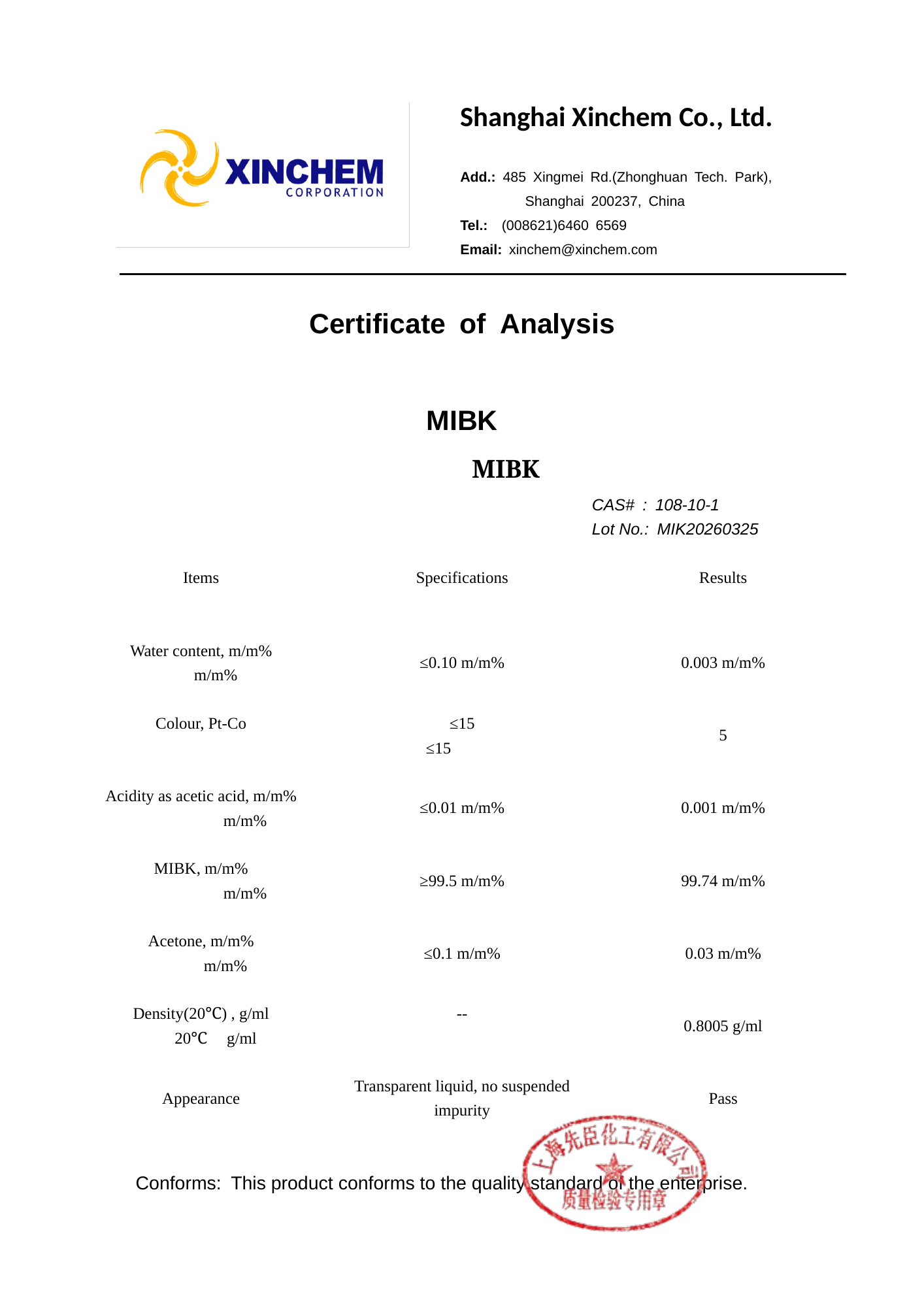


MIBK (CAS#108-10-1)
Chemical Properties
MIBK, chemically designated as 4-methyl-2-pentanone or methyl isobutyl ketone, is a clear, colorless liquid with a pleasant, sweet odor reminiscent of acetone. It is a medium-evaporating solvent with a flash point of 14–16 °C and a boiling point of 116–118 °C. The substance exhibits a specific gravity of 0.8017 at 20 °C and a vapor pressure of 15–16 mmHg at 20 °C. Its solubility in water is approximately 17–19 g/L at 20 °C, and it is miscible with alcohols, most hydrocarbons, and other organic liquids. The compound has a molecular weight of 100.16 g/mol and a log Pow of 1.38. Vapors are heavier than air (relative vapor density of 3.45) and may form explosive mixtures with air. MIBK can react violently with oxidizing agents such as peroxides, nitrates, and perchlorates, and may form explosive peroxides upon prolonged exposure to air.
Applications
MIBK is a versatile medium-evaporating solvent with broad applications across multiple sectors. In the coatings and paint industry, it serves as an active solvent for many synthetic resins including cellulosics, vinyl copolymers, acrylics, alkyds, polyesters, and epoxies. It is widely used in automotive OEM coatings, architectural coatings, wood coatings, marine coatings, and furniture finishes. In the printing sector, it is used as a solvent in gravure printing inks, flexographic inks, and commercial printing ink formulations.
In the pharmaceutical and agrochemical industries, MIBK is employed as a process solvent and extraction solvent for antibiotics, germicides, and fungicides, as well as in fine chemistry applications. A major industrial use is as a precursor to N-(1,3-dimethylbutyl)-N'-phenyl-p-phenylene diamine (6PPD), an antiozonant used in tire manufacturing, prepared by reductive coupling of MIBK with 4-aminodiphenylamine. MIBK is also used as a denaturing agent for denatured alcohol, a developer for PMMA electron beam lithography resist, and an extraction solvent for gold, silver, and other precious metals from cyanide solutions. Additional applications include use in dry-cleaning preparations, electroplating solutions, and as a chemical intermediate in the synthesis of methyl isobutyl carbinol.
Preparation Method
MIBK is commercially manufactured from acetone through a three-step process. In the first step, acetone undergoes an aldol condensation reaction to form diacetone alcohol. This is followed by dehydration of diacetone alcohol to produce mesityl oxide. In the final step, mesityl oxide is hydrogenated to yield MIBK. The process typically employs a one-pot synthesis approach with acid catalysts for the condensation and dehydration steps, and a hydrogenation catalyst such as copper or nickel for the final reduction step. The commercial product typically has a purity of ≥99.5% and may contain trace impurities including dimethyl heptane, water, methyl isobutyl carbinol, mesityl oxide, and acidity as acetic acid.
Safety Information
MIBK is classified as a highly flammable liquid and vapor (Category 2, H225). It causes serious eye irritation (Category 2A, H319) and may cause drowsiness or dizziness (Specific Target Organ Toxicity, Single Exposure, Category 3, H336). The substance is suspected of causing cancer (Category 2, H351) and is classified as possibly carcinogenic to humans (IARC Group 2B) and as an A3 confirmed animal carcinogen. Repeated exposure may cause skin dryness or cracking (EUH066). The substance may be absorbed through the skin, contributing significantly to total exposure in occupational settings.
For safe handling, it is essential to keep the substance away from heat, sparks, open flames, and hot surfaces. No smoking is permitted in areas where the material is stored or handled. Containers must be kept tightly closed, and grounding and bonding procedures should be followed during transfer operations. Explosion-proof electrical, ventilating, and lighting equipment must be used in all areas where the substance is present. Personal protective equipment including eye protection, protective clothing, and protective gloves is required. Inhalation of vapors should be avoided, and the material should only be used outdoors or in a well-ventilated area. In case of fire, powder extinguishing agent, AFFF (aqueous film-forming foam), foam, or carbon dioxide should be used. Storage should be maintained in a cool, well-ventilated, fireproof area separated from strong oxidants and strong reducing agents. The occupational exposure limit is set at 50 ppm as TWA and 75 ppm as STEL (OSHA PEL-TWA: 100 ppm; NIOSH REL-TWA: 50 ppm).