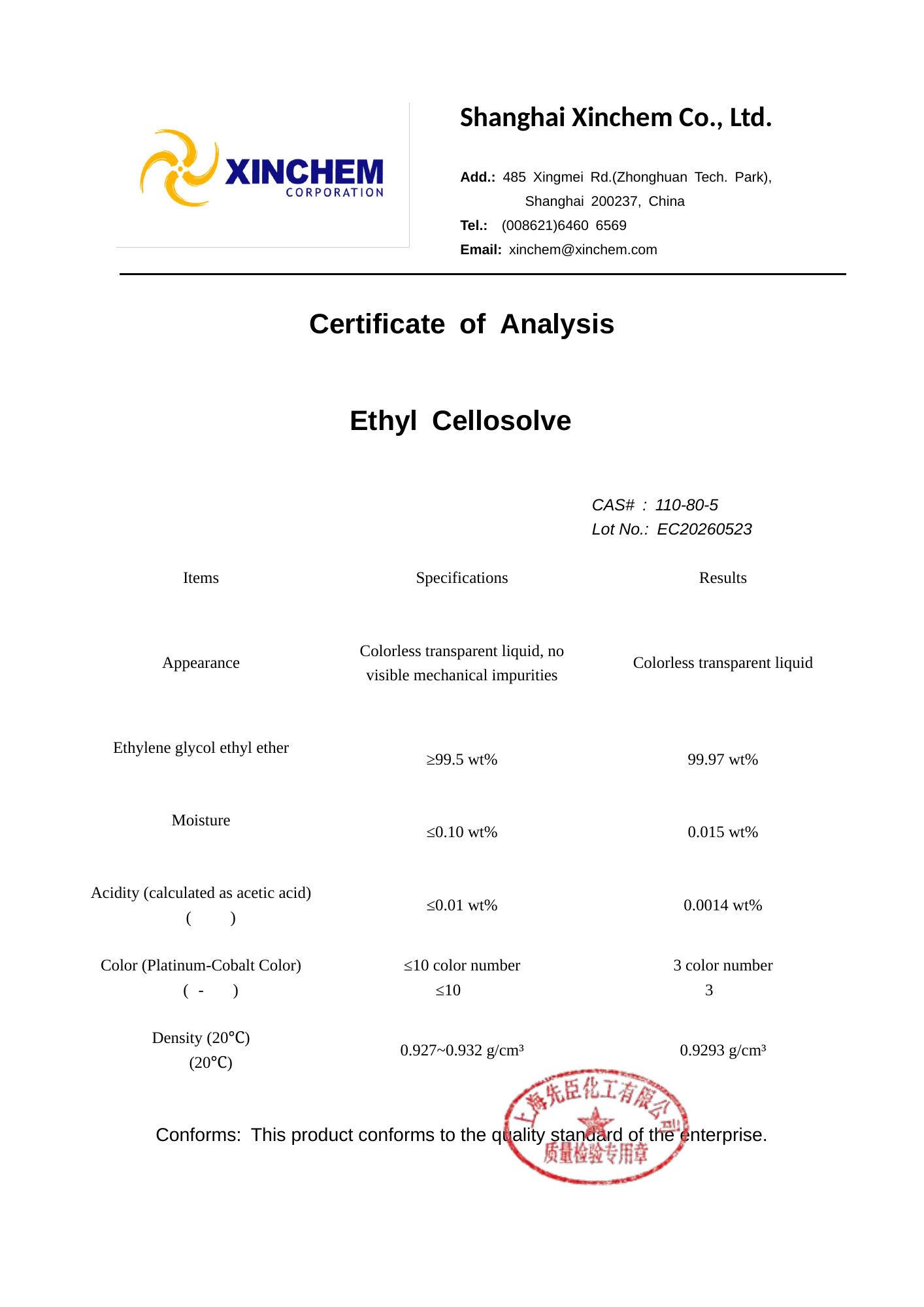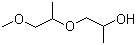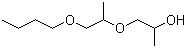


Ethyl Cellosolve (CAS#110-80-5)
Ethyl Cellosolve, chemically designated as 2-ethoxyethanol or ethylene glycol monoethyl ether, is a colorless, nearly odorless liquid with a mild, pleasant ether-like scent. It is fully miscible with water and common organic solvents including ethanol, diethyl ether, acetone, and ethyl acetate. With a boiling point of 135 °C and a flash point of 44 °C, it serves as a medium-volatility solvent that balances evaporation rate and solvency power. The compound exhibits a specific gravity of 0.931 at 20 °C and a vapor pressure of 4 mmHg at 20 °C.
Applications
Ethyl Cellosolve is a versatile industrial solvent with broad applications across multiple sectors. In the coatings industry, it is widely used as a solvent for nitrocellulose, cellulose acetate, synthetic resins, and lacquers, and serves as a diluent in spray paints and water-based coating formulations. The printing and packaging sector utilizes it as a solvent in flexographic and gravure inks, as well as in the preparation of sustained-release film coatings for pharmaceutical tablets and micro-particles.
In the leather industry, it functions as a dyeing agent, emulsion stabilizer, and finishing agent. The electronics and polymer fields employ it to facilitate polymer reactions and manipulate polymer chains, ensuring uniform application and smooth finishes. Additionally, it serves as a de-icing additive in aviation fuel, a component of hydraulic fluids, and a key ingredient in varnish removers and degreasing solutions.
Preparation Method
Ethyl Cellosolve is commercially manufactured through the reaction of ethylene oxide with anhydrous ethanol. In a typical process, ethylene oxide is gradually introduced into anhydrous ethanol at 25–30 °C, after which the temperature rises to approximately 70 °C to complete the reaction. The crude product is neutralized with a 10% sodium hydroxide solution to pH 8, followed by fractional distillation to recover excess ethanol and obtain the purified product, with the final fraction collected at 133.5–135.5 °C. Modern production may employ catalytic distillation using molecular sieve catalysts for enhanced efficiency.
Safety Information
Ethyl Cellosolve is classified as a flammable liquid (Category 3, H226) and presents significant health hazards. It is toxic if inhaled (H331) and harmful if swallowed (H302). The substance may damage fertility or the unborn child (H360FD), and is recognized as a reproductive toxicant with potential to cause specific skeletal defects. It also causes serious eye irritation (H319) and may cause damage to the central nervous system, blood system, kidneys, and liver through prolonged or repeated exposure.
For safe handling, adequate ventilation and personal protective equipment are essential. Storage should be maintained in a cool, dry, well-ventilated area away from ignition sources and oxidizing agents.