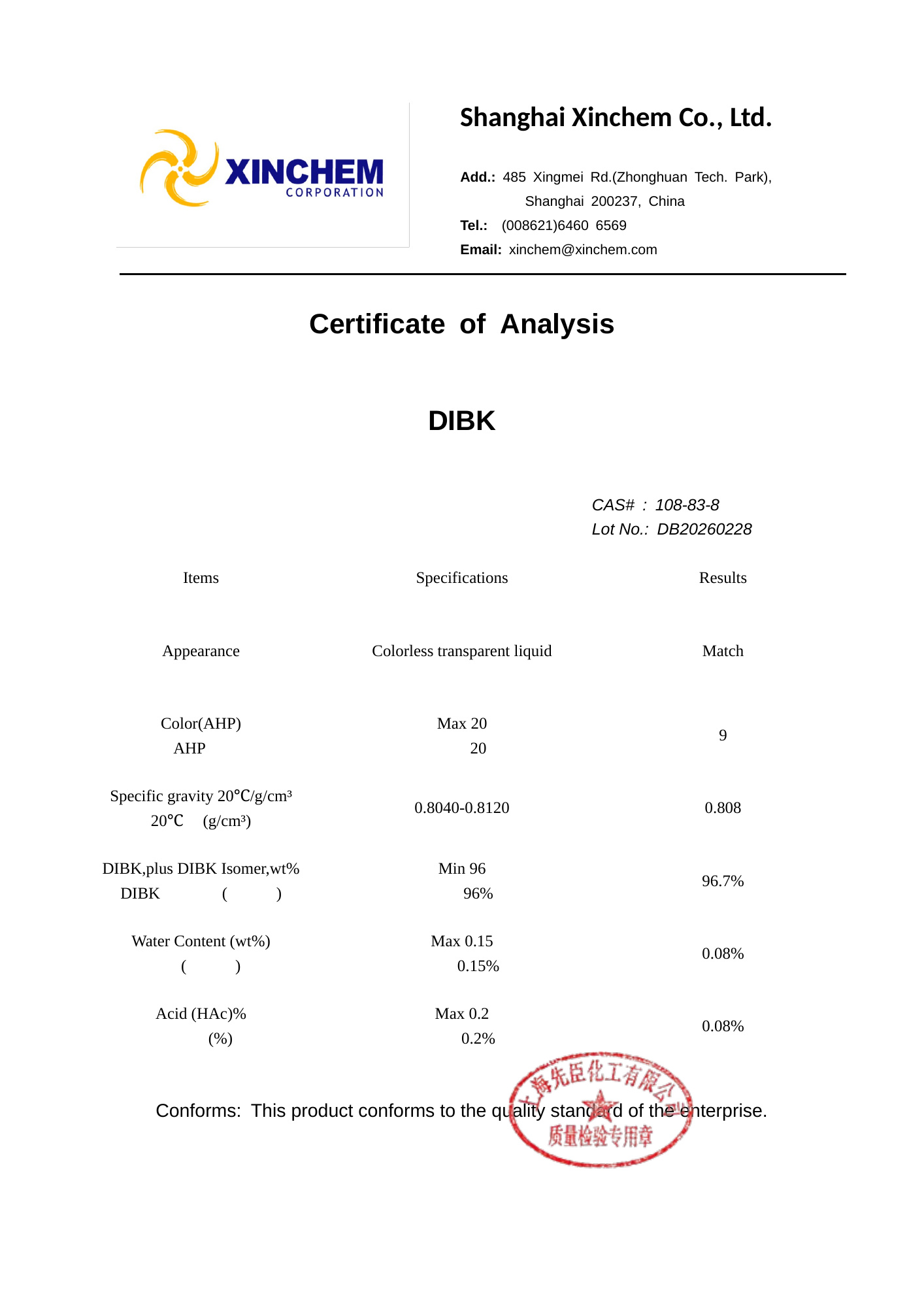


DIBK (CAS#108-83-8)
Chemical Properties
DIBK, chemically designated as 2,6-dimethyl-4-heptanone or diisobutyl ketone, is a clear, colorless liquid with a mild, sweet odor. It is a slow-evaporating, combustible liquid with a flash point of 49 °C and a boiling point of 163–168 °C at atmospheric pressure. The substance exhibits a specific gravity of 0.81 at 20 °C and a vapor pressure of 2 mmHg at 20 °C. Its solubility in water is only 0.05%, but it is soluble in most common organic solvents including alcohols, ketones, ethers, and aromatic hydrocarbons. The compound has a molecular weight of 142.24 g/mol and a log Pow of 2.56, indicating a low potential for bioaccumulation. DIBK is classified as a Class II combustible liquid (flash point at or above 100 °F and below 140 °F) and forms explosive vapor/air mixtures above 49 °C, with explosive limits of 0.8%–7.1% by volume in air. It has been assessed as a non-HAP (Hazardous Air Pollutant) solvent and is not listed under SARA Title III Section 313, and it is readily biodegradable.
Applications
DIBK is a versatile slow-evaporating solvent with broad applications across multiple sectors. Its primary application is in the coatings and paint industry, where it serves as an active solvent for many synthetic resins including nitrocellulose, rosin esters, phenolics, hydrocarbons, alkyds, polyesters, and acrylics. It is widely used in automotive OEM coatings, automotive refinish, general industrial coatings, and architectural paints. DIBK is particularly valued as a retarder solvent to improve flow and minimize humidity blushing in high-solids coatings, enabling formulators to develop low-VOC and excellent flow and leveling properties.
In the printing sector, DIBK is used as a solvent in commercial printing inks, providing excellent flow and leveling properties. The substance is also employed as a solvent for leather finishing products and as a process solvent in various chemical manufacturing operations. Additional applications include use as a solvent for inks and stains, a component in rubber formulations, and an intermediate in the synthesis of pharmaceuticals.
Preparation Method
DIBK is commercially produced primarily as a heavy-end byproduct from the manufacturing process of methyl isobutyl ketone (MIBK) via the condensation reaction of acetone. In this process, acetone undergoes acid-catalyzed aldol condensation to form diacetone alcohol, which is then dehydrated to mesityl oxide and subsequently hydrogenated to yield MIBK. DIBK is formed as a co-product through further condensation and hydrogenation reactions of the intermediates. However, the conversion and selectivity for DIBK in this process are generally low, and the product is isolated and purified by fractional distillation.
A more recent industrial process employs triacetonediol (TDA) as a feedstock in combination with a bifunctional catalyst capable of effecting both dehydration and hydrogenation reactions, which improves the yield and selectivity for DIBK. Laboratory-scale synthesis can also be achieved through the metal-catalyzed ketonization of isovaleric acid using metal oxide catalysts such as manganese dioxide at elevated temperatures in a tube furnace. The commercial product typically has a purity of ≥99.0% (GC).
Safety Information
DIBK is classified as a flammable liquid (Category 3, H226) with a flash point of 49 °C. It is a respiratory irritant (Specific Target Organ Toxicity, Single Exposure, Category 3, H335) and causes eye, nose, and throat irritation. The substance may cause headache, dizziness, drowsiness, and dermatitis, and prolonged exposure has been associated with liver and kidney damage in animal studies. DIBK has a uniformly low acute toxicity by all routes of exposure, with an oral LD50 of 5.8 g/kg in rats and a percutaneous LD50 of greater than 20 mL/kg in rabbits. The substance is not corrosive, not sensitizing, and has shown negative results in bacterial mutagenicity and chromosome aberration assays.
The NIOSH REL is 25 ppm (150 mg/m³) as a TWA, and the OSHA PEL is 50 ppm (290 mg/m³) as a TWA (with a proposed revision to 25 ppm). The IDLH is 500 ppm.
For safe handling, it is essential to keep the substance away from heat, sparks, open flames, and hot surfaces. No smoking is permitted in areas where the material is stored or handled. Containers must be kept tightly closed, and grounding and bonding procedures should be followed during transfer operations. Explosion-proof electrical, ventilating, and lighting equipment must be used in all areas where the substance is present. Personal protective equipment including eye protection, protective clothing, and protective gloves is required. Inhalation of vapors should be avoided, and the material should only be used outdoors or in a well-ventilated area. In case of fire, dry powder, alcohol-resistant foam, or carbon dioxide extinguishing media should be used. Storage should be maintained in a cool, well-ventilated, fireproof area separated from strong oxidizers. The substance is readily biodegradable and is not expected to pose a risk to the aquatic environment at current use levels.