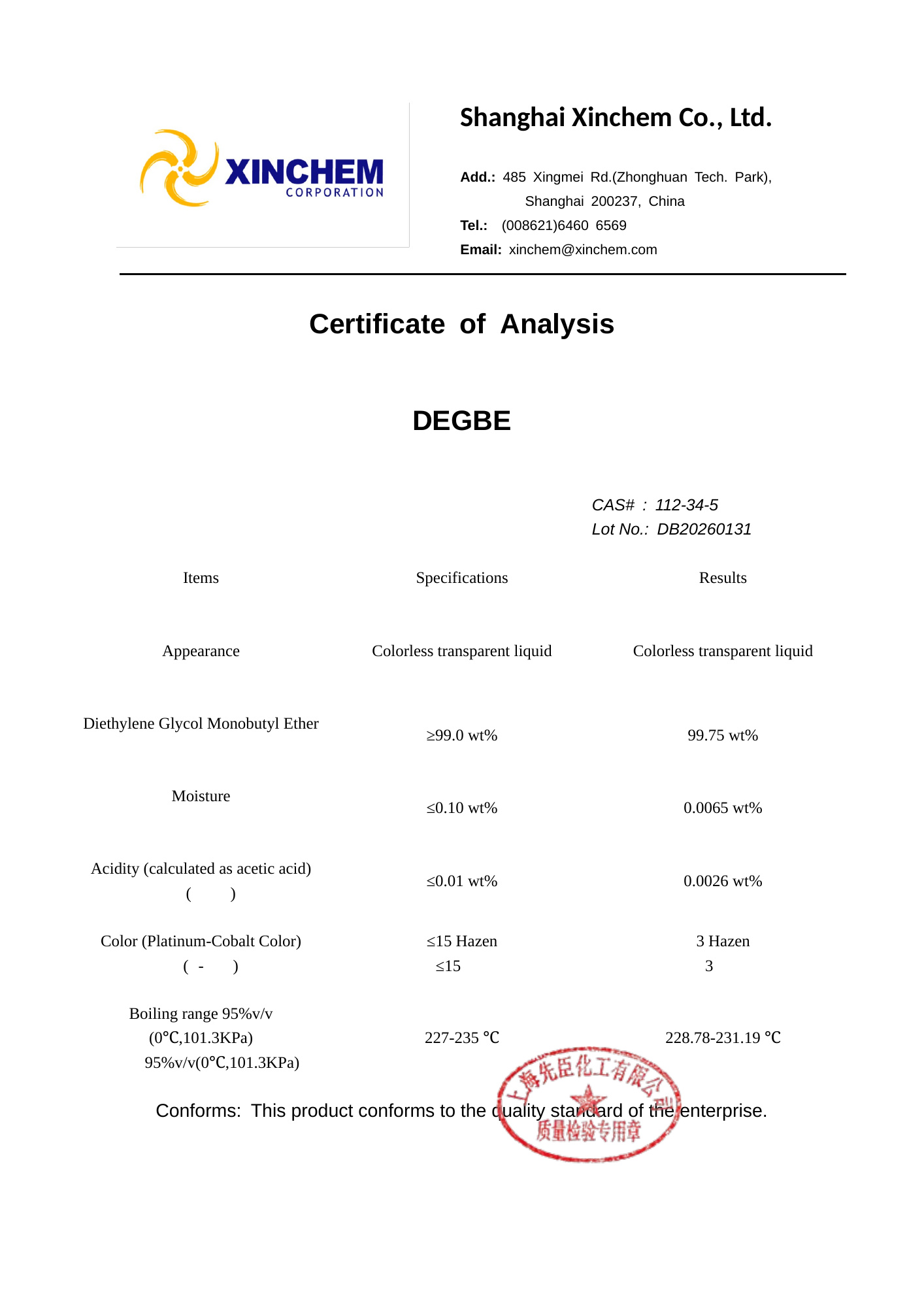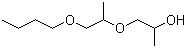


DEGBE (CAS#112-34-5)
Chemical Properties
DEGBE, chemically designated as 2-(2-butoxyethoxy)ethanol or diethylene glycol monobutyl ether, is a clear, colorless liquid with a faint butyl odor. It is a slow-evaporating, hydrophilic glycol ether with excellent coalescing and coupling power. The compound exhibits a boiling point of 228–234 °C and a flash point of 78 °C (closed cup). Its vapor pressure at 20 °C is 0.02–0.03 mmHg, and the relative vapor density is 5.6 (air = 1). DEGBE is fully miscible with water and most organic solvents, including acetone, alcohol, benzene, and ether. The substance has a molecular weight of 162.23 g/mol and a log Pow of 0.3–0.56, indicating very low potential for bioaccumulation. It is a combustible liquid, and above 78 °C explosive vapor/air mixtures may be formed. The substance can presumably form explosive peroxides and reacts with strong oxidants.
Applications
DEGBE is a versatile slow-evaporating solvent with broad applications across multiple sectors. In the coatings and paint industry, it serves as an efficient coalescent in water-based architectural and industrial coatings, significantly improving film leveling and gloss. It is also used in coatings for solvent-sensitive plastic substrates and automotive OEM and refinish applications. In the printing sector, DEGBE functions as the primary solvent in solvent-based silk screen printing inks, a coupling solvent for resins and dyes in water-based printing inks, and a solvent for ballpoint and felt-tip pen inks.
In the cleaning products industry, it is widely employed as a coupling agent and solvent in household and industrial cleaners, rust removers, hard surface cleaners, and disinfectants. Additional applications include use as a coalescent for latex adhesives, a deactivator and stabilizer for agricultural pesticides, a solvent for textile dyeing and printing, and a solvent for electronic materials. DEGBE is also used as a component of foam in fire extinguishers and in hydraulic fluids. In cosmetic products, it is used for hair dyes.
Preparation Method
DEGBE is commercially manufactured through the reaction of ethylene oxide with n-butanol in the presence of an alkaline catalyst, such as sodium hydroxide or potassium hydroxide. The reaction proceeds via sequential ethoxylation, initially producing ethylene glycol monobutyl ether, which further reacts with ethylene oxide to yield diethylene glycol monobutyl ether as the desired product. Industrial production is typically conducted in closed systems with adequate local exhaust ventilation during sampling and drumming operations. More advanced production employs reactive distillation technology, where preheated ethylene oxide and butanol enter a reactor and the reaction mixture is rectified in a reactive distillation column, with DEGBE recovered from the tower bottom. The commercial product typically has a purity of ≥99.0% (GC) with a water content of ≤0.10%.
Safety Information
DEGBE is classified as a combustible liquid with a flash point of 78 °C (closed cup). It is irritating to the eyes and causes redness and pain upon contact. The substance defats the skin, which may cause dryness or cracking upon prolonged or repeated exposure. Acute toxicity is low, with an oral LD50 in rats of 7,292–9,623 mg/kg. The substance can be absorbed through the skin, with percutaneous absorption rates ranging from 0.25 to 1.46 mg/cm²/h. The primary metabolite in urine is 2-(2-butoxyethoxy)acetic acid, accounting for up to 80% of urinary radioactivity.
The occupational exposure limits are as follows: TLV-TWA 10 ppm; MAK 67 mg/m³ (10 ppm), peak limitation category I(1), pregnancy risk group C; EU-OEL 67.5 mg/m³ (10 ppm) as TWA and 101.2 mg/m³ (15 ppm) as STEL. The substance is readily biodegradable and has low potential for bioaccumulation.
For safe handling, it is essential to keep the substance away from heat, sparks, open flames, and hot surfaces. Containers must be kept tightly closed, and grounding and bonding procedures should be followed during transfer operations. Personal protective equipment including safety spectacles, protective clothing, and protective gloves is required. Inhalation of vapors should be avoided, and the material should only be used with adequate ventilation. In case of fire, water spray, powder, alcohol-resistant foam, or carbon dioxide extinguishing media should be used. Storage should be maintained in a cool, well-ventilated area separated from strong oxidants, with ventilation along the floor. Check for peroxides prior to distillation and eliminate if found.