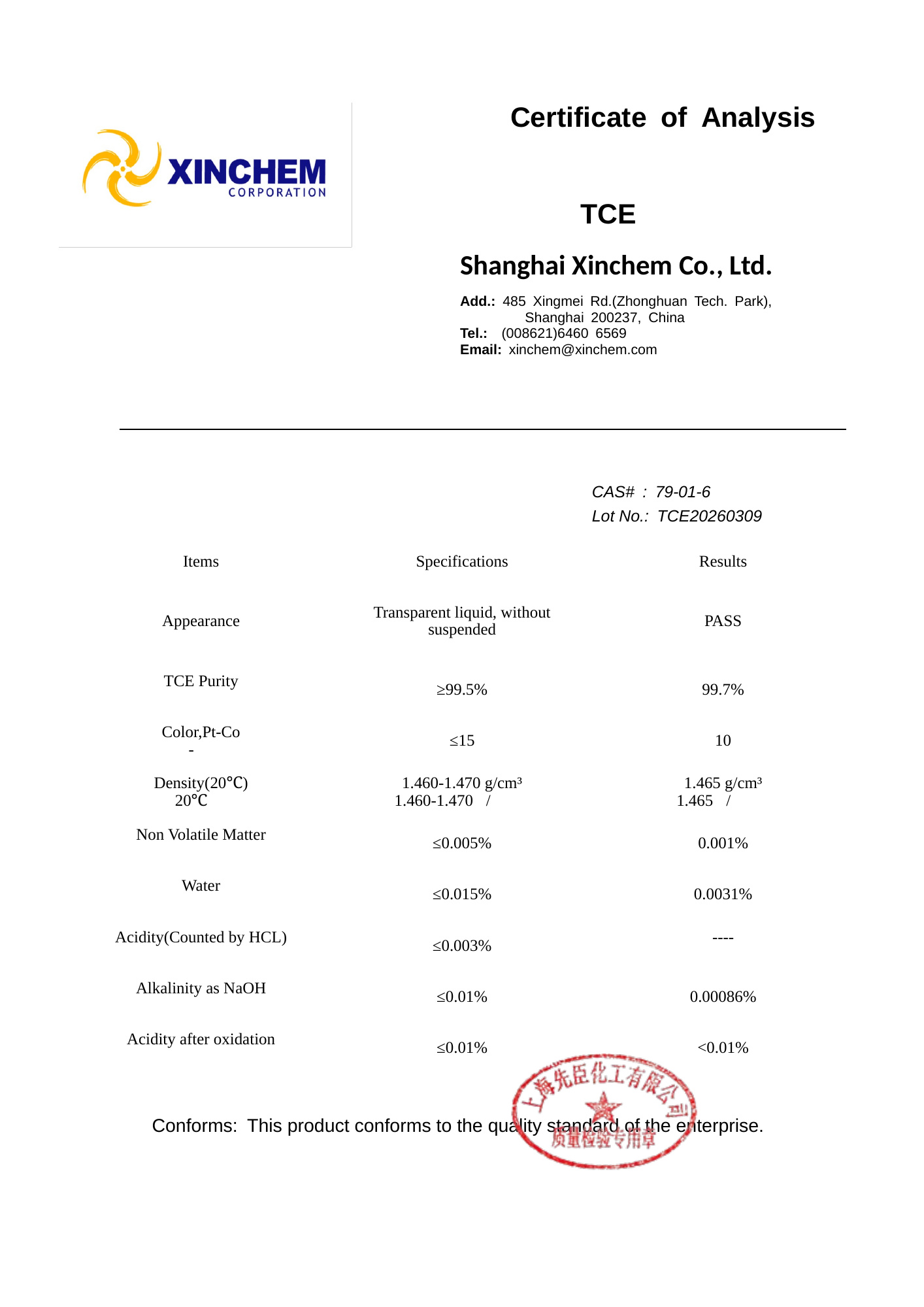


TCE (CAS#79-01-6)
Chemical Properties
TCE, chemically designated as trichloroethylene or trichloroethene, is a dense, nonflammable, volatile, colorless liquid with a chloroform-like odor. It is a chlorinated aliphatic hydrocarbon containing a carbon-carbon double bond. The compound exhibits a boiling point of 86.7–87.2 °C and a vapor pressure of 58 mmHg at 20 °C. Its specific gravity of 1.46 at 20 °C makes it significantly denser than water. TCE is only slightly soluble in water (0.1% at 25 °C) but is miscible with most organic solvents and other halogenated compounds. Most fixed and volatile oils are dissolved by trichloroethylene. The substance has a molecular weight of 131.39 g/mol and a log Pow of 2.42. TCE is nonflammable under ordinary conditions, but combustible liquid that burns with difficulty. It decomposes in the presence of moisture and light, forming hydrochloric acid, and upon combustion produces irritants and toxic gases including hydrogen chloride and phosgene. TCE reacts with strong caustics and alkalis, and with chemically active metals such as barium, lithium, sodium, magnesium, titanium, and beryllium.
Applications
TCE is a high-performance industrial solvent with broad applications across multiple sectors. Its primary application is as a degreaser for metal parts, and it has been a widely used solvent since the early 1900s. Five main industrial groups use TCE in vapor or cold degreasing operations: furniture and fixtures, fabricated metal products, electrical and electronic equipment, transport equipment, and miscellaneous manufacturing industries. The compound finds its greatest use in metal degreasing applications.
In the electronics industry, TCE is used for cleaning and drying electronic parts, printed circuit boards, and precision components. The chemical industry utilizes TCE as a chemical intermediate in the production of hydrofluorocarbons (HFCs), chloroacetic acid, and pesticides. TCE has been used as a diluent in paints and adhesives, a solvent in extraction processes, a refrigerant, a heat exchange liquid, and a chain terminator for PVC production. Additional applications include use as an extractant for oils, waxes, fats, and caffeine (for decaffeinated coffee), a fumigant, and in textile processing and aerospace operations such as flushing liquid oxygen.
Preparation Method
TCE is commercially produced through two primary routes: the acetylene-based process and the ethylene-based process. The classical acetylene-based process consists of two steps. First, acetylene is chlorinated to 1,1,2,2-tetrachloroethane at 50 °C and atmospheric pressure. The product is then dehydrohalogenated to trichloroethylene at 96–100 °C in aqueous bases such as calcium hydroxide, or by thermal cracking over a catalyst such as barium chloride on activated carbon or silica-alumina gels. However, because of the high cost of acetylene, the ethylene-based process became the preferred method for producing TCE.
The modern process involves direct chlorination or oxychlorination of ethylene dichloride (EDC) or other chlorinated ethanes. In the direct chlorination route, chlorine reacts with EDC or other C2 chlorinated hydrocarbons to form perchloroethylene and TCE as co-products and hydrochloric acid as a byproduct. Following reaction, the product undergoes quenching, HCl separation, neutralization, drying, and distillation. In the oxychlorination route, chlorine or HCl and oxygen react with EDC in the presence of a catalyst to produce perchloroethylene and TCE as co-products. The advantage of this process is that no byproduct HCl is produced, and it can be combined with other processes as a net HCl consumer. In both processes, the product ratio of TCE to perchloroethylene is controlled by adjusting the reactant ratios.
Safety Information
TCE is classified as a carcinogen (Category 1A, H350) and is recognized by the International Agency for Research on Cancer (IARC) as a Group 1 carcinogen (carcinogenic to humans). It is also classified as a suspected mutagen and is toxic to organs through prolonged or repeated exposure (Specific Target Organ Toxicity, Repeated Exposure, Category 1, H372). The substance is harmful if swallowed (H302), in contact with skin (H315), and if inhaled (H332). It causes serious eye irritation (H319) and may cause drowsiness or dizziness (H336).
The critical effects of TCE are central nervous system effects, cognitive decrements, kidney toxicity, and liver damage. Human exposure to TCE can produce toxic effects on multiple organs and systems, including immunotoxicity, reproductive toxicity, neurotoxicity, and teratogenic effects. TCE has been associated with an increased risk of kidney cancer, and there is some evidence linking it to liver cancer and lymphoma. Exposure to high concentrations can cause headache, visual disturbance, lassitude, dizziness, tremor, drowsiness, nausea, vomiting, dermatitis, cardiac arrhythmias, paresthesia, and liver injury. TCE can be absorbed through the skin, contributing significantly to total exposure in occupational settings.
The occupational exposure limits are as follows: NIOSH REL TWA 25 ppm (10-hour TWA), with a 2 ppm 60-minute ceiling during use as an anesthetic agent; OSHA PEL TWA 100 ppm (8-hour TWA), 200 ppm ceiling, 300 ppm 5-minute maximum peak in any 2 hours; ACGIH TLV TWA 10 ppm (8-hour TWA) with STEL 25 ppm and A2 classification (suspected human carcinogen); IDLH 1,000 ppm.
For safe handling, it is essential to keep the substance away from heat, sparks, open flames, and hot surfaces. Containers must be kept tightly closed, and grounding and bonding procedures should be followed during transfer operations. Personal protective equipment including safety goggles or face shields, protective clothing, and protective gloves is required. Inhalation of vapors should be avoided, and the material should only be used with adequate ventilation or local exhaust. In case of fire, water spray, dry powder, alcohol-resistant foam, or carbon dioxide extinguishing media should be used. Storage should be maintained in a cool, well-ventilated area separated from strong caustics, alkalis, and active metals. In case of skin contact, wash promptly with soap and water. In case of eye contact, irrigate immediately with plenty of water for several minutes and seek medical attention. If ingested, do not induce vomiting and seek medical attention immediately. Pregnant women should avoid exposure.