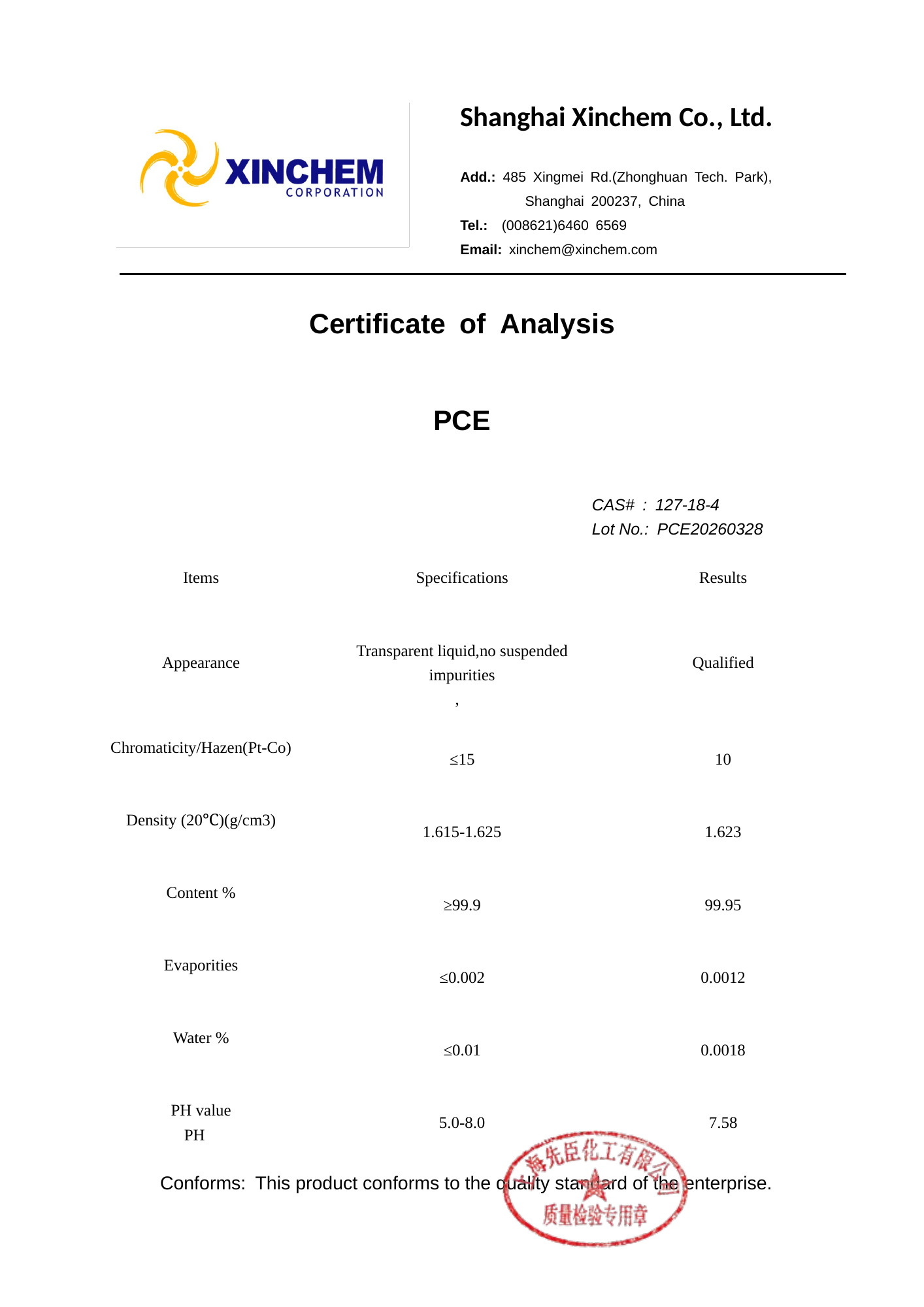


PCE (CAS#127-18-4)
Chemical Properties
PCE, chemically designated as perchloroethylene, tetrachloroethylene, or 1,1,2,2-tetrachloroethene, is a dense, noncombustible, volatile, colorless liquid with a mild, chloroform-like or ether-like odor. The compound exhibits a boiling point of 121.1–121.3 °C and a melting point of -22.3 °C. Its specific gravity of 1.62 at 20 °C makes it significantly denser than water, and it is insoluble in water but miscible with most organic solvents. PCE has a molecular weight of 165.83 g/mol and a vapor pressure of 13 mmHg at 20 °C. Vapors are heavier than air (vapor density 5.83) and can accumulate in low-lying areas. Although PCE is noncombustible under typical fire conditions, it decomposes upon heating and exposure to UV light to produce phosgene and hydrogen chloride. It reacts violently with finely dispersed light metals such as aluminum, zinc, barium, and lithium.
Applications
PCE is a high-performance chlorinated solvent with broad applications across multiple industries. Its primary application is as a dry cleaning solvent, where it is the dominant chemical used in professional garment care worldwide. The compound is also extensively used as a vapor degreasing solvent for metal parts, particularly in the fabrication of furniture and fixtures, electrical and electronic equipment, and transport equipment.
In the chemical industry, PCE serves as a key intermediate in the production of fluorinated compounds, including hydrofluorocarbons (HFCs) and chlorofluorocarbons (CFCs), and as a feedstock for the synthesis of refrigerants and propellants. Additional applications include use in the manufacture of adhesives, aerosol degreasers, brake cleaners, aerosol lubricants, sealants, stone polish, stainless steel polish, and wipe cleaners. PCE is also employed as a heat transfer medium, a drying agent for metals, and an extraction solvent in various industrial processes.
Preparation Method
PCE was first commercially produced in the United States in 1925 via a four-step process using acetylene and chlorine as raw materials. The classical acetylene-based route involves the chlorination of acetylene to produce 1,1,2,2-tetrachloroethane, followed by dehydrochlorination to yield trichloroethylene, and further chlorination to obtain PCE. However, due to the high cost of acetylene, modern industrial production has shifted to hydrocarbon-based processes.
Currently, the majority of PCE produced in the United States is manufactured by one of three processes: direct chlorination of certain hydrocarbons, chlorination of ethylene dichloride (EDC), and oxychlorination. The direct chlorination process involves the reaction of chlorine with a light hydrocarbon such as methane, ethane, propane, or propylene at high temperatures (500–700 °C), with or without a catalyst. The chlorination of EDC involves the reaction of ethylene dichloride with chlorine to produce perchloroethylene and trichloroethylene as co-products, with hydrochloric acid as a byproduct. The oxychlorination process uses hydrogen chloride and oxygen in the presence of a catalyst, offering the advantage of consuming byproduct HCl rather than producing it. In all processes, PCE is recovered and purified by distillation.
Safety Information
PCE is classified as a carcinogen (Category 2, H351) and is recognized by the International Agency for Research on Cancer (IARC) as a Group 2A carcinogen (probably carcinogenic to humans). It is also classified as a suspected mutagen and is toxic to organs through prolonged or repeated exposure (Specific Target Organ Toxicity, Repeated Exposure, Category 1). The substance is harmful if swallowed, in contact with skin, and if inhaled. It causes serious eye irritation and may cause respiratory irritation.
The critical effects of PCE are central nervous system depression, liver damage, kidney damage, and cognitive impairment. Acute exposure to high concentrations can cause irritation of the eyes, skin, nose, and throat; nausea; flushing of the face and neck; dizziness; incoordination; headache; drowsiness; and skin redness. PCE is well-absorbed through inhalation, oral, and dermal routes. The substance can be absorbed through the skin, contributing significantly to total exposure in occupational settings.
The occupational exposure limits are as follows: NIOSH REL Ca (carcinogen) — minimize workplace exposure concentrations; OSHA PEL TWA 100 ppm (8-hour TWA), with a ceiling of 200 ppm (for 5 minutes in any 3-hour period) and a maximum peak of 300 ppm; ACGIH TLV TWA 25 ppm with STEL 100 ppm and A3 classification (confirmed animal carcinogen with unknown relevance to humans); IDLH 150 ppm.
For safe handling, it is essential to keep the substance away from heat, sparks, open flames, and hot surfaces. Containers must be kept tightly closed, and grounding and bonding procedures should be followed during transfer operations. Personal protective equipment including safety goggles or face shields, protective clothing, and protective gloves is required. Inhalation of vapors should be avoided, and the material should only be used with adequate ventilation or local exhaust. In case of fire, water spray, dry powder, alcohol-resistant foam, or carbon dioxide extinguishing media should be used. Storage should be maintained in a cool, well-ventilated area separated from strong oxidizers, chemically active metals, caustic soda, sodium hydroxide, and potash. In case of skin contact, wash promptly with soap and water. In case of eye contact, irrigate immediately with plenty of water for several minutes and seek medical attention. If ingested, do not induce vomiting and seek medical attention immediately. Pregnant women should avoid exposure.