

Cyclohexane (CAS#110-82-7)
Chemical Properties
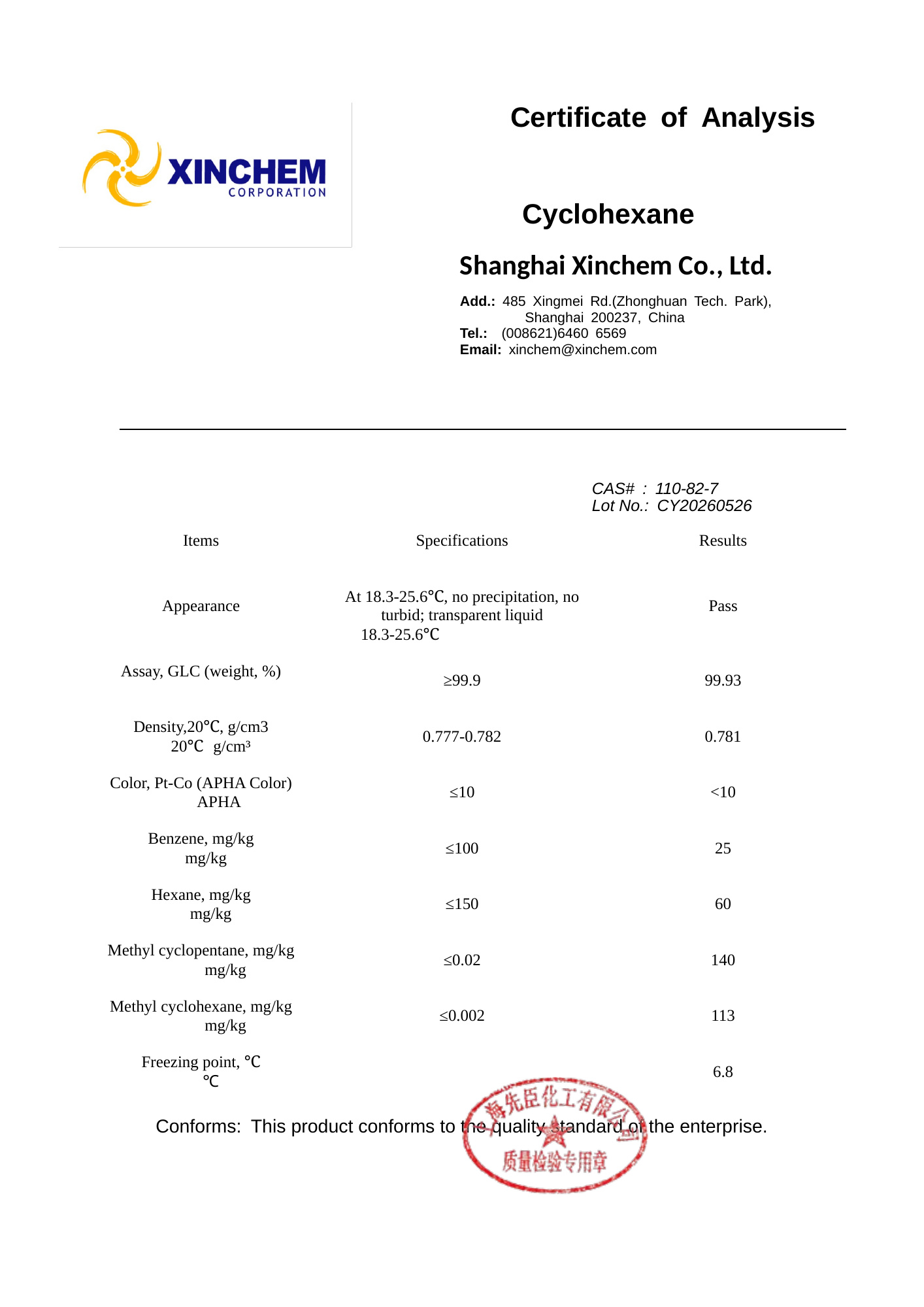
Cyclohexane is a clear, colorless, mobile liquid with a characteristic odor resembling benzene. It is a saturated cycloalkane hydrocarbon consisting of a six-membered carbon ring with all carbon atoms in sp³ hybridization. The compound exhibits a boiling point of 80.7 °C and a melting point of 4–7 °C. Its specific gravity of 0.779 at 25 °C is less than that of water. Cyclohexane is a non-polar solvent with a flash point of -18 °C, indicating high flammability. It is insoluble in water (58 mg/L at 25 °C) but soluble in ether, alcohol, acetone, and most organic solvents. The substance has a molecular weight of 84.16 g/mol, a vapor density of 2.9 (air = 1), and a log Pow of 3.44, indicating moderate lipophilicity. Vapors are heavier than air and may travel along the ground and accumulate in low-lying areas. Cyclohexane can react vigorously, violently, or explosively with oxidizers, and when mixed hot with liquid dinitrogen tetraoxide, an explosion can result.
Applications
Cyclohexane is a versatile non-polar organic solvent and chemical intermediate with broad applications across multiple industries. Its primary application is as a chemical building block for downstream derivatives, particularly adipic acid and caprolactam, both of which are key chemical intermediates in the production of nylon 6 and nylon 6,6. The majority of cyclohexane produced globally is consumed in this capacity, supporting the manufacture of clothing, tents, carpets, and thermoplastics. It has been substituted for benzene in many applications due to its safer toxicological profile.
In the coatings and adhesives industry, cyclohexane is used as a solvent in neoprene-based adhesives for shoe and floor coating manufacture, as well as in the automobile equipment industry. It serves as a diluent in adhesives and coatings formulations. In the rubber industry, it is employed for rubber dissolution and as a solvent in polymerization reactions. Additional applications include use as an extraction solvent in analytical processes for detecting harmful substances in environmental samples, a mobile phase solvent in HPLC analysis, a solvent in textile processing, and a component in the manufacture of thermoplastics, adhesives, and sealants. Cyclohexane is also used as a solvent for oils, fats, waxes, and resins.
Preparation Method
Cyclohexane is produced commercially through several established routes. The most common industrial process is the catalytic hydrogenation of benzene. In this method, benzene is reacted with hydrogen gas in the presence of a metal catalyst, typically nickel, platinum, or palladium, at elevated temperatures and pressures. The reaction proceeds via the catalytic addition of hydrogen to the aromatic ring, producing cyclohexane in high yield. The crude product is subsequently washed with a sodium carbonate solution and purified by distillation to obtain the finished product.
An alternative industrial route involves the isomerization of methylcyclopentane to cyclohexane using specific catalysts such as acidic ionic liquids. Cyclohexane can also be produced by the hydrocracking of cyclopentane or from toluene by simultaneous dealkylation and double bond hydrogenation. Laboratory-scale synthesis may be accomplished through the dehydration of cyclohexanol using concentrated sulfuric acid, followed by distillation to collect the fraction boiling at 80–82 °C, or through the reduction of cyclohexanone. Additionally, cyclohexane can be fractionated from petroleum.
Safety Information
Cyclohexane is classified as a highly flammable liquid and vapor (Category 2, H225). It is a flammable liquid with a flash point of -18 °C and forms explosive vapor/air mixtures, with explosive limits of 1.3%–8.4% by volume in air. The substance is harmful if swallowed and enters the airways (Aspiration Hazard, Category 1, H304). It causes skin irritation (Category 2, H315), may cause respiratory irritation (H335), and may cause drowsiness or dizziness (Specific Target Organ Toxicity, Single Exposure, Category 3, H336). Cyclohexane is also classified as very toxic to aquatic life with long-lasting effects (Aquatic Chronic, Category 1, H410).
The critical effects of cyclohexane exposure are irritation of the eyes, skin, and respiratory system; drowsiness; dermatitis; and central nervous system depression. Symptoms of exposure include headache, nausea, dizziness, and incoordination. Cyclohexane is absorbed through inhalation, ingestion, and skin/eye contact. The substance can be absorbed through the skin and may contribute to total exposure in occupational settings.
The occupational exposure limits are as follows: NIOSH REL TWA 300 ppm (1050 mg/m³); OSHA PEL TWA 300 ppm (1050 mg/m³); ACGIH TLV TWA 100 ppm; IDLH 1,300 ppm.
For safe handling, it is essential to keep the substance away from heat, sparks, open flames, and hot surfaces. No smoking is permitted in areas where the material is stored or handled. Containers must be kept tightly closed, and grounding and bonding procedures should be followed during transfer operations. Explosion-proof electrical, ventilating, and lighting equipment must be used in all areas where the substance is present. Personal protective equipment including safety goggles or face shields, protective clothing, and protective gloves is required. Inhalation of vapors should be avoided, and the material should only be used with adequate ventilation or local exhaust. In case of fire, dry powder, alcohol-resistant foam, or carbon dioxide extinguishing media should be used; water spray may be ineffective. Storage should be maintained in a cool, well-ventilated area separated from strong oxidizers, liquid dinitrogen tetraoxide, and other incompatible materials. In case of skin contact, wash promptly with soap and water. In case of eye contact, irrigate immediately with plenty of water for several minutes and seek medical attention. If ingested, do not induce vomiting and seek medical attention immediately.