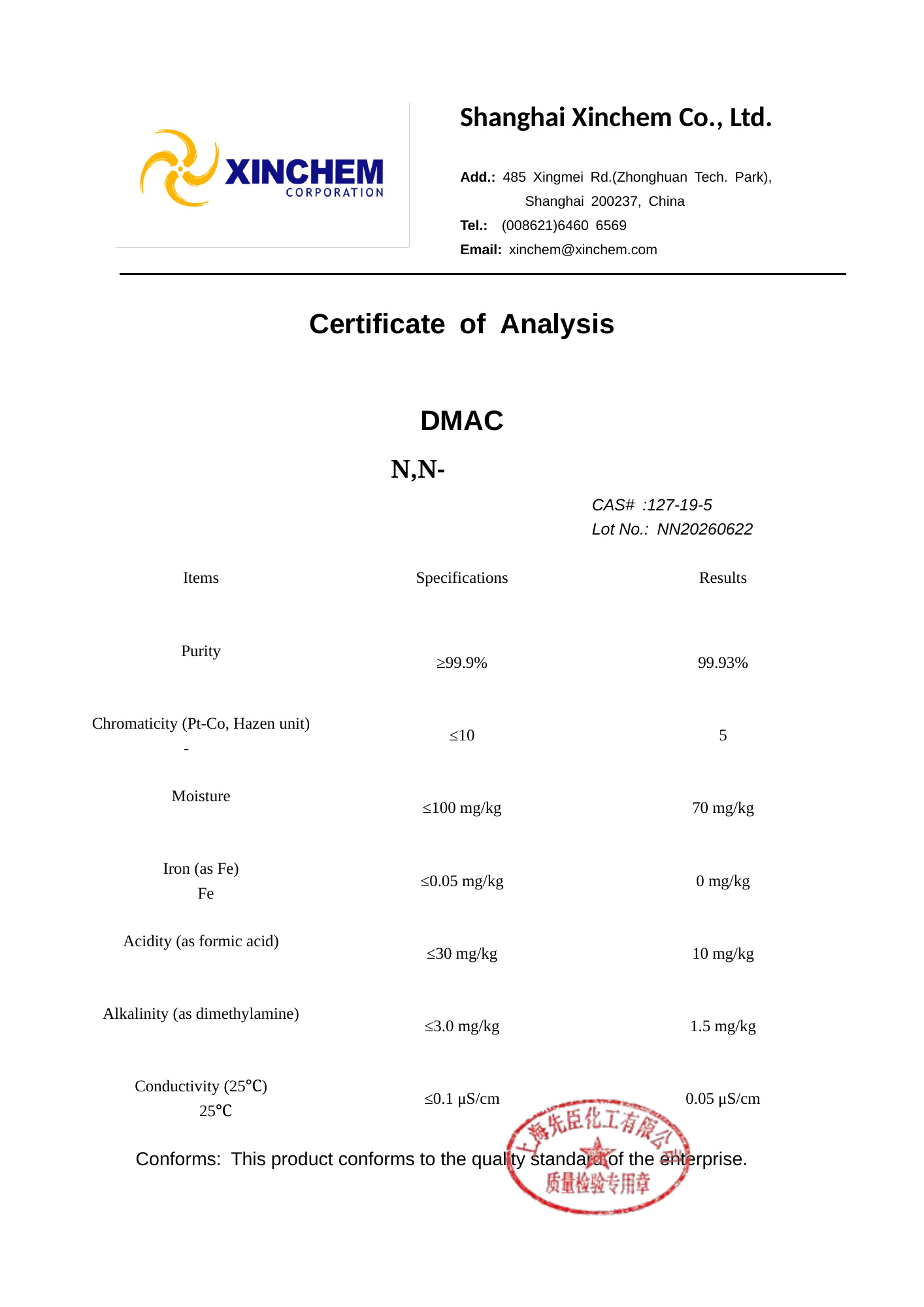


N,N-Dimethylacetamide(CAS#127-19-5)
| Hazard Symbols | T - Toxic |
| Risk Codes | R11 - Highly Flammable R20/22 - Harmful by inhalation and if swallowed. R61 - May cause harm to the unborn child R20/21 - Harmful by inhalation and in contact with skin. R36 - Irritating to the eyes |
| Safety Description | S16 - Keep away from sources of ignition. S24 - Avoid contact with skin. S53 - Avoid exposure - obtain special instructions before use. S45 - In case of accident or if you feel unwell, seek medical advice immediately (show the label whenever possible.) S36 - Wear suitable protective clothing. S28 - After contact with skin, wash immediately with plenty of soap-suds. S26 - In case of contact with eyes, rinse immediately with plenty of water and seek medical advice. |
| RTECS | AB7700000 |
| FLUKA BRAND F CODES | 3-10 |
| HS Code | 29241900 |
| Toxicity | LD50 orally in rats: 5.4 ml/kg (Bartsch) |
Introduction
Soluble in water, soluble in most organic solvents such as acetone, benzene, chloroform, ethanol, and toluene.
Chemical Properties
N,N-Dimethylacetamide (DMAc) is a clear, colorless, high-boiling, dipolar aprotic solvent with a faint ammonia or fish-like odor. It is a combustible, hygroscopic liquid that is miscible with water and most oxygen- and nitrogen-containing organic solvents, including alcohols, ethers, esters, benzene, chloroform, and aromatic compounds. The compound exhibits a boiling point of 164.5–166 °C and a flash point of 63–70 °C (closed cup). Its vapor pressure is 1.5–2 mmHg at 20 °C, and the relative vapor density is 3.01 (air = 1). DMAc has a molecular weight of 87.12 g/mol, a specific gravity of 0.94 at 20 °C, and a log Pow of -0.77, indicating very low potential for bioaccumulation. It is stable under ordinary conditions but decomposes on heating to produce toxic fumes, and reacts with strong oxidants. DMAc is a powerful solvent for a wide range of resins, polymers, and some inorganic salts, and is stable to strong bases but hydrolyzes in the presence of acids.
Applications
DMAc is a versatile high-performance solvent with broad applications across multiple industries. Its primary application is as a spinning solvent for synthetic fibers, particularly polyacrylonitrile (PAN) for carbon fiber precursors, spandex, and aramid fibers. In the pharmaceuticals industry, DMAc serves as both a solvent and a reagent in the production of various pharmaceuticals, including novel X-ray contrast media and cephalosporin antibiotics. It is also used as an excipient in drug formulations such as vumon and busulfex.
In the electronics industry, DMAc is employed as a solvent in photoresist stripping compounds and for electronic component cleaning. The polymer industry utilizes DMAc as a reaction medium for the synthesis of polyimides, polysulfone amides, and other high-performance polymers, and as a solvent for resins and coatings. Additional applications include use as a paint remover, an extracting agent for oil and gases, a reaction medium for agrochemicals, dyes, and plasticizers, a catalyst in cyclization, halogenation, cyanation, alkylation, and dehydrogenation reactions, and a solvent for separating styrene from C8 fractions by extractive distillation.
Preparation Method
DMAc is commercially manufactured through several established routes. The classical method involves the reaction of acetic acid or acetic anhydride with dimethylamine at elevated temperatures. In a typical procedure described in the literature, acetic acid and dimethylamine are heated at 150 °C for 3 hours to produce DMAc in approximately 84% yield. Modern industrial production typically employs methyl acetate as the acetylating agent, reacting it with dimethylamine in the presence of a basic catalyst. The liquid-phase reaction of methyl acetate, dimethylamine, methanol, and a catalyst in a reaction kettle is followed by crude distillation to remove dimethylamine, methyl acetate, methanol, and water, and then rectification under reduced pressure to obtain DMAc with purity greater than 99.9%.
An alternative industrial route involves the carbonylation of trimethylamine with carbon monoxide in the presence of dicobalt octacarbonyl as a catalyst at temperatures of 175–275 °C and elevated pressure. This process achieves near-quantitative selectivity for DMAc. Another method employs acetonitrile and methanol as raw materials, offering advantages in terms of raw material cost and process simplicity.
Safety Information
DMAc is classified as a combustible liquid (Category 4, H227) with a flash point of 63–70 °C (closed cup). Above 63 °C, explosive vapor/air mixtures may be formed, with explosive limits of 1.8%–11.5% by volume in air. The substance is harmful in contact with skin (Category 4, H312) and if inhaled (Category 4, H332). It causes serious eye irritation (Category 2A, H319) and may cause drowsiness or dizziness (Specific Target Organ Toxicity, Single Exposure, Category 3, H336). DMAc is suspected of causing cancer (Category 2, H351) and may damage fertility or the unborn child (Reproductive Toxicity, Category 1B, H360). It causes damage to the liver through prolonged or repeated exposure (Specific Target Organ Toxicity, Repeated Exposure, Category 1, H372) and may cause damage to the respiratory system through prolonged or repeated exposure (Category 2, H373).
The critical effects of DMAc are respiratory tract irritation and hepatotoxicity. Repeated exposure at 100 ppm and above produces significant dose-dependent toxicity, with nasal and upper respiratory tract irritation or inflammation and liver damage as the predominant findings. DMAc is well-absorbed orally, by inhalation, and percutaneously. The substance can be absorbed through the skin, contributing significantly to total exposure in occupational settings.
The occupational exposure limits are as follows: NIOSH REL TWA 10 ppm (35 mg/m³) with skin notation; OSHA PEL TWA 10 ppm (35 mg/m³) with skin notation; ACGIH TLV TWA 10 ppm with skin notation and A3 classification (confirmed animal carcinogen with unknown relevance to humans); EU indicative OEL TWA 36 mg/m³ (10 ppm) with skin notation, and STEL 72 mg/m³ (20 ppm); IDLH 300 ppm. The EU REACH long-term DNEL is 13 mg/m³ (inhalation) and 1.8 mg/kg bw/day (dermal).
For safe handling, it is essential to keep the substance away from heat, sparks, open flames, and hot surfaces. Above 63 °C, closed systems, ventilation, and explosion-proof electrical equipment must be used. Personal protective equipment including safety spectacles or face shields, protective clothing, and protective gloves is required. Inhalation of vapors should be avoided, and the material should only be used with adequate ventilation or local exhaust. In case of fire, powder, alcohol-resistant foam, water spray, or carbon dioxide extinguishing media should be used. Storage should be maintained in a cool, well-ventilated area with ventilation along the floor, separated from strong oxidants. In case of skin contact, remove contaminated clothes and rinse skin with water and soap. In case of eye contact, rinse with plenty of water for several minutes and refer for medical attention. Avoid exposure of pregnant women.