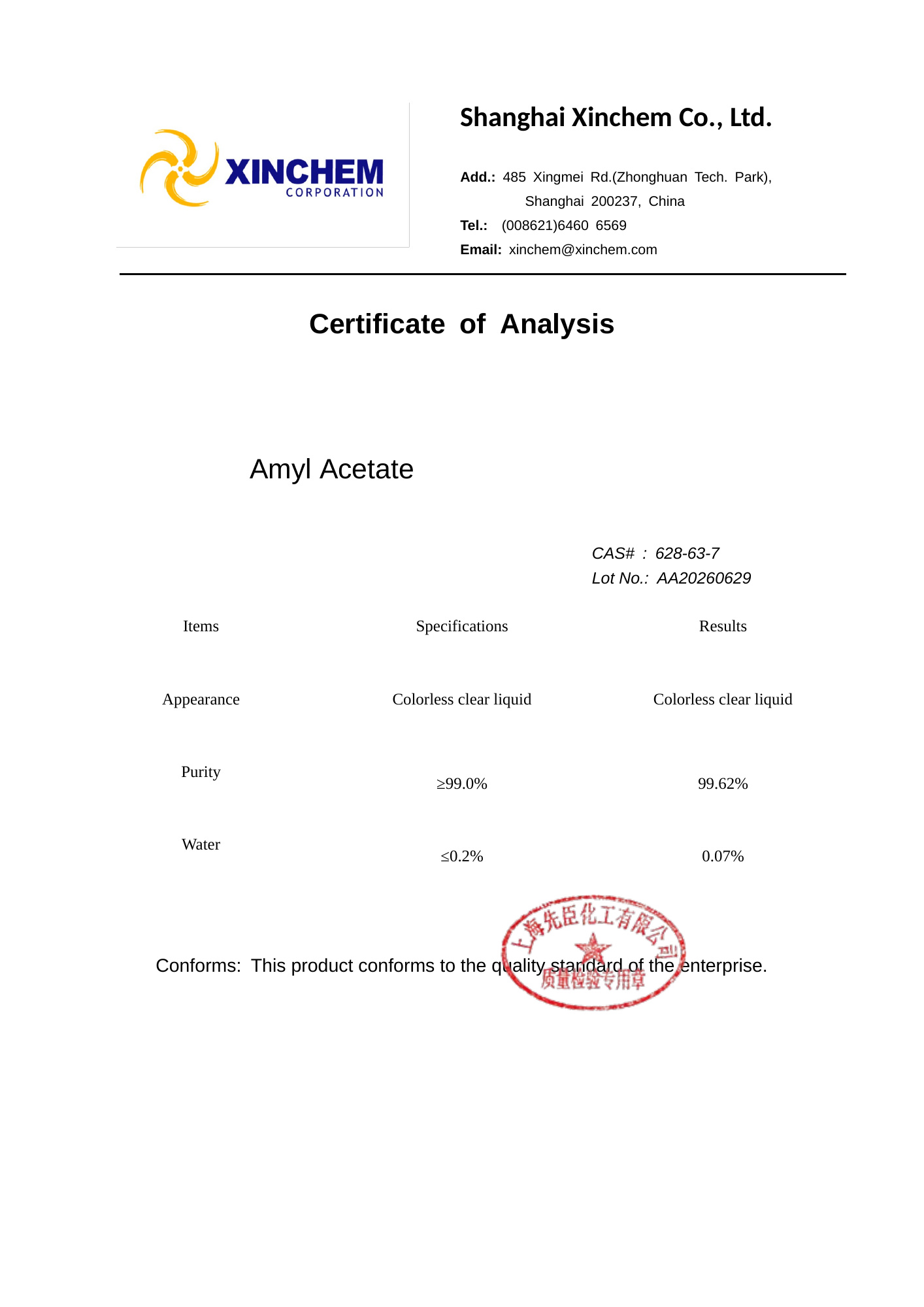

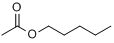
Amyl Acetate (CAS#628-63-7)
Chemical Properties
Amyl Acetate, chemically designated as n-pentyl acetate or acetic acid pentyl ester, is a clear, colorless liquid with a characteristic banana-like odor. It is a flammable, volatile compound with a flash point of 25 °C and a boiling point of 149 °C. The substance exhibits a specific gravity of 0.88 at 20 °C and a vapor pressure of 4 mmHg at 20 °C. Its solubility in water is approximately 1700 mg/L at 25 °C, and it is miscible with most common organic solvents, including ethanol, diethyl ether, and acetone. The compound has a molecular weight of 130.2 g/mol and a log Pow of 2.18, indicating moderate lipophilicity. Vapors are heavier than air (relative vapor density of 4.5) and may form explosive mixtures with air at elevated temperatures.
Applications
Amyl Acetate is a versatile industrial solvent with broad applications across multiple sectors. In the coatings and paint industry, it serves as an effective solvent for lacquers, nitrocellulose, and various resin systems, enhancing application properties and drying times. It is particularly valued as a non-HAP (non-hazardous air pollutant) solvent that offers good resin solvency and is miscible with many common organic solvents. In the printing sector, it is used as a solvent in printing inks and for finishing fabrics, providing excellent flow and leveling properties.
In the pharmaceutical industry, Amyl Acetate is employed as an extraction solvent for penicillin production. The food and fragrance industry utilizes it as a flavoring agent to impart fruity notes to candies and beverages, and as a fragrance component in perfumes and personal care products. Additional applications include use in photographic film manufacturing, leather polishes, nail polish, cleaning fluids, and as a solvent for phosphors in fluorescent lamps. It also functions as a solvent, cosolvent, or attractant in pesticide formulations.
Preparation Method
Amyl Acetate is commercially manufactured primarily through the esterification of acetic acid with n-pentanol (amyl alcohol). The classical Fischer esterification reaction utilizes an acid catalyst such as sulfuric acid or p-toluenesulfonic acid, with one reactant typically used in excess to drive the equilibrium toward the product side. The crude product is then purified by fractional distillation, collecting the fraction boiling around 149 °C.
On an industrial scale, heterogeneous catalysts such as titanic sulfate have demonstrated good catalytic activity, with optimal conditions achieving yields of approximately 89%. More advanced production employs catalytic distillation columns with seepage catalytic packing internal (SCPI), achieving product purity of up to 99.3 wt% under optimized operating parameters including pressures of 20–22 kPa and 16–18 theoretical stages of reaction zone. Enzymatic esterification using immobilized lipase catalysts has also been developed as a solvent-free, environmentally friendly alternative for pentyl acetate production.
Safety Information
Amyl Acetate is classified as a flammable liquid (Category 3, H226) with a flash point of 25 °C. It is irritating to the eyes, skin, and respiratory tract, and may cause drowsiness or dizziness (H336). The substance causes serious eye irritation (H319) and may cause respiratory irritation (H335). Prolonged or repeated exposure can defat the skin, causing dryness or cracking, and at high levels, exposure could cause lowering of consciousness. The compound is also classified as harmful to aquatic life with short-term (acute) and long-term (chronic) hazards (H402).
For safe handling, it is essential to keep the substance away from heat, sparks, open flames, and hot surfaces. No smoking is permitted in areas where the material is stored or handled. Containers must be kept tightly closed, and grounding and bonding procedures should be followed during transfer operations. Explosion-proof electrical, ventilating, and lighting equipment must be used in all areas where the substance is present. Personal protective equipment including eye protection, protective clothing, and protective gloves is required. In case of fire, alcohol-resistant foam, dry chemical, or carbon dioxide extinguishing media should be used. Storage should be maintained in a cool, well-ventilated, fireproof area separated from oxidants. The occupational exposure limit is set at 50 ppm as TWA and 100 ppm as STEL.