
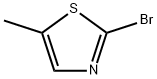
2-Bromo-5-methylthiazole(CAS#41731-23-1)
Chemical Property:
41731-23-1 - Names and Identifiers
| Name | 2-Bromo-5-methylthiazole |
| Synonyms | 2-Bromo-5-methylthizaole 2-Bromo-5-methylthiazole 2-BROMO-5-METHYL-THIAZOLE Thiazole,2-broMo-5-Methyl- 2-Bromo-5-methyl-1,3-thiazole 2-BROMO-5-METHYL-1,3-THIAZOLE 2-Bromo-5-methyl-thiazole Hydrobromide |
| CAS | 41731-23-1 |
| InChI | InChI=1/C4H4BrNS/c1-3-2-6-4(5)7-3/h2H,1H3 |
41731-23-1 - Physico-chemical Properties
| Molecular Formula | C4H4BrNS |
| Molar Mass | 178.05 |
| Density | 1.702±0.06 g/cm3(Predicted) |
| Boling Point | 192-200°C |
| Flash Point | 71.778°C |
| Water Solubility | Slightly soluble in water. |
| Solubility | Chloroform, Methanol (Slightly) |
| Vapor Presure | 0.598mmHg at 25°C |
| Appearance | Oil |
| Color | Colourless to Yellow |
| pKa | 1.32±0.10(Predicted) |
| Storage Condition | under inert gas (nitrogen or Argon) at 2-8°C |
| Refractive Index | 1.5730 to 1.5770 |
| MDL | MFCD08460610 |
41731-23-1 - Risk and Safety
| Hazard Symbols | Xn – Harmful |
| Risk Codes | R22 – Harmful if swallowed R41 – Risk of serious damage to eyes R36 – Irritating to the eyes |
| Safety Description | S26 – In case of contact with eyes, rinse immediately with plenty of water and seek medical advice. S39 – Wear eye / face protection. |
41731-23-1 - Introduction
Nature:
-Appearance: 2-Bromo-5-methylthiazole is a colorless or light yellow crystal.
-Solubility: It is soluble in most organic solvents, such as ethanol, ether and dichloromethane.
Use:
-Chemical reagent: 2-Bromo-5-methylthiazole can be used as an intermediate in organic synthesis and is often used to synthesize other functional compounds.
-Pharmaceutical field: It is also used in drug research and development, and can be used as the skeleton of drug molecules or drug synthesis intermediates.
Preparation Method:
The preparation method of-2-Bromo-5-methylthiazole generally involves adding sodium bromide (NaBr) to 2-chloro-5-methylthiazole, or using a photosynthetic reaction.
-Another preparation method is obtained by alkali treatment of 2-Bromo-5-methylthiazole hydrochloride.
Safety Information:
-The dust of this compound can cause irritation, and inhalation or contact with skin and eyes should be avoided.
-Wear appropriate protective equipment such as gloves, goggles and lab coats during operation.
-Observe safety procedures and precautions during storage and handling, and avoid contact with combustibles.
-If ingested or inhaled, seek medical help immediately and provide the package or label to your doctor.