

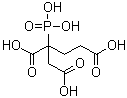
2-Phosphonobutane-1,2,4-tricarboxylic acid(CAS#37971-36-1)
| Risk Codes | 34 - Causes burns |
| Safety Description | S26 - In case of contact with eyes, rinse immediately with plenty of water and seek medical advice. S45 - In case of accident or if you feel unwell, seek medical advice immediately (show the label whenever possible.) |
| UN IDs | UN 3265 |
| Hazard Class | 8 |
| Packing Group | III |
Introduction
2-Phosphonate butane-1,2,4-tricarboxylic acid (or 2-phosphonate butadyne-1,2,4-tricarboxylic acid) is an organic compound. The following is an introduction to its properties, uses, preparation methods and safety information:Quality:- Appearance: 2-phosphonate butane-1,2,4-tricarboxylic acid is a colorless crystalline or powdery solid.- Solubility: Soluble in water and organic solvents such as alcohols, ethers, etc.- Thermal stability: Decomposes at high temperatures.Use:- 2-Phosphonate butane-1,2,4-tricarboxylic acid is commonly used as a reagent in organic synthesis.- It can be used as a catalyst or ligand, with the ability to catalyze reactions such as esterification, amidination, nucleophilic substitution, etc.- It can also be used as an intermediate in coordination chemistry and organic synthesis.Preparation method:- 2-Butane-1,2,4-tricarboxylic acid can be obtained by reacting butane-1,2,4-triglycol with hydrofluoric acid.- Specific synthesis methods can be found in organic chemical synthesis manuals or related literature.Safety Information:- No specific pathogenicity or toxicity has been reported for butane-1,2,4-tricarboxylic acid 2-phosphonate.- However, as an organic compound, standard laboratory operating procedures are required for general operation, such as wearing appropriate safety equipment (e.g., gloves, goggles, etc.).- When using or storing, keep away from fire, avoid contact with oxidizing agents, and store in a dry, well-ventilated place.
Application
2-Phosphonobutane-1,2,4-tricarboxylic acid (PBTCA, CAS 37971-36-1) is a high-performance organophosphonate used as a scale inhibitor and corrosion inhibitor in industrial water treatment. It exhibits exceptional calcium carbonate, calcium sulfate, and barium sulfate scale inhibition even at low concentrations, with excellent thermal stability and resistance to chlorine oxidation. PBTCA is widely applied in cooling water systems, boiler water treatment, reverse osmosis (RO) processes, and oilfield water injection. It also functions as a chelating agent for metal ions, dispersant for particulate matter, and stabilizer for hydrogen peroxide and bleach formulations. Its low phosphorus content and high efficiency make it environmentally favorable. Xinchem offers custom synthesis, custom chemical synthesis, and contract manufacturing of high-purity PBTCA with flexible scaling from R&D to commercial tons. Contact us today for a competitive quote and reliable global supply.
![octahydro-7,7,8,8-tetramethyl-2,3b-methano-3bH-cyclopenta[1,3]cyclopropa[1,2]benzene-4-methyl acetate(CAS#59056-62-1)](https://www.xinchem.com/uploads/octahydro-7788-tetramethyl-23b-methano-3bH-cyclopenta13cyclopropa12benzene-4-methyl-acetate.gif)

.gif)