
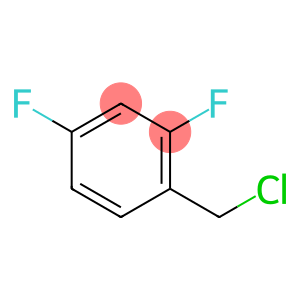
2,4-Difluorobenzyl chloride(CAS#452-07-3)
| Risk Codes | 34 - Causes burns |
| Safety Description | S26 - In case of contact with eyes, rinse immediately with plenty of water and seek medical advice. S36/37/39 - Wear suitable protective clothing, gloves and eye/face protection. |
| UN IDs | 1760 |
| Hazard Note | Corrosive/Lachrymatory |
| Hazard Class | 8 |
| Packing Group | III |
Introduction
2,4-Difluorobenzyl chloride is an organic compound with the formula C7H5ClF2. The following is a description of the properties, uses, preparation and safety information of the compound:
Nature:
- 2,4-Difluorobenzyl chloride is a colorless to pale yellow liquid with a pungent odor.
-Its density is about 1.258 g/mL, its melting point is -10 ℃, and its boiling point is 132-134 ℃.
-At room temperature, it can slowly volatilize in contact with air.
Use:
- 2,4-Difluorobenzyl chloride has important application value in organic synthesis and is usually used as an intermediate for aromatic compounds.
-It can be used to synthesize organic compounds such as pesticides, medicines and chemical reagents.
-Due to the existence of 2,4-Difluorobenzyl chloride, it has become a compound widely studied and used in organic synthesis.
Preparation Method:
- 2,4-Difluorobenzyl chloride is usually obtained by reacting 2,4-difluorobenzyl alcohol with thionyl chloride.
-In the reaction, 2,4-difluorobenzyl alcohol is first reacted with thionyl chloride to generate an intermediate, and the intermediate is reacted with a strong base (such as alkali metal carbonate or alkali metal alkoxide) to generate 2,4-Difluorobenzyl chloride.
Safety Information:
- 2,4-Difluorobenzyl chloride is an organic compound, so you should handle it with care and take appropriate measures to protect your safety.
-When in contact with skin, eyes or respiratory tract, rinse immediately with plenty of water.
-When using 2,4-Difluorobenzyl chloride, should be equipped with appropriate protective equipment, such as protective glasses, gloves and protective clothing.
-When storing, keep the compound sealed and away from fire and oxidizing agents.
Application
2,4-Difluorobenzyl chloride is a highly reactive fluorinated benzyl halide serving as a key pharmaceutical intermediate and versatile building block in organic synthesis. The chloromethyl group enables efficient nucleophilic substitution with amines, alcohols, and thiols, allowing rapid introduction of the 2,4-difluorobenzyl moiety into drug candidates. Its strategic fluorine substitution enhances metabolic stability, lipophilicity, and target binding affinity. This compound is widely used in the synthesis of antifungal agents (e.g., fluconazole, voriconazole), antiviral drugs, and CNS-active pharmaceuticals including antidepressants and antipsychotics. In agrochemical R&D, it serves as a critical precursor for selective herbicides, fungicides, and insecticides with improved environmental safety and efficacy. It also participates in palladium-catalyzed cross-coupling reactions and can be transformed into benzyl alcohols, aldehydes, or nitriles for further derivatization. Additionally, 2,4-difluorobenzyl chloride is employed in the production of specialty polymers, liquid crystal materials, and functional coatings. High purity ensures reproducible results in SAR studies, high-throughput screening, and scalable GMP manufacturing. Xinchem offers reliable custom synthesis, custom chemical synthesis, and contract manufacturing of this essential building block with flexible scaling from R&D to commercial tons. Contact us today for a competitive quote and dependable global supply.
Please note that when using and handling 2,4-Difluorobenzyl chloride and related compounds, relevant safety operating procedures should be followed, and evaluation and operation should be carried out according to specific conditions.