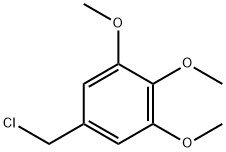
3,4,5-Trimethoxybenzyl chloride(CAS#3840-30-0)
1. Properties:
- Appearance and Physical Form: 3,4,5-Trimethoxybenzyl chloride is a white to beige or faint beige/light brown crystalline solid. It is an electrophilic benzyl chloride derivative bearing three methoxy groups at the 3-, 4-, and 5-positions of the benzene ring.
- Solubility: The compound is soluble in methanol (0.1 g/mL, clear) and is expected to be soluble in other common organic solvents such as dichloromethane, THF, and DMF.
- Chemical Properties: 3,4,5-Trimethoxybenzyl chloride (C₁₀H₁₃ClO₃) is a key alkylating reagent and pharmaceutical intermediate. Its molecular structure features a benzyl chloride moiety with three electron-donating methoxy groups that enhance the electrophilicity of the benzylic carbon, facilitating nucleophilic substitution reactions.
- Reactivity: The compound serves as an electrophilic alkylating agent, enabling the introduction of the 3,4,5-trimethoxybenzyl pharmacophore into target molecules via nucleophilic substitution. The three methoxy groups confer distinct electronic and steric properties that cannot be replicated by other substituted benzyl chlorides.
- Pharmaceutical Applications: 3,4,5-Trimethoxybenzyl chloride is validated in the syntheses of trimetoquinol (TMQ) and fedotozine tartrate. It serves as a crucial intermediate in the preparation of various pharmacologically active compounds.
- Stability: The compound should be stored at 2–8°C (refrigerated) in a tightly closed container, protected from moisture.
2. Applications:
Pharmaceutical Industry (Primary):
- Anticancer Drug Development: 3,4,5-Trimethoxybenzyl chloride is widely utilized as a key intermediate in the synthesis of various anticancer agents and has been evaluated by the National Cancer Institute (NCI).
- Anti-inflammatory Agents: The compound serves as a building block for the synthesis of anti-inflammatory drug candidates.
- Bioactive Natural Product Analogs: It is a key intermediate in the synthesis of resveratrol and other natural active compounds.
- Trimetoquinol (TMQ) and Fedotozine Tartrate Synthesis: The compound is validated in the synthesis of these pharmaceutical agents.
Chemical Synthesis & Research:
- Alkylating Reagent: As a versatile alkylating reagent, it is used to introduce the 3,4,5-trimethoxybenzyl group into various molecular structures. Its reactivity with amines is demonstrated in the synthesis of N-substituted piperazine derivatives.
- Building Block for Coumarin Derivatives: The compound is a precursor for coumarin derivatives with antiproliferative and cytotoxic properties.
Organic Synthesis:
- Nucleophilic Substitution: Used in reactions to create novel heterocyclic derivatives and other complex organic molecules.
3. Preparation Method:
- Industrial Synthesis: 3,4,5-Trimethoxybenzyl chloride is typically synthesized from 3,4,5-trimethoxybenzaldehyde. The aldehyde is reduced with sodium borohydride (NaBH₄) to provide the corresponding benzyl alcohol, which is then converted to the benzyl chloride using thionyl chloride (SOCl₂). The product is purified by recrystallization to achieve high purity (≥98%).
4. Safety Information:
- Hazard Classification: 3,4,5-Trimethoxybenzyl chloride is classified as a corrosive substance. Under GHS, it carries the following hazard statements:
- H314: Causes severe skin burns and eye damage
- H335: May cause respiratory irritation
- Hazard pictogram: GHS05 (Corrosive)
- Signal word: Danger
- UN Number / Hazard Class: UN 3261, Class 8 (Corrosive solids), Packing Group II
- Risk phrases: R34 (Causes burns), R37 (Irritating to respiratory system)
- Safety phrases: S26 (In case of contact with eyes, rinse immediately with plenty of water and seek medical advice), S36/37/39 (Wear suitable protective clothing, gloves, and eye/face protection), S45 (In case of accident or if you feel unwell, seek medical advice immediately)
- WGK Germany: 3 (very hazardous to water)
- Health Hazards:
- Inhalation: May cause respiratory irritation (H335).
- Skin Contact: Causes severe skin burns and eye damage (H314).
- Eye Contact: Causes serious eye damage.
- Ingestion: May be harmful if swallowed; causes burns to the digestive tract.
- First Aid Measures:
- Eye Contact: Rinse immediately with plenty of water for at least 15 minutes, occasionally lifting the upper and lower eyelids. Remove contact lenses if present. Seek medical attention immediately.
- Skin Contact: Wash skin with plenty of soap and water. Remove contaminated clothing and wash before reuse. Seek medical attention immediately.
- Inhalation: Remove from exposure to fresh air immediately. If breathing is difficult, give oxygen. Seek medical attention.
- Ingestion: Do NOT induce vomiting. If conscious and alert, rinse mouth and drink 2-4 cupfuls of milk or water. Never give anything by mouth to an unconscious person. Seek medical attention immediately.
- Personal Protective Equipment (PPE):
- Respiratory protection: Use appropriate respiratory protection if ventilation is inadequate.
- Eye protection: Wear safety goggles or chemical splash goggles.
- Skin protection: Wear chemical-resistant gloves (nitrile, neoprene) and protective clothing.
- General hygiene: Do not eat, drink, or smoke when using this product. Wash thoroughly after handling. Use only in a well-ventilated area.
- Storage & Stability: Store in tightly closed containers at 2–8°C (refrigerated) in a cool, dry, well-ventilated area away from incompatible substances. Keep container closed when not in use. Protect from moisture. Under recommended storage conditions, 3,4,5-trimethoxybenzyl chloride has a shelf life of 12 to 24 months from the date of manufacture in sealed original containers.
- Regulatory Compliance: 3,4,5-Trimethoxybenzyl chloride (CAS#3840-30-0) is listed on EINECS (223-330-9), TSCA, and other regional chemical inventories. It is classified under HS code 2909309090. This product is for R&D use only and is not intended for medicinal, household, or other uses. Always consult the Safety Data Sheet (SDS) and local regulations for complete safety, environmental, and regulatory information specific to each product grade and application jurisdiction.
Write your message here and send it to us