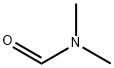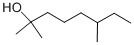


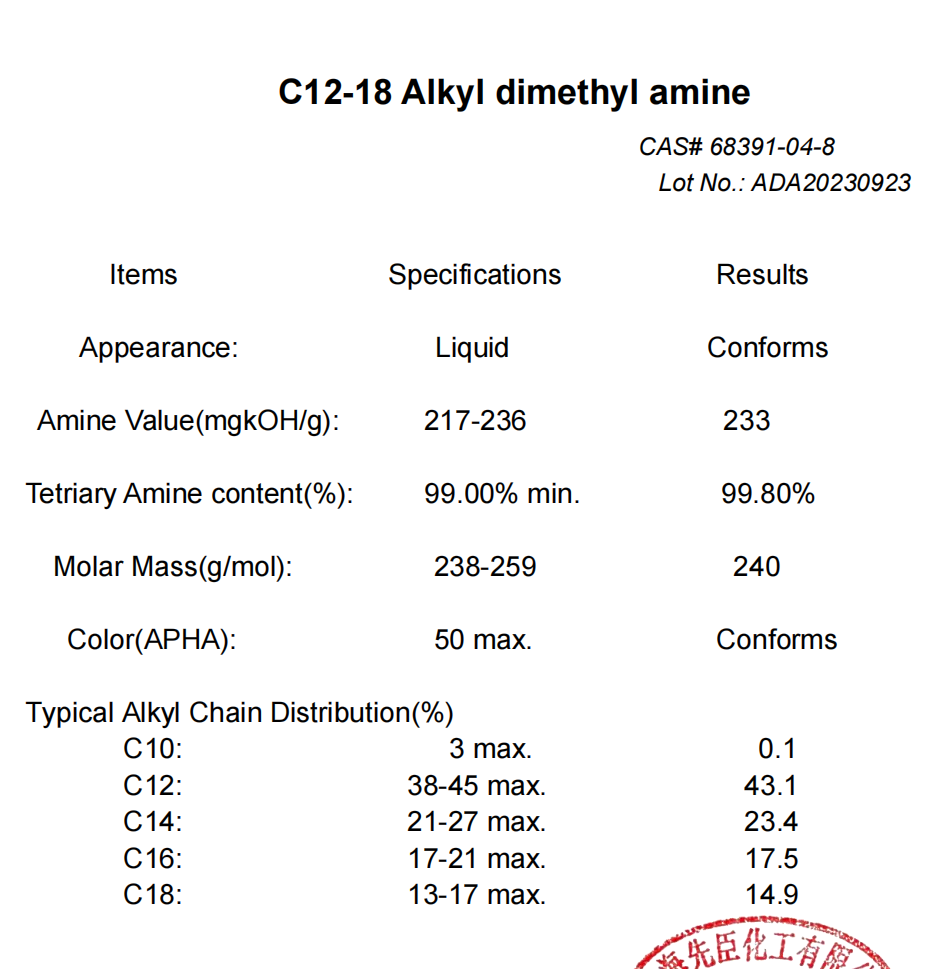
C12-18 Alkyl Dimethyl Amine(CAS#68391-04-8)
1. Properties:
- Appearance and Physical Form: C12-18 alkyl dimethyl amine is a yellow semi-solid at room temperature, supplied as a colorless to pale yellow liquid in higher-purity grades. It has a characteristic amine (fishy) odor.
- Solubility: As a long-chain fatty amine with a hydrophobic C12-18 alkyl tail, the compound is practically insoluble in water but highly soluble in most organic solvents, including alcohols, hydrocarbons, and chlorinated solvents. It forms water-soluble salts upon neutralization with acids.
- Chemical Properties: C12-18 alkyl dimethyl amine is a tertiary amine with the general structure R-N(CH₃)₂, where R represents a mixture of C12 to C18 alkyl chains. It exhibits typical amine reactivity:
- Basicity: The compound is a moderately strong base (pKa ~9.78 at 25°C) and readily forms salts with inorganic and organic acids.
- Quaternization: It reacts with alkylating agents (e.g., methyl chloride, benzyl chloride, dimethyl sulfate) to produce quaternary ammonium compounds (quats), which are widely used as disinfectants, fabric softeners, and cationic surfactants.
- Oxidation: It can be oxidized to form amine oxides (C12-18 alkyl dimethyl amine oxides), which are amphoteric surfactants with excellent foaming, cleansing, and conditioning properties.
- Surface Activity: The compound itself and its derivatives exhibit strong surface-active properties, reducing surface tension (30.5 mN/m at 1 g/L) and serving as emulsifiers, dispersants, and wetting agents.
2. Applications:
Surfactant & Quaternary Ammonium Compound Production (Primary Application):
- Cationic Surfactant Precursor: C12-18 alkyl dimethyl amine is the key intermediate for synthesizing a wide range of cationic surfactants, including quaternary ammonium compounds used in fabric softeners, hair conditioners, and antistatic agents.
- Amine Oxide Synthesis: It is the primary raw material for producing C12-18 alkyl dimethyl amine oxides, which are amphoteric surfactants used in detergents, foaming agents, emulsifiers, and personal care products.
- Germicides & Bactericides: The compound is used as a raw material for germicides and bactericides, including benzalkonium chloride-type disinfectants.
Industrial & Mining Applications:
- Mineral Flotation Agent: C12-18 alkyl dimethyl amine is widely used as a flotation agent in mineral processing for the separation of valuable ores.
- Extractant for Rare Metals: It serves as an extractant for rare metals in hydrometallurgical processes.
- Corrosion Inhibitor: The compound and its derivatives function as corrosion inhibitors in various industrial formulations.
- Fuel Additive: Used as an intermediate for fuel additives to improve combustion and fuel stability.
Textile & Chemical Industry:
- Textile Auxiliaries: It is used as a raw material for textile leveling agents and other finishing auxiliaries.
- Pigment Dispersant: The compound serves as a pigment dispersant in coatings and inks.
- Fungicide Intermediate: It is an intermediate for the synthesis of fungicides.
Other Applications:
- Preservative Intermediate: Used as an intermediate for preservatives in various formulations.
- Indirect Food Additive: Certain grades are approved as indirect food additives in sanitizing solutions for food contact surfaces.
- Emulsifier & Antistatic Agent: Directly employed as an emulsifier and antistatic agent in industrial formulations.
3. Preparation Method:
- Industrial Synthesis: C12-18 alkyl dimethyl amine is produced commercially by the reductive amination of C12-18 fatty alcohols (or corresponding aldehydes) with dimethylamine in the presence of a hydrogenation catalyst (e.g., copper-chromite or nickel-based catalysts) under high temperature and pressure. The reaction proceeds via the formation of an iminium intermediate, which is subsequently hydrogenated to the tertiary amine. The crude product is purified by distillation to achieve high purity (≥98%).
4. Safety Information:
- Hazard Classification: C12-18 alkyl dimethyl amine is classified as a corrosive substance. Under GHS, it carries the following hazard statements:
- H314: Causes severe skin burns and eye damage
- H318: Causes serious eye damage
- Hazard pictogram: GHS05 (Corrosion)
- Signal word: Danger
- UN Number / Hazard Class: UN 2735, Class 8 (Corrosive solids/liquids), Packing Group III
- Risk phrases: R34 (Causes burns)
- Safety phrases: S26 (In case of contact with eyes, rinse immediately with plenty of water and seek medical advice), S36/37/39 (Wear suitable protective clothing, gloves, and eye/face protection), S45 (In case of accident or if you feel unwell, seek medical advice immediately)
- Health Hazards:
- Skin Contact: Causes severe skin burns (H314). The compound is corrosive and can cause tissue damage upon contact.
- Eye Contact: Causes serious eye damage (H314/H318). Contact can lead to severe irritation and potential blindness.
- Inhalation: May cause respiratory tract irritation due to its basic nature and amine odor.
- Ingestion: Causes burns to the digestive tract.
- First Aid Measures:
- Eye Contact: Rinse immediately with plenty of water for at least 15 minutes, occasionally lifting the upper and lower eyelids. Remove contact lenses if present. Seek medical attention immediately.
- Skin Contact: Wash skin with plenty of soap and water. Remove contaminated clothing and wash before reuse. Seek medical attention immediately.
- Inhalation: Remove from exposure to fresh air immediately. If breathing is difficult, give oxygen. Seek medical attention.
- Ingestion: Do NOT induce vomiting. If conscious and alert, rinse mouth and drink 2-4 cupfuls of milk or water. Never give anything by mouth to an unconscious person. Seek medical attention immediately.
- Personal Protective Equipment (PPE):
- Respiratory protection: Use appropriate respiratory protection if ventilation is inadequate.
- Eye protection: Wear chemical splash goggles or a face shield.
- Skin protection: Wear chemical-resistant gloves (nitrile, neoprene) and protective clothing (e.g., lab coat, apron).
- General hygiene: Do not eat, drink, or smoke when using this product. Wash thoroughly after handling. Use only in a well-ventilated area.
- Storage & Stability: Store in tightly closed containers in a cool, dry, well-ventilated area away from incompatible substances (strong acids, oxidizing agents). Keep container closed when not in use. Protect from moisture. Under recommended storage conditions, C12-18 alkyl dimethyl amine has a shelf life of 12 to 24 months from the date of manufacture in sealed original containers.
- Regulatory Compliance: C12-18 alkyl dimethyl amine (CAS#68391-04-8) is listed on EINECS (269-923-6), TSCA, and other regional chemical inventories. It is listed as a pesticide active ingredient and is approved for use as an indirect food additive in sanitizing solutions for food contact surfaces. This product is for industrial and R&D use only and is not intended for medicinal, household, or other uses without proper authorization. Always consult the Safety Data Sheet (SDS) and local regulations for complete safety, environmental, and regulatory information specific to each product grade and application jurisdiction.
Write your message here and send it to us