
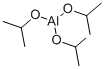
Aluminum Isopropoxide(CAS#555-31-7)
1. Properties:
- Appearance and Physical Form: Aluminum isopropoxide (AIP) is a white to colorless, hygroscopic solid. When freshly prepared, it appears as a colorless viscous liquid and solidifies into a white, semi-transparent solid mass or powder within 5-10 days. It is supplied as a crystalline powder (may contain chunks) in various high-purity grades (≥98.0% to 99.99% metals basis).
- Solubility: The compound is soluble in ethanol, isopropanol, benzene, toluene, chloroform, carbon tetrachloride, and petroleum hydrocarbons. It reacts vigorously with water, undergoing hydrolysis to aluminum hydroxide and isopropanol. It is moisture-sensitive and must be handled under dry conditions.
- Chemical Properties: Aluminum isopropoxide (Al(O-i-Pr)₃, C₉H₂₁AlO₃) is a widely used aluminum alkoxide reagent and catalyst precursor. In the solid state, it adopts a tetrameric structure [Al(O-i-Pr)₃]₄, which disaggregates in solution to enable catalytic activity.
- Lewis Acidity: AIP is a Lewis acid, capable of accepting electron pairs and activating carbonyl groups for nucleophilic attack.
- Meerwein-Ponndorf-Verley (MPV) Reduction: The compound is the classic reagent for the MPV reduction, a chemoselective method for reducing ketones and aldehydes to their corresponding secondary and primary alcohols. The reaction proceeds via a cyclic six-membered transition state with high selectivity.
- Alcoholysis and Transesterification: AIP catalyzes alcoholysis and ester exchange reactions.
- Sol-Gel Precursor: Controlled hydrolysis of aluminum isopropoxide yields high-surface-area γ-alumina (BET surface area: 362-378 m²/g) with tunable pore structure. Thermal treatment produces χ-alumina stable up to 1150°C, avoiding the surface area collapse associated with conventional γ→θ→α phase transitions.
- Hydrolysis Sensitivity: AIP reacts rapidly with water, moisture, and protic solvents, releasing isopropanol and forming aluminum hydroxide. It must be stored under an inert atmosphere in tightly sealed containers.
2. Applications:
Organic Synthesis (Primary Application):
- MPV Reduction: Aluminum isopropoxide is the reagent of choice for the Meerwein-Ponndorf-Verley reduction of ketones and aldehydes to alcohols. This reaction is valued for its high chemoselectivity and mild conditions.
- Alcoholysis and Transesterification: It catalyzes alcoholysis and ester exchange reactions, enabling the synthesis of higher alkoxides and various esters.
- Synthesis of Alkoxides, Chelates, and Acrylates: AIP is a useful reagent in the synthesis of alkoxides, chelates, and acrylates.
Pharmaceutical Industry:
- Pharmaceutical Intermediate: Aluminum isopropoxide serves as a key intermediate in the synthesis of pharmaceutical products, including isophytol (a precursor to vitamins E and K), testosterone, progesterone, and ethisterone.
Materials Science & Sol-Gel Processing:
- Sol-Gel Precursor for Alumina: AIP is the preferred precursor for synthesizing mesoporous γ-alumina with controlled pore structure via the sol-gel process. The resulting high-surface-area alumina (362-378 m²/g) is used as a catalyst support, adsorbent, and in ceramic membrane fabrication.
- High-Temperature Alumina Phases: Thermal decomposition of AIP-derived alumina produces χ-alumina, which remains stable up to 1150°C.
- Aluminate Coupling Agents: AIP serves as a raw material for aluminate coupling agents used in high-performance lubricants for industrial and automotive applications.
Polymerization Catalysis:
- Catalyst Precursor: Aluminum isopropoxide is used as a catalyst precursor for ring-opening polymerization of cyclic esters and epoxides.
Other Industrial Applications:
- Chemical Intermediate: Used in the synthesis of various organic and organometallic compounds.
- Rubber and Plastics: Applied as a crosslinking agent and additive in rubber and plastics formulations.
3. Preparation Method:
- Industrial Synthesis: Aluminum isopropoxide is produced commercially by the direct reaction of aluminum metal with anhydrous isopropanol in the presence of a catalyst (e.g., mercury(II) chloride or aluminum chloride). The reaction is typically carried out under reflux with continuous removal of water to drive the equilibrium toward the alkoxide product. The crude product is purified by distillation to achieve high purity (≥98.0%). Alternatively, it can be synthesized via the reaction of aluminum chloride with sodium isopropoxide.
4. Safety Information:
- Hazard Classification: Aluminum isopropoxide is classified as a flammable solid. Under GHS, it carries the following hazard statements: H228 (Flammable solid). Hazard pictogram: GHS02 (Flame). Signal word: Danger. UN Number: UN 3181, Class 4.1 (Flammable Solid), Packing Group II. WGK Germany: 1. LD50 (oral, rat): 11.3 g/kg.
- Health Hazards:
- Inhalation: May cause respiratory tract irritation.
- Skin Contact: May cause skin irritation.
- Eye Contact: May cause eye irritation.
- Ingestion: Low acute toxicity but may cause gastrointestinal irritation.
- Reactivity Hazard: Reacts violently with water, releasing flammable isopropanol vapor and heat. Incompatible with acids, oxidizing agents, and protic solvents.
- First Aid Measures:
- Eye Contact: Rinse immediately with plenty of water for at least 15 minutes. Remove contact lenses if present. Seek medical attention.
- Skin Contact: Wash skin with plenty of soap and water. Remove contaminated clothing.
- Inhalation: Move person to fresh air. If breathing is difficult, give oxygen. Seek medical attention.
- Ingestion: Do NOT induce vomiting. Rinse mouth. Seek medical attention.
- Personal Protective Equipment (PPE):
- Respiratory protection: Use a dust mask (N95 or P2 respirator) if airborne dust is present.
- Eye protection: Wear safety goggles or chemical splash goggles.
- Skin protection: Wear chemical-resistant gloves (nitrile) and protective clothing.
- General hygiene: Do not eat, drink, or smoke when using this product. Wash thoroughly after handling. Use in a well-ventilated area.
- Fire & Explosion Hazards: Aluminum isopropoxide is a flammable solid (Class 4.1). In case of fire, use dry powder, carbon dioxide, or sand as extinguishing media. Do not use water, as it will react violently. Thermal decomposition may produce toxic fumes including carbon monoxide and aluminum oxides.
- Environmental Precautions: Avoid large-scale release into natural water bodies, drains, or soil. Comply with local environmental regulations for disposal.
- Storage & Stability: Store in tightly closed, moisture-proof containers in a cool, dry, well-ventilated area away from direct sunlight, heat sources, and incompatible materials. Store under inert gas (nitrogen or argon) to prevent moisture absorption. Keep away from water, acids, and oxidizing agents. Under recommended storage conditions, aluminum isopropoxide has a shelf life of 12 to 24 months from the date of manufacture in sealed original containers.
- Regulatory Compliance: Aluminum isopropoxide (CAS#555-31-7) is listed on EINECS (209-090-8), TSCA (Yes), DSL, and other regional chemical inventories. It is subject to transportation regulations as a flammable solid (UN 3181, Class 4.1). This product is for R&D and industrial use only. Always consult the Safety Data Sheet (SDS) and local regulations for complete safety, environmental, and regulatory information specific to each product grade and application jurisdiction.
Write your message here and send it to us