
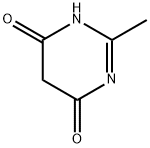
4,6-Dihydroxy-2-methylpyrimidine(CAS#40497-30-1)
1. Properties:
- Appearance and Physical Form: 4,6-Dihydroxy-2-methylpyrimidine is a white to light yellow crystalline powder . It is a heterocyclic organic compound belonging to the pyrimidine family, featuring hydroxyl groups at the 4- and 6-positions and a methyl group at the 2-position .
- Solubility: The compound is soluble in sodium hydroxide . It is expected to be slightly soluble in water and soluble in other common organic solvents such as DMSO and DMF.
- Chemical Properties: 4,6-Dihydroxy-2-methylpyrimidine (C₅H₆N₂O₂) exhibits tautomerism, existing predominantly in the keto form (2-methyl-1H,5H-pyrimidine-4,6-dione) in the solid state . It has a melting point above 300°C (with decomposition), a predicted pKa of 9.42 ± 0.20, and is stable under recommended storage conditions.
- Key Pharmaceutical Intermediate: This compound is a crucial building block for the synthesis of Moxonidine, an antihypertensive active pharmaceutical ingredient (API) . It forms the pyrimidine core of the drug, which is then elaborated through subsequent chlorination, amination, and coupling steps .
- Precursor for High-Energy Materials: 4,6-Dihydroxy-2-methylpyrimidine serves as a critical precursor for the insensitive high explosive FOX-7 (1,1-diamino-2,2-dinitroethylene) via an established two-step nitration-hydrolysis pathway .
- Oncology Research Scaffold: The compound is used as a scalable intermediate for the synthesis of kinase inhibitors, including Dasatinib and Sunitinib analog libraries, making it valuable for oncology drug discovery .
- Versatile Building Block: Its unique 2-methyl substitution pattern enables regioselective synthesis of diverse pharmaceuticals, agrochemicals, and specialty materials .
2. Applications:
Pharmaceutical Industry (Primary):
- Moxonidine Synthesis: 4,6-Dihydroxy-2-methylpyrimidine is a key intermediate in the production of the antihypertensive drug Moxonidine .
- Kinase Inhibitor Development: It serves as a scalable intermediate for the synthesis of kinase inhibitors, including Dasatinib and Sunitinib analog libraries .
- Pharmaceutical Building Block: Used as a versatile building block for the synthesis of various pharmaceutical compounds and bioactive molecules.
High-Energy Materials:
- FOX-7 Precursor: 4,6-Dihydroxy-2-methylpyrimidine is a critical precursor for the synthesis of the insensitive high explosive FOX-7 (1,1-diamino-2,2-dinitroethylene) .
Agrochemical Research:
- Agrochemical Intermediate: The compound is utilized in the synthesis of crop protection agents and other agricultural chemicals.
Organic Synthesis & Chemical Research:
- Heterocyclic Synthesis: 4,6-Dihydroxy-2-methylpyrimidine is a key building block for constructing complex heterocyclic structures.
- Radiolabeled Probes: It is used in the synthesis of [¹⁴C₃]-radiolabeled ADME probes .
- Research Reagent: Used in biochemical research and drug development, particularly in nucleic acid chemistry and metabolic pathway studies.
3. Preparation Method:
- Industrial Synthesis: 4,6-Dihydroxy-2-methylpyrimidine can be synthesized via the condensation of appropriate precursors, typically involving the reaction of guanidine or urea derivatives with β-dicarbonyl compounds under controlled conditions. The 2-methyl substitution pattern is introduced through the choice of starting materials, ensuring the desired regioselectivity . The product is typically purified by recrystallization to achieve high purity (≥99.0%) .
4. Safety Information:
- Hazard Classification: 4,6-Dihydroxy-2-methylpyrimidine is classified as a hazardous substance. Under GHS, it carries the following hazard statements:
- R36/37/38: Irritating to eyes, respiratory system, and skin .
- Hazard pictogram: GHS07 (Irritant) .
- Signal word: Warning.
- UN Number / Hazard Class: UN 1759, Class 8 (Corrosive solids, n.o.s.) .
- WGK Germany: 3 (very hazardous to water) .
- Health Hazards:
- Inhalation: May cause respiratory tract irritation .
- Skin Contact: May cause skin irritation .
- Eye Contact: May cause eye irritation .
- Ingestion: May cause gastrointestinal irritation with nausea, vomiting, and diarrhea .
- First Aid Measures:
- Eye Contact: Flush eyes with plenty of water for at least 15 minutes, occasionally lifting the upper and lower eyelids. Get medical aid immediately .
- Skin Contact: Flush skin with plenty of soap and water for at least 15 minutes while removing contaminated clothing and shoes .
- Inhalation: Remove from exposure to fresh air immediately. If not breathing, give artificial respiration. If breathing is difficult, give oxygen .
- Ingestion: If conscious and alert, give 2-4 cupfuls of milk or water. Never give anything by mouth to an unconscious person. Get medical aid immediately .
- Personal Protective Equipment (PPE):
- Respiratory protection: Use appropriate respiratory protection if ventilation is inadequate.
- Eye protection: Wear safety goggles or chemical splash goggles.
- Skin protection: Wear chemical-resistant gloves (nitrile, neoprene) and protective clothing.
- General hygiene: Wash thoroughly after handling. Do not eat, drink, or smoke in work areas. Use only in a well-ventilated area.
- Storage & Stability: Store in tightly closed containers in a cool, dry, well-ventilated area away from incompatible substances . Keep container closed when not in use . Under recommended storage conditions, 4,6-dihydroxy-2-methylpyrimidine has a shelf life of 12 to 24 months from the date of manufacture in sealed original containers.
- Regulatory Compliance: 4,6-Dihydroxy-2-methylpyrimidine (CAS#40497-30-1) is listed on EINECS (254-941-9), TSCA, DSL, and other regional chemical inventories . It is classified under HS code 29335995 . This product is for R&D use only and is not intended for medicinal, household, or other uses. Always consult the Safety Data Sheet (SDS) and local regulations for complete safety, environmental, and regulatory information specific to each product grade and application jurisdiction.
Write your message here and send it to us

![1H-Pyrrolo[2 3-b]pyridine 6-methoxy-(CAS# 896722-53-5)](https://www.xinchem.com/uploads/1HPyrrolo23bpyridine6methoxy.png)