
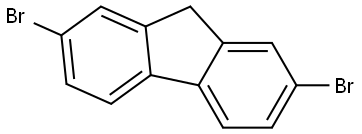
2,7-Dibromofluorene(CAS#16433-88-8)
1. Properties:
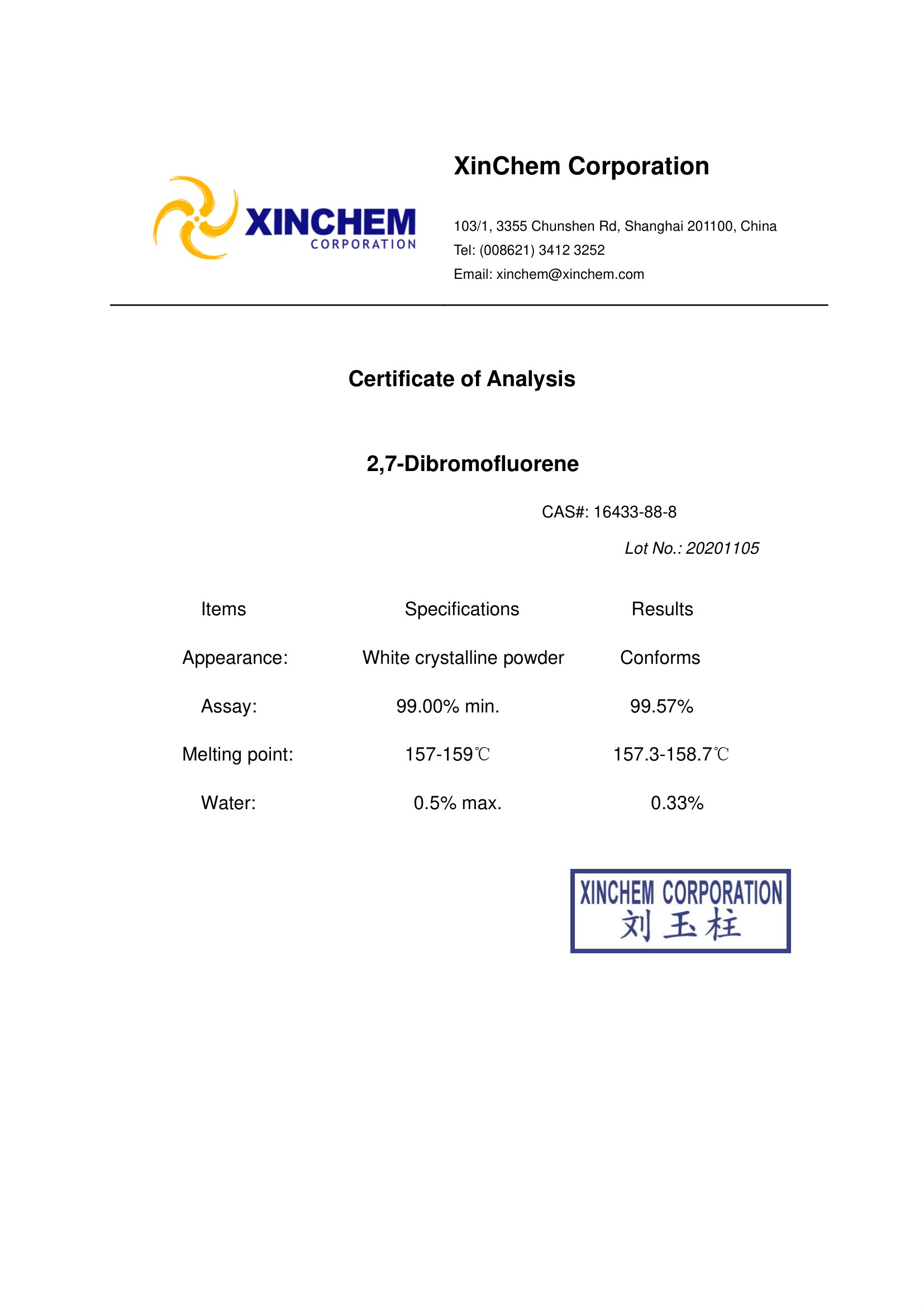
- Appearance and Physical Form: 2,7-Dibromofluorene is a white to off-white crystalline powder. It is a halogenated polycyclic aromatic hydrocarbon (PAH) with a rigid, planar fluorene backbone. The compound is available in high-purity grades (≥98.0% by GC) for research and development applications.
- Solubility: 2,7-Dibromofluorene is slightly soluble in chloroform and soluble in toluene. It is expected to be soluble in other common organic solvents such as dichloromethane, tetrahydrofuran (THF), and DMF.
- Chemical Properties: 2,7-Dibromofluorene (C₁₃H₈Br₂) is a brominated derivative of fluorene featuring bromine substituents at the 2- and 7-positions. The bromine atoms at the 2- and 7-positions serve as reactive handles for palladium-catalyzed cross-coupling reactions (Suzuki, Stille, Yamamoto, etc.), enabling the construction of complex conjugated systems and functional materials. The unsubstituted 9-position enables direct installation of aryl groups to suppress the green emission band in blue OLEDs without deprotection steps.
- OLED and Optoelectronic Applications: 2,7-Dibromofluorene is a key precursor for N-carbazole capped oligofluorenes, which show potential as hole-transporting materials for organic light-emitting devices (OLEDs). It is also used in the synthesis of blue photoluminescent polyfluorenes and conjugated polymers for label-free DNA microarrays.
- Materials Chemistry: The compound serves as a fundamental synthetic intermediate in materials chemistry, enabling the preparation of dendronized monomers and advanced multifunctional materials.
- Stability: 2,7-Dibromofluorene is stable under normal temperatures and pressures. It should be stored in a dry, well-ventilated area away from heat and incompatible materials.
2. Applications:
Organic Electronics & Optoelectronics (Primary):
- OLED Materials: 2,7-Dibromofluorene is used as a template for N-carbazole capped oligofluorenes, which are promising hole-transporting materials for organic light-emitting devices (OLEDs). These materials enable high-efficiency displays and solid-state lighting.
- Conjugated Polymers: The compound is used in the synthesis of poly[9,9′-bis(6′′-N,N,N-trimethylammonium)hexyl)fluorene-co-alt-4,7-(2,1,3-benzothiadiazole) dibromide] (PFBT), a conjugated polymer utilized in label-free DNA microarrays.
- Blue Photoluminescent Materials: It is employed in the preparation of blue photoluminescent unsymmetrically substituted polyfluorenes for optoelectronic applications.
- Dendronized Monomers: 2,7-Dibromofluorene is used in the synthesis of 9,9′-disubstituted monomers containing benzyl ether dendrons for the development of advanced functional materials.
Chemical Synthesis & Pharmaceutical Research:
- Pharmaceutical Intermediate: Serves as an intermediate in the synthesis of pharmaceuticals and bioactive molecules.
- Agrochemical Intermediate: Used as a building block for the development of insecticides and other crop protection agents.
- Organic Synthesis: Functions as a versatile building block for the construction of complex heterocyclic and aromatic compounds.
Materials Science:
- Advanced Materials: The compound is a fundamental synthetic intermediate in materials chemistry, enabling the development of multifunctional materials for various applications.
3. Preparation Method:
- Synthesis from Fluorene: 2,7-Dibromofluorene is typically synthesized via the bromination of fluorene. A general procedure involves the reaction of fluorene with bromine in the presence of a catalyst such as iron or aluminum bromide. The reaction is usually carried out in an inert solvent like carbon tetrachloride or chloroform at room temperature. The resulting product is then purified through recrystallization. On an industrial scale, optimized reaction conditions are employed to ensure high yield and purity.
4. Safety Information:
- Hazard Classification: 2,7-Dibromofluorene is classified as a hazardous substance. Under GHS, it carries the following hazard statements:
- H315: Causes skin irritation
- H319: Causes serious eye irritation
- H335: May cause respiratory irritation
- Hazard pictogram: GHS07
- Signal word: Warning
- Risk phrases: R36/37/38 (Irritating to eyes, respiratory system, and skin)
- Safety phrases: S26 (In case of contact with eyes, rinse immediately with plenty of water and seek medical advice), S37/39 (Wear suitable gloves and eye/face protection)
- WGK Germany: 3 (very hazardous to water)
- Storage Class: 11 – Combustible Solids
- Health Hazards:
- Inhalation: May cause respiratory tract irritation (H335). If inhaled, move the person to fresh air.
- Skin Contact: Causes skin irritation (H315). Wash with plenty of soap and water.
- Eye Contact: Causes serious eye irritation (H319). Rinse cautiously with water for several minutes; remove contact lenses if present and easy to do; continue rinsing.
- Ingestion: May be harmful if swallowed. Rinse mouth; do NOT induce vomiting; seek medical attention.
- First Aid Measures:
- Eye Contact: Rinse immediately with plenty of water for at least 15 minutes, occasionally lifting the upper and lower eyelids. Remove contact lenses if present. Seek medical attention if irritation persists.
- Skin Contact: Wash skin with plenty of soap and water. Remove contaminated clothing and wash before reuse.
- Inhalation: Remove from exposure to fresh air immediately. If not breathing, give artificial respiration. If breathing is difficult, give oxygen.
- Ingestion: Rinse mouth. Do NOT induce vomiting. Seek medical attention immediately.
- Personal Protective Equipment (PPE):
- Respiratory protection: Use a dust mask type N95 (US) if airborne dust is present.
- Eye protection: Wear safety goggles or chemical splash goggles.
- Skin protection: Wear chemical-resistant gloves (nitrile, neoprene) and protective clothing.
- General hygiene: Do not eat, drink, or smoke when using this product. Wash thoroughly after handling.
- Fire & Explosion Hazards: 2,7-Dibromofluorene is a combustible solid (Storage Class 11). In case of fire, use water spray, dry powder, foam, or carbon dioxide as extinguishing media. Thermal decomposition may produce toxic fumes including hydrogen bromide (HBr) and carbon oxides.
- Environmental Precautions: 2,7-Dibromofluorene is classified as WGK 3 (very hazardous to water). Avoid large-scale release into natural water bodies, drains, or soil. Comply with local environmental regulations for disposal.
- Storage & Stability: Store in tightly closed containers in a cool, dry, well-ventilated area away from direct sunlight, heat sources, and incompatible materials. Protect from moisture. Under recommended storage conditions (room temperature, cool and dark place, <15°C recommended), 2,7-dibromofluorene has a shelf life of 12 to 24 months from the date of manufacture in sealed original containers.
- Regulatory Compliance: 2,7-Dibromofluorene (CAS#16433-88-8) is listed on EINECS (629-430-2), TSCA, DSL, and other regional chemical inventories. It is classified under HS code 2903.99-000. This product is for R&D use only and is not intended for medicinal, household, or other uses. Always consult the Safety Data Sheet (SDS) and local regulations for complete safety, environmental, and regulatory information specific to each product grade and application jurisdiction.
Write your message here and send it to us