
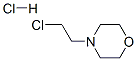
4-(2-Chloroethyl)morpholine hydrochloride(CAS#3647-69-6)
| Hazard Symbols | T – Toxic |
| Risk Codes | R21 – Harmful in contact with skin R25 – Toxic if swallowed R34 – Causes burns R43 – May cause sensitization by skin contact R52/53 – Harmful to aquatic organisms, may cause long-term adverse effects in the aquatic environment. |
| Safety Description | S26 – In case of contact with eyes, rinse immediately with plenty of water and seek medical advice. S36/37/39 – Wear suitable protective clothing, gloves and eye/face protection. S45 – In case of accident or if you feel unwell, seek medical advice immediately (show the label whenever possible.) S61 – Avoid release to the environment. Refer to special instructions / safety data sheets. |
| UN IDs | UN 2923 8/PG 3 |
| WGK Germany | 2 |
| RTECS | QE0260000 |
| TSCA | Yes |
| HS Code | 29349990 |
| Hazard Class | 8 |
| Packing Group | III |
| Toxicity | LD50 orally in Rabbit: 96 mg/kg LD50 dermal Rat 1502 mg/kg |
Introduction
N-(2-Chloroethyl)morpholine hydrochloride is an organic compound. Below is some information about the properties, uses, preparation, and safety of this compound:Properties:- Appearance: a colorless or slightly yellow liquid.- Solubility: soluble in water and organic solvents such as alcohols, ethers, and ketones.- Odor: has a strong amine-like smell.- Chemical properties: it is a basic substance and can react with acids to form the corresponding salts.Uses:- N-(2-Chloroethyl)morpholine hydrochloride is often used as a raw material for the synthesis of other organic compounds.- It can also be used as a catalyst in certain organic chemical reactions.Preparation:- It is usually prepared by reacting 2-chloroethyl chloride with morpholine to produce N-(2-chloroethyl)morpholine hydrochloride.Safety Information:- N-(2-Chloroethyl)morpholine hydrochloride is a corrosive substance that may cause redness, pain, and irritation if it comes into contact with the skin or eyes.- Personal protective equipment such as gloves, goggles, and protective clothing should be worn when handling it.- It should be kept away from fire and not come into contact with oxidizing agents during storage and use.- In case of accidental contact, rinse immediately with plenty of water and seek medical attention promptly.