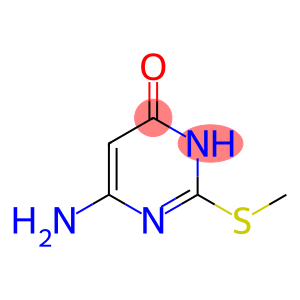

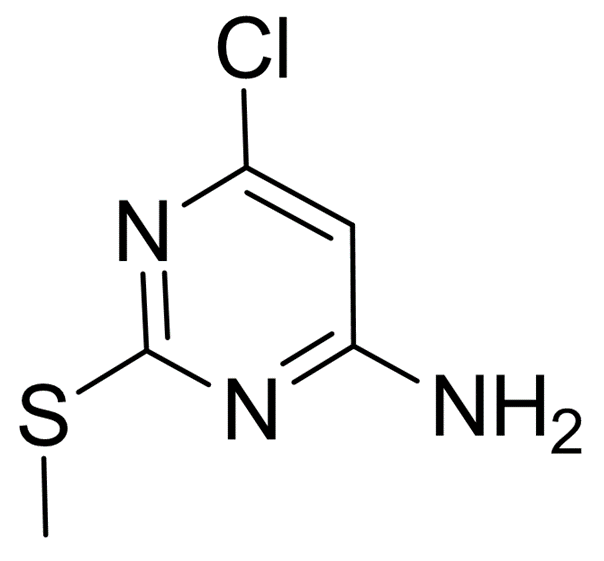
4-Amino-6-chloro-2-methylmercaptopyrimidine(CAS#1005-38-5)
| Hazard Symbols | Xi - Irritant |
| Risk Codes | 36/37/38 - Irritating to eyes, respiratory system and skin. |
| Safety Description | S37/39 - Wear suitable gloves and eye/face protection S26 - In case of contact with eyes, rinse immediately with plenty of water and seek medical advice. |
| WGK Germany | 3 |
| HS Code | 29335990 |
Introduction
4-Amino-6-chloro-2-methylmercaptopyrimidine (ACLMT for short) is an organic compound. The following is an introduction to the nature, use, manufacturing method, and safety information of ACLMT:Properties: It is stable at room temperature and is not volatile. It is a weakly alkaline substance with low solubility in water. ACLMT has good chemical and thermal stability.Uses: It is a broad-spectrum fungicide that can be used to treat fungal infections of the skin and other fungal infections. ACLMT can also be used as a reagent to inhibit bacterial growth in the treatment of bacterial infections.Method:The synthesis of ACLMT is usually carried out through a series of organic synthesis reactions. A common preparation method is to react 2-amino-4-methylmercaptopyrimidine with chloroacetic acid to generate N-methyl-3-chloro-2-pyrimidimidine, and then react with aminoethanol to form the final product ACLMT.Safety Information: It may be irritating to the eyes and skin and should be avoided when touched. When using ACLMT, appropriate protective equipment such as chemical protective gloves and goggles should be worn. When storing, ACLMT should be kept in a cool, dry place, away from fire and oxidants.
Application
4-Amino-6-chloro-2-methylmercaptopyrimidine (CAS 1005-38-5) is a multifunctional pyrimidine derivative used as a key intermediate in pharmaceutical research and drug discovery. The presence of an amino group, a reactive chlorine atom, and a methylthio group provides orthogonal handles for sequential nucleophilic substitution, cross-coupling (Suzuki, Buchwald-Hartwig), and oxidation reactions, enabling rapid construction of diverse 2,4,6-trisubstituted pyrimidine libraries. This scaffold is widely employed in the synthesis of selective kinase inhibitors targeting cancer, inflammation, and autoimmune diseases (e.g., BTK, JAK, CDK inhibitors), antiviral agents (e.g., HIV-1 integrase inhibitors), antibacterial and antifungal compounds. Its unique substitution pattern also allows the preparation of proteasome inhibitors and purine analogs. High purity ensures reproducible results in high-throughput screening and GMP manufacturing. Xinchem offers custom synthesis, custom chemical synthesis, and contract manufacturing of this essential building block with flexible scaling from R&D to commercial tons. Contact us today for a competitive quote and reliable global supply.