
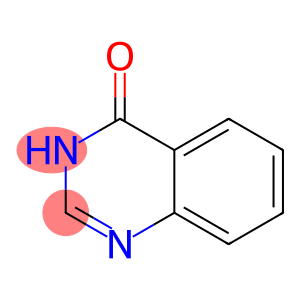
4(3H)-Quinazolinone (9CI)(CAS#132305-20-5)
4(3H)-Quinazolinone (9CI)(CAS#132305-20-5)
Chemical Properties: As a nitrogenous heterocyclic compound, 4 (3H)-quinazolinone is somewhat basic and acidic. The nitrogen atom and carbonyl group in its molecular structure can undergo a variety of chemical reactions, such as nucleophilic addition, substitution reaction, etc. It can react with some nucleophiles to generate derivatives with different functional groups, and these reactions are widely used in organic synthesis for the construction of various biologically active compounds.
Uses: It is an important building block in chemical synthesis, which can be used to synthesize nitrogen-containing heterocyclic compounds with a wide range of biological activities. These biological activities include antibacterial, antifungal, anticonvulsant, anti-inflammatory, anti-HIV, anticancer, and analgesic activities.
Safety Information: Compounds that are generally considered relatively safe, but care should still be taken to avoid contact with skin and eyes, and avoid inhaling their dust or vapors during use. In case of contact, rinse immediately with plenty of water and seek medical help.
Application
4(3H)-Quinazolinone (9CI) (CAS 132305-20-5), also known as quinazolin-4(3H)-one or 4-hydroxyquinazoline, is a fundamental heterocyclic building block in medicinal chemistry. This bicyclic scaffold features a fused benzene-pyrimidine ring system with a lactam at the 4-position, serving as a privileged structure for drug discovery. It is widely used as a key intermediate in the synthesis of pharmaceutical compounds with diverse biological activities, including anticancer agents (EGFR, VEGFR, and PARP inhibitors), antimicrobials, antimalarials, antivirals, anti-inflammatory agents, and antihypertensives. The 4(3H)-quinazolinone core has also been employed to prepare compounds that activate the PI3-kinase/Akt pathway in liver studies, and its derivatives have shown promise as selective kinase inhibitors for targeted cancer therapies, including gefitinib and erlotinib analogs. The lactam tautomer provides hydrogen bond donor and acceptor sites for enhanced target binding affinity, while the versatile C2, C4, and C6 positions enable diverse functionalization via nucleophilic substitution, cross-coupling reactions (Suzuki, Buchwald-Hartwig), and amide bond formation. This compound also serves as a critical precursor in the synthesis of agrochemicals, fluorescent probes, and specialty chemicals. Its high purity ensures reproducible results in high-throughput screening, structure-activity relationship (SAR) studies, and scalable GMP synthesis. Xinchem offers custom synthesis, custom chemical synthesis, and contract manufacturing of high-purity 4(3H)-Quinazolinone (9CI) with flexible scaling from R&D to commercial tons. Contact us today for a competitive quote and reliable global supply.

![[3-(4-BROMO-PHENYL)-ISOXAZOL-5-YL]-METHANOL(CAS#206055-91-6)](https://www.xinchem.com/uploads/METHANOL.png)
![tert-butyl[(1-methoxyethenyl)oxy]dimethylsilane (CAS# 77086-38-5)](https://www.xinchem.com/uploads/tertbutyl1methoxyethenyloxydimethylsilane.png)