
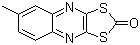
Chinomethionate(CAS#2439-01-2)
| Risk Codes | R20/21/22 - Harmful by inhalation, in contact with skin and if swallowed. R36 - Irritating to the eyes R43 - May cause sensitization by skin contact R48/22 - Harmful danger of serious damage to health by prolonged exposure if swallowed. R50/53 - Very toxic to aquatic organisms, may cause long-term adverse effects in the aquatic environment. R62 - Possible risk of impaired fertility |
| Safety Description | S24 - Avoid contact with skin. S37 - Wear suitable gloves. S60 - This material and its container must be disposed of as hazardous waste. S61 - Avoid release to the environment. Refer to special instructions / safety data sheets. |
| UN IDs | UN3077 9/PG 3 |
| RTECS | FG1400000 |
| HS Code | 29349990 |
| Toxicity | LD50 in male, female rats (mg/kg): 1800, 1100 orally (Gaines) |
Introduction
Acaricide (also known as chlorphenyl ether) is a commonly used mite insecticide with the following properties:Properties: Mitesocide is a colorless liquid with a strong aromatic odor. It is insoluble in water and easily soluble in organic solvents such as ethers and ketones. It has a high volatility and melting point, which can kill and repel mites.Uses: Mitesicide is mainly used in the fields of agriculture, household cleaning and pet care. In household cleaning, it can be used to wash and disinfect bedding, furniture, and carpets, among other things, to kill mites hiding in them. In pet care, it can be used to kill mites on the surface of pets to prevent or treat mite infestations.Preparation method: The preparation method of mite-killing is mainly carried out by the reaction of ketone compounds with chlorobenzene and ethanol. The manufacturing process generally needs to be carried out in a suitable industrial setting.It has a certain toxicity and may cause harm to the human body and the environment. Wear appropriate personal protective equipment (such as gloves and masks) and avoid contact with skin and eyes. Ensure a well-ventilated environment when using to avoid excessive concentration of harmful gases. During use, follow the relevant safety operation procedures to ensure the safety of use.When using chemicals, follow the product's Safety Data Sheet and the instructions provided by the manufacturer.
Application
Chinomethionate (quinomethionate, CAS 2439-01-2) is a quinoxaline-based, non-systemic contact fungicide and acaricide (miticide) with both protective and eradicant action. It is primarily used to control powdery mildew and spider mites across a broad range of crops, including citrus fruits, apples, pears, stone fruits (plums, peaches), grapes, cucurbits (cucumbers, melons), vegetables (tomatoes, peppers), walnuts, ornamentals, tobacco, and greenhouse crops. It is also effective against pear psylla, whiteflies, aphids, and mite eggs. The compound exhibits a multi-site mode of action, inhibiting key sulfhydryl enzymes involved in carbohydrate metabolism. As a dual-purpose pest control agent, Chinomethionate is used as a reference standard for pesticide residue analysis, instrument calibration, and method validation. Xinchem offers high-purity Chinomethionate with flexible custom synthesis, custom chemical synthesis, and reliable contract manufacturing, scaled from R&D to commercial tons. Contact us for a competitive quote and global supply.
![Bis[2-hydroxy-2-methyl-1-[4-(1-methylvinyl)phenyl]propane and 2-Hydroxy-2-methyl-1-phenyl-propan-1-one(CAS#163702-01-0)](https://www.xinchem.com/uploads/Bis2-hydroxy-2-methyl-1-4-1-methylvinylphenylpropane-and-2-Hydroxy-2-methyl-1-phenyl-propan-1-one-163702-01-0-.png)
![yclohexene 1-[2-(triethylsilyl)ethynyl]-(CAS# 21692-54-6)](https://www.xinchem.com/uploads/yclohexene12triethylsilylethynyl.png)