

MEA Triazine(CAS#4719-04-4)–H2S Scavenger for Oil & Gas Industry
1. Properties:
- Appearance and Physical Form: MEA triazine is supplied as a colourless to pale yellow, clear, viscous liquid with a slight amine odour. It is available in multiple active content grades ranging from 35% to 80%, with commercial products typically at 78% min. [H2S Scavenger. Manufactured from high-purity raw materials, MEA triazine has low insoluble content and excellent batch-to-batch consistency.
- Solubility: MEA triazine is readily soluble in water, alcohols, and propylene glycol, and is miscible with deionised water, standard hard water (3 mmol calcium ion/L), and polar organic solvents. It also exhibits partial oil solubility, making it suitable for treating both aqueous and hydrocarbon streams.
- Chemical Properties: MEA triazine (monoethanolamine triazine) is a hexahydro-s-triazine derivative synthesised from monoethanolamine and formaldehyde. Its molecular structure features a six‑membered heterocyclic triazine ring composed of alternating carbon and nitrogen atoms, with each carbon bearing a 2‑hydroxyethyl substituent. The compound acts as a formaldehyde releaser, which contributes to its broad‑spectrum biocidal efficacy.
- H₂S Scavenging: When MEA triazine is injected into an H₂S‑contaminated gas or liquid stream, the triazine ring reacts rapidly and irreversibly with hydrogen sulfide. The nucleophilic nitrogen atoms in the triazine ring attack H₂S, forming stable, water‑soluble organic polysulfide compounds and trithianes. The reaction products are non‑volatile, water‑soluble, thermally stable, and can be safely discharged or reinjected into the formation.
- Efficiency: MEA triazine is highly selective for H₂S removal and remains effective even at low dosage rates. Typically, 2–3 ppm of the product is required to remove 1 ppm of H₂S in the liquid phase. For vapour‑phase applications, the required dosage is directly proportionate to the concentration of H₂S in the gas stream. H₂S concentration can be reduced to <1 ppm within minutes under proper contact conditions.
- Biocidal Activity: MEA triazine exhibits strong bacteriostatic and fungicidal activity against a wide range of microorganisms, including Gram‑positive bacteria, Gram‑negative bacteria, mold, and yeast. It functions by slowly releasing formaldehyde over time, providing long‑term microbiological protection of industrial process fluids. MEA triazine is effective across a pH range of 7–12, with optimal performance in neutral to weakly alkaline environments.
2. Applications:
Oil & Gas Industry (Primary H₂S Scavenger):
- Natural Gas Sweetening (Sour Gas Treatment): MEA triazine is widely used for the selective removal of H₂S from natural gas streams, both upstream (production) and midstream (processing). The reaction is instantaneous when triazine is injected into the gas stream or contacted in a bubble tower. Gas can be treated from inlet concentrations of several hundred ppm down to <1 ppm within a single contact stage. MEA triazine is the most widely used liquid H₂S scavenger in the oil and gas industry globally, occupying at least 80% of the available oilfield market.
- Crude Oil Desulfurization (Sour Crude Treatment): MEA triazine is injected into crude oil production flowlines, manifolds, and separators to remove H₂S from the oil phase. In three‑phase separation systems, the water‑soluble triazine partitions preferentially into the water phase where it contacts and neutralises H₂S. The reaction products remain in the water phase, which is subsequently separated and reinjected or discharged.
- Drilling Fluids & Completion Fluids: MEA triazine is used in drilling muds to neutralise H₂S that enters the wellbore from formation fluids, preventing corrosion of drill pipe, casing, and downhole equipment, as well as protecting rig personnel. It is compatible with most drilling fluid additives and does not adversely affect rheological properties.
- Produced Water Treatment: In produced water handling systems, MEA triazine is used to scavenge H₂S from water streams before reinjection or disposal, preventing pipeline corrosion, reducing scaling, and minimising H₂S stripping into tank batteries and atmospheric vents.
- Pipeline Corrosion Control: In crude oil and wet gas pipelines, MEA triazine is continuously injected to remove H₂S and prevent sour corrosion, sulfide stress cracking (SSC), and hydrogen‑induced cracking (HIC).
Biocide & Microbiological Control:
- Metalworking Fluids (MWF): MEA triazine is a broad‑spectrum biocide additive for cutting fluids, grinding fluids, rolling emulsions, and drawing compounds, protecting against bacterial and fungal spoilage that causes foul odours, pH drop, and reduced tool life.
- Paper Industry: As a third‑generation biocide, MEA triazine is used in pulp and paper mills to prevent microbiological degradation of paper stock, reduce fiber degradation, and protect paper coatings from mold and mildew. The white water system treated at 50–250 ppm active triazine maintains biological control without affecting paper strength or colour.
- Water Treatment: MEA triazine is used as an algicide, bactericide, and slime control agent in recirculating cooling water systems, reverse osmosis pre‑treatment, oilfield water injection wells, and industrial process water.
- Leather and Textile: Applied as a preservative and anti‑mildew agent in leather processing and textile finishing baths.
- Paints, Coatings and Adhesives: Used as an in‑can preservative for water‑based paints, polymer emulsions, adhesives, sealants, and pigment slurries to protect against microbial spoilage during storage.
- Oilfield Waterflood & EOR Injection Water: MEA triazine is injected into waterflood systems and enhanced oil recovery (EOR) injection wells to control sulfate‑reducing bacteria (SRB) activity, preventing reservoir souring and reducing H₂S generation downhole.
3. Preparation Method:
- Laboratory Method: MEA triazine can be synthesised in the laboratory by reacting monoethanolamine (MEA) with aqueous formaldehyde (formalin) in a 1:1 molar ratio. The reaction proceeds under mild conditions (40–60°C, atmospheric pressure) with continuous stirring. The mixture is held at temperature for 2–4 hours to ensure complete conversion, then cooled and neutralised if required. The product is a viscous liquid with active content of approximately 74–78%.
- Industrial Process: Industrial production of high‑purity MEA triazine follows a controlled reaction of monoethanolamine with formaldehyde in aqueous medium: (1) Reaction: Monoethanolamine and 37% aqueous formaldehyde are combined in a stirred reactor in a 1:1.05–1:1.1 MEA:formaldehyde molar ratio under continuous agitation. (2) Condensation: The reaction mixture is heated to 50–80°C and held for 3–8 hours, driving the condensation reaction to form the hexahydro‑s-triazine ring structure. (3) Product Conditioning: The crude product is cooled to 40°C, adjusted to the desired pH (9.0–10.5), and filtered to remove particulate impurities. (4) Quality Control: The final product is analysed for active content (typically 78% min. by titration), pH, density, refractive index (1.478–1.485), and residual free formaldehyde content (<1%). (5) Packaging: The purified MEA triazine is packaged in 200 kg HDPE drums, 1000 kg IBC totes, ISO tanks, or bulk tank trucks for shipment. Commercial grades are available in various concentrations including 35%, 40%, 74%, 75%, and 78% active content to suit specific customer requirements.
4. Safety Information:
- Hazard Classification: According to GHS/CLP Regulation (EC) No 1272/2008 and UN transport regulations, MEA triazine is classified as: H302 (Harmful if swallowed), H312 (Harmful in contact with skin), H317 (May cause an allergic skin reaction), H318 (Causes serious eye damage), H400 (Very toxic to aquatic life). UN Number: 2810. Hazard Class: 6 (Toxic substances). Hazard pictograms: GHS07, GHS09. Signal word: Danger. MEA triazine is not flammable under standard conditions but may release formaldehyde upon heating or under strongly acidic conditions.
- Health Hazards:
- Inhalation: Inhalation of mists or vapours may cause respiratory tract irritation, coughing, and throat discomfort.
- Skin Contact: Causes mild to moderate skin irritation; repeated or prolonged exposure may lead to sensitisation and allergic dermatitis.
- Eye Contact: Causes serious eye damage (H318). Direct contact may result in corneal injury, conjunctival swelling, and permanent visual impairment.
- Ingestion: Harmful if swallowed (H302). May cause gastrointestinal irritation, nausea, vomiting, and abdominal pain.
- Acrylamide Monomer Residue: Residual formaldehyde (typically <1%) is classified as a suspected carcinogen and skin sensitiser; handle with adequate ventilation and PPE.
- First Aid Measures:
- Eye Contact: Rinse immediately with plenty of water for at least 15 minutes while holding eyelids open. Remove contact lenses if present and easy to do. Seek immediate medical attention.
- Skin Contact: Wash affected skin with plenty of soap and water. Remove contaminated clothing. If skin irritation develops, seek medical advice. Wash contaminated clothing before reuse.
- Inhalation: Move victim to fresh air. Keep at rest in a position comfortable for breathing. If symptoms (coughing, throat irritation) persist, seek medical advice.
- Ingestion: Rinse mouth immediately. Do NOT induce vomiting (risk of aspiration). Drink water to dilute if conscious and able to swallow. Seek immediate medical attention.
- Fire & Explosion Hazards: MEA triazine is not combustible but will burn if involved in a fire. Thermal decomposition may release toxic and irritating fumes including formaldehyde, carbon monoxide (CO), carbon dioxide (CO₂), and nitrogen oxides (NOₓ). In case of fire, use water spray, foam, alcohol‑resistant foam, dry powder, or CO₂ as extinguishing media. Avoid allowing run‑off water to enter drains or waterways.
- Personal Protective Equipment (PPE):
- Respiratory protection: Use a NIOSH‑approved respirator with organic vapour/acid gas cartridge (e.g., P95 or P100) if airborne mists are present or when handling the product in poorly ventilated areas.
- Eye protection: Chemical splash goggles and face shield (mandatory, due to risk of serious eye damage).
- Skin protection: Chemical‑resistant gloves (nitrile or neoprene), chemical‑resistant apron or coveralls, and closed‑toe shoes.
- General hygiene: Wash hands and exposed skin thoroughly after handling. Do not eat, drink, or smoke in work areas. Remove contaminated clothing immediately and launder before reuse. Maintain eyewash stations and safety showers in work areas.
- Environmental Precautions: MEA triazine is classified as H400 (Very toxic to aquatic life). Avoid direct release into natural water bodies, drains, sewers, or soil. In the event of a large spill, contain the product using absorbent materials (sand, diatomaceous earth, vermiculite) and collect for disposal in accordance with local regulations. Notify environmental authorities if contamination of waterways or groundwater occurs.
- Storage & Stability: Store in tightly closed, corrosion‑resistant containers (HDPE, stainless steel) in a cool, dry, well‑ventilated area away from direct sunlight, heat sources (>50°C), strong acids, and strong oxidising agents. MEA triazine is sensitive to low pH; exposure to strong acids may decompose the triazine ring, releasing formaldehyde and reducing H₂S scavenging efficiency. Under recommended storage conditions (ambient temperature, low humidity), MEA triazine has a shelf life of 24 months (2 years) from the date of manufacture in sealed original containers. Protect from freezing; if product becomes viscous at low temperatures, warm to 25–40°C with gentle agitation to restore flow properties.
- Regulatory Compliance: MEA triazine (Hexahydro-1,3,5-tris(hydroxyethyl)-s-triazine, CAS#4719-04-4, EC#225-208-0) is listed on EINECS, TSCA, DSL, AICS, NZIoC, ENCS, KECI, and other regional chemical inventories. It is regulated under UN dangerous goods regulations as Class 6, UN2810. The product is approved for use as an H₂S scavenger, biocide, and preservative in many jurisdictions, subject to concentration limits for formaldehyde release in certain applications. End‑users must ensure that final formulated products comply with relevant local regulations for occupational exposure, environmental discharge, and product labelling. Always consult the Safety Data Sheet (SDS) and local regulations for complete safety, environmental, and regulatory information specific to each product grade and application jurisdiction.
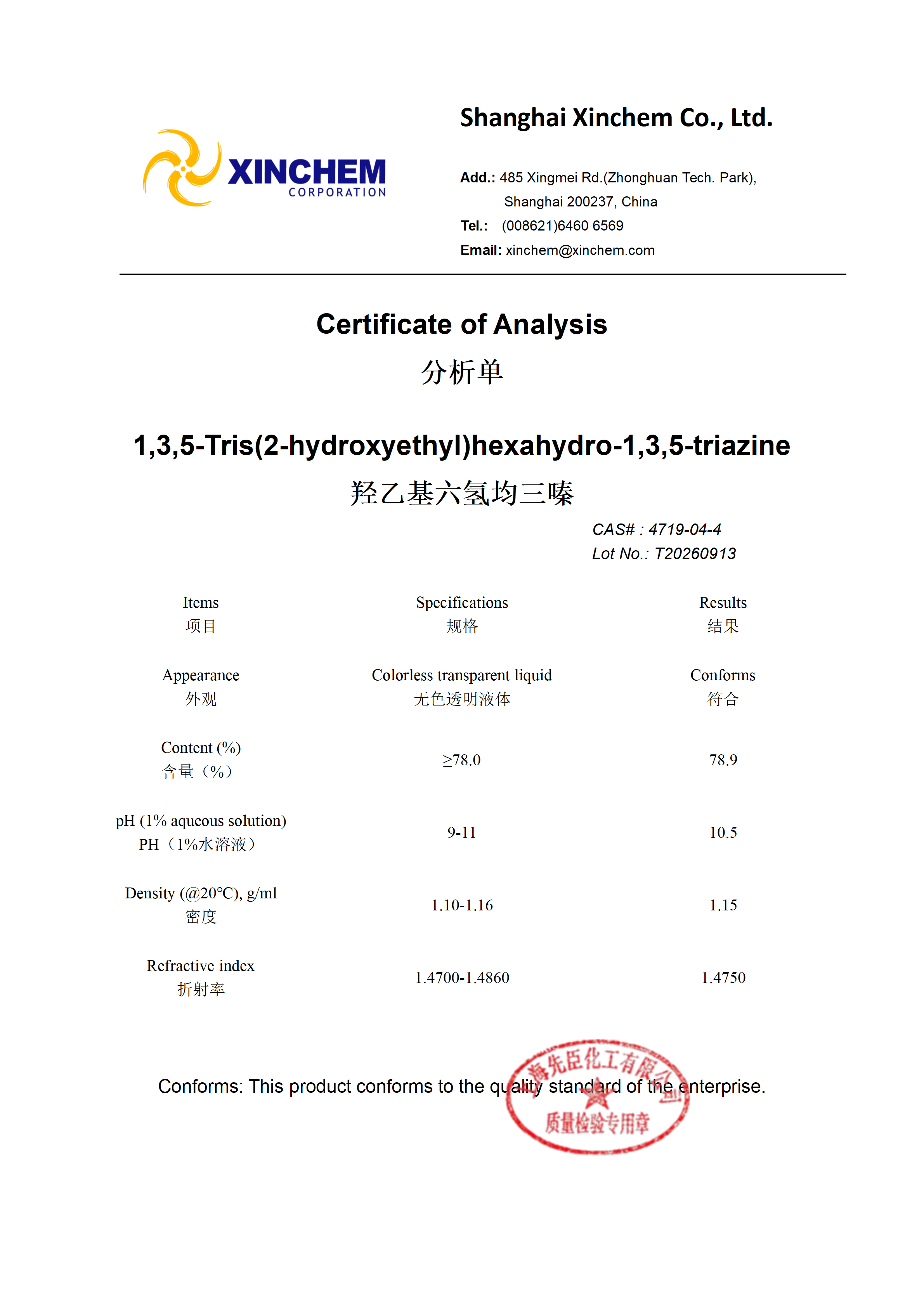
hexahydro-1,3,5-triazine%204719-04-4%20COA_01.png")
Write your message here and send it to us

![4-[(4,6-Dihydroxy-2-pyrimidinyl)amino]benzonitrile(CAS#374067-80-8)](https://www.xinchem.com/uploads/4-46-Dihydroxy-2-pyrimidinylaminobenzonitrile.png)
![4-chlorothieno[3,2-d]pyrimidine(CAS#16269-66-2)](https://www.xinchem.com/uploads/4-chlorothieno32-dpyrimidine.gif)