
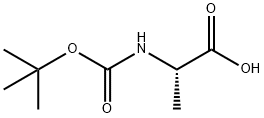
N-alpha-t-BOC-L-alanine(CAS# 15761-38-3)
Risk and Safety
| Risk Codes | R20/21/22 - Harmful by inhalation, in contact with skin and if swallowed. R36/37/38 - Irritating to eyes, respiratory system and skin. |
| Safety Description | S24/25 - Avoid contact with skin and eyes. S36 - Wear suitable protective clothing. S26 - In case of contact with eyes, rinse immediately with plenty of water and seek medical advice. |
| WGK Germany | 3 |
| TSCA | Yes |
| HS Code | 2924 19 00 |
| Hazard Class | IRRITANT |
N-alpha-t-BOC-L-alanine(CAS# 15761-38-3) Introduction
Toxin peptides are a class of toxic peptide molecules, usually produced by bacteria, plants, or animals. The properties of toxin peptides depend on their structure and source, and some are neurotoxic, cytotoxic, or otherwise biological. CALCISEPTINE IS A TOXIN PEPTIDE WITH CAS NUMBER 178805-91-9, AND ITS SPECIFIC PROPERTIES REQUIRE FURTHER INVESTIGATION.
The preparation of toxin peptides usually needs to be extracted from living organisms or obtained by synthetic methods, and the preparation process can be complex and requires professional technical support.
Toxin peptides are potentially toxic, and the dosage and concentration need to be strictly controlled when used to avoid harm to the human body or the environment. When operating in the laboratory, you need to wear personal protective equipment and follow the relevant safety operating procedures. For the research and application of toxin peptides, relevant regulations and safety standards should be followed to ensure the safety of people and the environment.
Application
N-alpha-t-BOC-L-alanine (N-(tert-Butoxycarbonyl)-L-alanine, Boc-Ala-OH, CAS 15761-38-3) is a Boc-protected alanine derivative that serves as a standard building block for the introduction of L-alanine residues by Boc solid-phase peptide synthesis (SPPS) and solution-phase peptide synthesis. The Boc (tert-butyloxycarbonyl) group masks the α-amino group, effectively preventing unwanted side reactions during coupling steps, and can be removed under mild acidic conditions (e.g., with TFA) to expose the free amine for further chain elongation. Its high optical purity and stability ensure reliable enantioselective synthesis and the construction of high-fidelity peptide sequences. As a chiral pharmaceutical intermediate, Boc-L-alanine is widely employed in medicinal chemistry to synthesize peptide-based drugs, therapeutic peptides, and protein therapeutics that target specific disease pathways. It is essential for manufacturing peptide drugs (e.g., insulin analogs, GLP-1 receptor agonists), enzyme inhibitors, and protein-based vaccines, as well as for producing recombinant proteins and custom peptides in biotechnology. Research applications include neuroscience studies of neurotransmitter function, chemical biology, and structural biology. This Boc-protected amino acid is also utilized in developing pharmaceutical compounds, optimizing ADME properties, and conducting structure-activity relationship (SAR) studies. Industries rely on high-purity Boc-L-alanine in process development, custom peptide manufacturing, and GMP-compliant API production. Its orthogonality to Fmoc chemistry provides flexibility for complex SPPS strategies. Additional applications include fragrance synthesis and basic biochemical research. Xinchem offers custom synthesis, custom chemical synthesis, and contract manufacturing of high-purity Boc-L-alanine with flexible scaling from R&D to commercial tons. Contact us for a competitive quote and reliable global supply.